
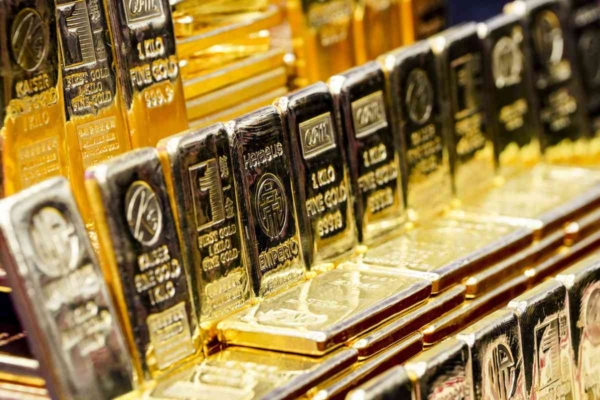
After reaching a rebound following the agreement between the US and Iran, the international gold price quickly declined after the Federal Reserve’s interest rate decision on June 17. Market expectations diverged, with nearly half of central banks planning to increase their gold holdings, while some institutions revised down their gold price targets.
On June 18 (Friday), international gold prices continued to fall, with spot gold dropping below $4300 per ounce, fluctuating around $4240 per ounce.
The primary reason for the gold price decline is widely believed to be the result of the Federal Reserve’s interest rate meeting. As widely expected by the market, the Federal Reserve kept the benchmark interest rate unchanged at 3.50%–3.75%, but the updated economic forecast summary and the highly anticipated dot plot sent clear hawkish signals to the market.
The new Federal Reserve chair, Kevin Warsh, chaired the interest rate meeting and attended the press conference. Warsh confirmed during the press conference that, breaking from convention, he did not submit any forecast points.
The dot plot is used to convey the expectations of the Federal Reserve’s 19 decision-makers regarding future interest rate trends. The updated dot plot shows a significant shift in the expectations of Federal Reserve policymakers, with the median indicating that interest rates by the end of the year will be higher than previously predicted, effectively eliminating the room for rate cuts forecast earlier this year. Nearly half of the committee members expressed support for possible rate hikes later this year, citing sticky inflation and a resilient labor market. Additionally, the Federal Reserve streamlined its policy statement, removing previous indications of a dovish bias or hints of impending rate cuts.
Furthermore, the market also believes that for non-interest-bearing gold, long-term tight monetary policy and high actual interest rates significantly increase the opportunity cost for investors holding gold, leading to rapid unwinding by institutions, which is also one of the reasons for the decline in gold prices.
Regarding the future trend of gold prices, market expectations are also divided. Bullish views on the gold market believe that central banks around the world are the biggest supporters of gold prices.
Data from the World Gold Council shows that by the end of 2025, gold accounted for 27% of official reserves globally, surpassing US Treasury bonds to become the largest reserve asset.
A report released by the World Gold Council on June 16 revealed that among 74 central banks surveyed, 45% of central banks indicated plans to buy gold in the coming year, the highest proportion since the World Gold Council began collecting data in 2018. Only one central bank mentioned plans to reduce gold holdings.
The report noted that over the past three years, gold prices have more than doubled, largely due to central banks worldwide significantly ramping up their gold purchases. However, this year, the escalation of the Iran conflict has pushed up energy costs, prompting market bets that interest rates will stay high for longer, weakening the appeal of gold as a non-interest-bearing asset and causing a partial retracement in gold prices.
Institutions bearish on the gold market have also highlighted some factors that must be taken seriously.
A research report released by Jefferies last week stated that for gold to resume its upward trend, it cannot rely solely on short-term market sentiment. Three substantial changes are needed to occur in the macro environment. First, the formal resolution of the US-Iran conflict, which would effectively reduce the market’s “geopolitical risk premium” and bring stability back to the chaotic energy market.
Secondly, a decline in international crude oil prices would directly alleviate global currency inflation pressures, helping to loosen monetary policies across countries and open the door to a “loose policy” approach.
Lastly, as long as major central banks release clear and credible signals of rate cuts, actual interest rates will be lowered, restoring gold’s appeal as a hedge asset.
Furthermore, a report released by Citigroup’s commodities team in June 2026 explicitly warned investors that without setting broad stop-loss limits, the short-term risks faced are extremely high. The reason being that the purchasing power of physical gold cannot support the current prices. To maintain gold prices at high levels, the global scale of physical gold purchases would need to reach an astonishing level of approximately $900 billion annually.