
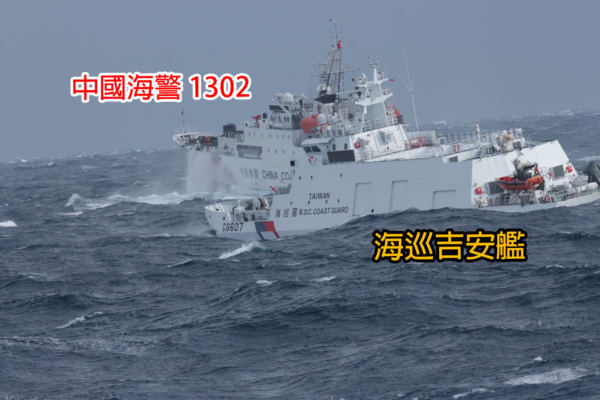
Japan and the Philippines have announced negotiations on the delimitation of their Exclusive Economic Zones (EEZ). Using this as a pretext, China deployed its coast guard ships in early June to conduct so-called “special maritime law enforcement and surveying operations,” repeatedly disturbing the waters off Taiwan’s east coast. This move by China has been deemed as “grey zone harassment” by Taiwan’s Ministry of National Defense and national security agencies, while experts and foreign media see it as a test of implementing “quasi-isolation” or “quasi-blockade” against Taiwan.
Following this, two Chinese government vessels for the first time intruded into the “prohibited/restricted waters” under Taiwan’s jurisdiction near Taiping Island in the Nansha Islands. Simultaneously, China continues to exert pressure at sea on Japan, the Philippines, Vietnam, and South Korea, even announcing sanctions against the Philippine Defense Minister.
Amid China’s grey zone operations, Professor Kuo Yuren, Deputy Director of Taiwan’s Institute for National Policy Research, pointed out on NTD’s program “News Analysis Unraveled” that the only solution is for democratic countries like Taiwan, Japan, and the Philippines to reach a consensus and collaborate in response to the security threats posed by China.
On May 28, Philippine President Marcos traveled to Tokyo for talks with Prime Minister Sanae Takai, with one of the key topics being the negotiations on overlapping EEZ boundaries between Japan and the Philippines. Kuo Yuren stated that China views this as a perfect opportunity to exploit because the overlapping EEZ between Japan and the Philippines happens to be off the southeast coast of Taiwan.
Kuo Yuren pointed out that China’s coast guard actions towards Taiwan’s east coast and southeastern seas coincide with similar activities near the Diaoyu Islands, the southern waters of Japan and the Yaeyama Islands, the prohibited/restricted waters of Taiping Island, and the forbidden/restricted areas surrounding Kinmen and Matsu. Hence, this is a deliberate, planned operation, with several factors serving as further evidence:
Firstly, not only coast guard ships but also the Liaoning aircraft carrier strike group are on standby nearby.
Kuo Yuren highlighted that while the focus is on China’s coast guard actions, in the vicinity of the Philippines, China’s aircraft carrier Liaoning has been present for over 40 days, marking the longest deployment in history. As coast guard and research vessels, as well as government ships, operate off Taiwan’s east coast, the Liaoning strike group waits on the east coast of the Philippines, indicating a planned, organized, and coordinated grey zone action.
Secondly, the operational areas are strategically placed along the route frequented by US and Australian warships.
The grey zone operation targeting Taiwan’s eastern waters and the waters east of the Philippines includes the area through which US and Australian warships pass, as well as the common waters where US aircraft carriers frequently conduct exercises.
Thirdly, Chinese coast guard ships intruded into Japan’s EEZ for law enforcement purposes.
The distance between the Chinese coast guard ships and the nearest point of the Yaeyama Islands was approximately 80 nautical miles. This marks the first instance where in Japan’s EEZ, Chinese coast guard ships radioed Japanese vessels, declaring that the Japanese Coast Guard must not hinder Chinese law enforcement. While Chinese coast guard ships have been engaging in such actions around the Diaoyu Islands since 2008, this incident in the waters south of the Yaeyama Islands is unprecedented. Combined with China’s continuous advocacy for Okinawan independence in recent years, it indicates that this is not an isolated event.
Moreover, near South Korea, China has constructed iron structures in the Yellow Sea that can facilitate helicopter takeoffs and landings. Similar iron structures have been erected in the vicinity of the South China Sea and the Huangyan Island. Japan is concerned that if China were to replicate such iron structures south of the Yaeyama Islands, it would pose significant security threats to the US, Japan, and Taiwan.
Kuo Yuren believes that based on various indicators, China’s actions this time were deliberate and well-planned.
He explained that China’s so-called special law enforcement operation involved not only coast guard ships but also Chinese patrol vessels, research vessels, and government ships. The term “special law enforcement” implies both a one-time operation and, since China’s coast guard has been under the jurisdiction of the People’s Armed Police since 2018, directly subordinated to the Central Military Commission, it also indicates the execution of tasks commissioned by higher authorities.
Kuo Yuren’s analysis suggests that China’s launch of the so-called special law enforcement has three considerations:
Firstly, seizing the opportunity to conduct cognitive warfare within Taiwan. This includes public statements from Taiwan’s Mainland Affairs Council Deputy Minister and international maritime law expert Song Cheng’en, as well as Japan’s Chief Cabinet Secretary Minenori Kihara, who has reiterated multiple times that the EEZ dispute between Japan and the Philippines does not affect third parties and has no connection to the fisheries agreements between Taiwan and Japan or the agreements between Taiwan and the Philippines. Despite the clarity of these statements, there are voices within Taiwan suggesting that the Taiwan government’s stance on fisheries and land protection mirrors Beijing’s rhetoric. Regardless of how long such rhetoric can persist, China’s goal of sowing confusion has been achieved, as mixing facts and falsehoods is a primary objective of its cognitive warfare.
Secondly, in the first half of this year, China did not conduct large-scale joint military exercises with Taiwan. Instead, actions were broken down into five parts, comprising four joint patrol readiness exercises and the current special law enforcement operation. Viewing these five actions on the same map reveals a clear intention to block off Taiwan’s southern region, including the Bashi Channel of the southwest and the southeastern passageways of Taiwan, along with the Miyako Strait near Miyako Island.
Thirdly, testing the responses of Taiwan, Japan, the Philippines, and the United States. If the responses are not forceful enough, China can smoothly change the status quo.
Kuo Yuren further analyzed that from Taiwan’s perspective, the government’s immediate response has been to prevent any incursion by Chinese coast guard ships, with Taiwanese patrol vessels almost paralleling and closely monitoring the Chinese vessels, with distances as close as two nautical miles. This shows that Taiwan’s response has been appropriate.
Regarding Japan, when Chinese coast guard ships entered Japan’s EEZ and asserted their authority over recognized Japanese waters, the Japanese Coast Guard seemed somewhat taken aback and unsure of how to respond.
On June 11, the Chinese Ministry of Foreign Affairs announced sanctions against the Philippine Defense Minister and his family. Since March 2025, the Philippine Defense Minister has repeatedly emphasized the need for increased security cooperation between the Philippines and Taiwan.
Kuo Yuren strongly agrees with the Philippine Defense Minister’s statement. He believes that China’s actions in the seas southeast of Taiwan under the guise of negotiating EEZ boundaries between Japan and the Philippines constitute a clear strategy of slicing sausages using grey zone operations. If the coast guards of Taiwan and Japan could jointly patrol on this occasion, it would deal a significant blow to China.
Kuo Yuren pointed out that China has been continuously employing these grey zone operations as part of its sausage-slicing strategy, gradually altering the status quo. If these actions spur Taiwan-Philippine, Taiwan-Japan cooperation, in addition to joint coast guard operations between Taiwan and the US, as well as maritime cooperation among the QUAD nations, it could lead to greater collaboration within the first island chain, prompting China to rethink its repeated attempts at pressure tactics through sausage slicing.
The information is based on the video: [“News Analysis Unraveled”: China’s Grey Zone Operations Ignite Global Concern, Infringement on ROC’s Taiping Island Restricted Waters]