
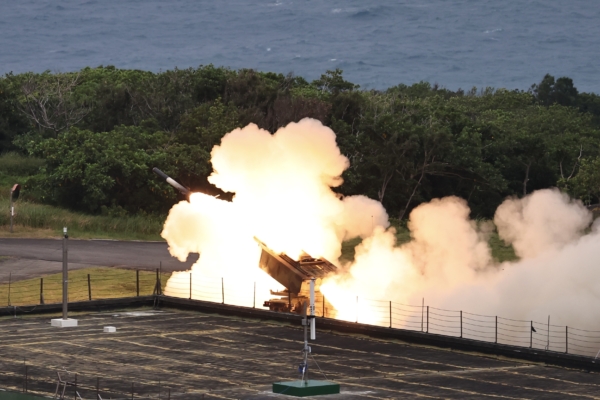
On June 10, the Taiwanese army conducted a live-fire drill by launching 32 rockets along the central coast. The exercise took place at a potential hotspot area believed to be for a future amphibious landing by the Chinese Communist Army (CCP), using the U.S. High Mobility Artillery Rocket System (HIMARS). Unlike previous tests aimed towards the Pacific Ocean, this exercise directly faced mainland China, carrying a strong sense of real combat retaliation and seen by outsiders as a clear deterrent signal to Beijing.
HIMARS gained significant recognition due to its performance on the Russia-Ukraine battlefield, known for its shoot-and-scoot capability, allowing for rapid relocation after launching, making it difficult for the enemy to counterattack and greatly enhancing battlefield survivability.
Of particular interest is that Taiwan’s existing HIMARS systems are equipped with an Army Tactical Missile System, which is also a missile used by the U.S. with a range of approximately 300 kilometers, theoretically capable of targeting military objectives along the coastal areas of Fujian, China. If Taiwan acquires more long-range missiles in the future, the strike range will expand further.
Experts believe that this exercise demonstrates a significant shift in Taiwan’s defense strategy towards seeking peace through strength, greatly increasing deterrence against the CCP.
Professor Chen Wenjia, Vice President of National Chung Nan University in Taiwan, explained that Taiwan’s decision to conduct a live-fire exercise facing mainland China with HIMARS sends a very clear strategic signal that Taiwan has the capability to counter, survive, and significantly raise the costs of any CCP amphibious landing, thus escalating the deterrence against the CCP.
This exercise showcased Taiwan’s shift from defending the beaches to stopping threats at the source. HIMARS’ long-range precision strike characteristics offer the ability to engage threats before they cross the Taiwan Strait, a departure from past defense strategies. Japan’s national security documents also emphasize preemptive strikes, and Taiwan’s live-fire HIMARS exercise is in line with Japan’s approach to addressing threats at their origin.
Additionally, HIMARS’ shoot-and-scoot capability poses a threat to CCP amphibious landing forces. The high mobility launch system allows for quick relocation after firing, making it challenging for targeting by enemy missiles. Recent CCP military exercises have highlighted HIMARS as a primary target because of its mobile firepower that poses a continuous threat to CCP amphibious landing forces.
Taiwan’s “Porcupine Strategy” is now entering a phase of practical implementation. This strategy focuses on mobile missiles, drones, anti-ship missiles, and dispersed fire deployment to impose substantial costs on the CCP even with military superiority. This approach, reminiscent of Finland during the Cold War and recent events in Ukraine, emphasizes not defeating the enemy but making it clear that even if attacks are possible, the costs may be too high to bear.
In response to Taiwan’s test, Beijing quickly criticized the exercise as mere bluster and self-encouragement, reiterating opposition to military cooperation between the U.S. and Taiwan. However, Professor Chen pointed out that Beijing’s repeated inclusion of HIMARS as a key target in military exercises indicates the seriousness with which the Chinese view this threat.
The direct HIMARS test towards mainland China sends a clear message that Taiwan has the capability to retaliate and will not tolerate continued CCP provocations. This exhibits a qualitative shift in Taiwan’s defense strategy and a significant strategic redirection.
This strategic shift is critical, indicating that Taiwan will no longer passively endure, at least signaling to the CCP that continued provocations may come at a cost. Confronted with ongoing CCP harassments and encirclement tactics, Taiwan’s previous surveillance approach, while strategic in defense, may inadvertently encourage further aggression. By displaying a determination to defend itself, Taiwan aims to dissuade aggressive actions.
The motivations behind Taiwan’s significant shift are likely influenced by changes in the international landscape, with recent conflicts in Ukraine and the Middle East raising questions about U.S. commitment to defending Taiwan. These global shifts may have prompted Taiwan to demonstrate a resolve similar to Ukraine, showcasing a firm commitment to self-defense, which may spur external support.
Beijing’s response dismissing Taiwan’s exercises as empty boasts may reflect a desire for peace through strength. Beijing seeks to prevent Taiwan from deterring CCP pressure effectively, showing its limitations in altering the direction of Taiwan’s exercises. Furthermore, Beijing may downplay the significance of Taiwan’s maneuvers targeting the Taiwan Strait and the direction of a potential CCP landing to avoid unnecessary attention.
Moreover, overplaying threats can diminish their effectiveness over time, potentially prompting Beijing to adjust its strategies. Beijing’s response could also indicate surprise at Taiwan’s sudden shift, causing some confusion as the mainland’s spokespersons were unprepared to respond without clear directives from higher authorities.
Looking ahead, there is a possibility that Beijing may conduct larger-scale exercises in response. While escalation is conceivable, repeating past actions to exert pressure may have limited impact, further escalating tensions towards potential conflict.
In the broader context, Taiwan’s HIMARS live-fire exercise signifies a strategic message of resolve and preparedness, highlighting a crucial pivot in Taiwan’s defense posture towards a more assertive stance in the face of CCP provocations and threats.