
In November 2025, after Japanese Prime Minister Sanae Takamichi proposed the “Taiwan contingency plan,” the Chinese authorities retaliated with measures such as travel alerts, flight adjustments, and restrictions by travel agencies, leading to a significant decrease in Chinese tourists traveling to Japan.
However, the Japanese tourism industry not only remained unaffected but also reached a historic peak. The number of visitors to Japan continued to reach new highs, with total expenditures setting records, demonstrating Japan’s successful shift away from reliance on the Chinese market towards a more resilient and diversified structure.
According to data released by the Japan National Tourism Organization (JNTO) on May 20, the number of Chinese tourists visiting Japan in April dropped to 331,000, a significant 56.8% decrease compared to 765,000 during the same period last year and the fifth consecutive monthly decline. However, in April, Japan received a record high of 3.6922 million foreign tourists.
In April, visitor numbers from nine countries including Korea, Taiwan, Vietnam, France, among others, visiting Japan hit historical highs. In particular, the number of French tourists reached a record high for a single month.
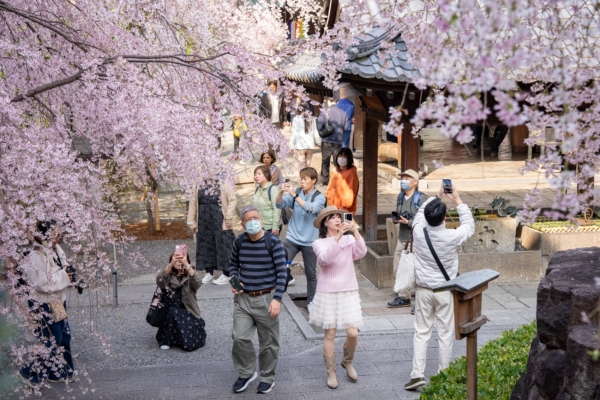
With the arrival of the cherry blossom season in Japan, the number of foreign tourists from East and Southeast Asian countries, as well as Europe, America, and Australia, significantly increased.
In 2025, the total number of foreign visitors to Japan reached 42.7 million, a 16% increase, and total foreign visitor spending in Japan reached 9.5 trillion yen (approximately 600 billion USD), both setting new historical records.
Why did the number of Chinese tourists decrease significantly? This stems from Prime Minister Takamichi’s remarks in November 2025 that the “Taiwan contingency” could constitute a “crisis of existence” for Japan. Subsequently, the Chinese authorities issued a warning notice citing worsened security in Japan and increased safety risks for Chinese citizens, urging the public to “avoid travel to Japan.”
However, Beijing’s economic retaliation did not have the intended effect. While there was a temporary surge in cancellations of Chinese tourist bookings and a subsequent drop of over 50% in the number of visitors to Japan, the overall tourism market in Japan flourished.
Regarding this phenomenon of “Beijing’s call to strike, while Japan prospers,” Chen Wenjia, a Taiwan national security strategy scholar and vice president of Kainan University, pointed out that this highlights a critical transformation in the Japanese market structure.
He believes that Beijing’s attempt to pressure Japan through restrictions on tourism fell short, indicating that the Chinese Communist Party overestimated its outbound market strategy value while underestimating Japan’s ability to promote market diversification.
Sun Guoxiang, a professor at the Department of International Affairs and Business at Nanhua University in Taiwan, also stated that Japan’s tourism structure has gradually shifted towards “de-Sinicization and diversification.” He noted during an interview, “Beijing has traditionally believed that the substantial number of Chinese tourists is a vital leverage, but Beijing has clearly underestimated the changes in the Japanese market structure.”
Professor Sun further analyzed that this shift is remarkably similar to the logic of recent international supply chain “de-risking.” When China frequently uses market tourism, studying abroad, or consumption as political tools, other countries are more inclined to reduce their singular dependence on China.
He stated, “The direction of the Japanese tourism industry is not anti-China but rather reducing China’s central reliance to one of many markets. This reflects the de-risking logic that is emerging in global supply chains, technology, energy, and tourism services.”
In the absence of Chinese tourists, Korean, Taiwanese, and American tourists have become crucial in filling the gap.
According to reports from NBC News and “Skift,” in January 2026, Korean visitors to Japan reached 1.18 million (a 22% increase), Taiwanese visitors reached 694,500 (a 17% increase), and American visitors also increased by 14%.
A significant shift can be seen in purchasing power. According to data released by the Japan National Tourism Organization on May 15, foreign tourists spent a total of 2.3 trillion yen (approximately 147.8 billion USD) in Japan in the first quarter of the year, representing a 2.5% increase. Taiwanese tourists led globally with expenditures of 388.4 billion yen (approximately 24.6 billion USD), surpassing Korea’s 318.2 billion yen and China’s 271.5 billion yen.
Professor Sun Guoxiang analyzed that Japan’s tourism model has shifted from the past heavily reliant on Chinese tourist “shopping spree” to a “globally diversified market,” including skiing, hot springs, anime culture, and deep experiential travel, attracting a significant number of non-Chinese tourists, especially high-spending American and Taiwanese tourists.
Moreover, long-haul tourists from the Americas, Europe, and Australia increased by 22% in 2025. These tourists have longer stays and higher purchasing power, further boosting overall tourism revenue.
Chen Wenjia believes that global tourism demand is highly substitutable. When Chinese tourists decrease, other countries’ sources can quickly fill the gap, making it challenging for the Chinese government to use tourism as an effective economic sanction.
It is worth noting that despite the impressive overall performance of the Japanese tourism industry, not all businesses have emerged unscathed.
Sun Guoxiang pointed out that the impacts are showing a “centralization” feature. Numerous guesthouses operated by Chinese individuals in Japan have suffered greatly because these operators heavily rely on Chinese platforms such as WeChat and Xiaohongshu for customer traffic, creating an overly singular customer structure.
Chen Wenjia described this phenomenon as the “backlash effect of the spillover of Chinese policies.” He noted that these Chinese investors operating overseas tend to lean towards the “same-market layer,” lacking localization and diversified layouts. When Beijing issues travel warnings or reduces flights, these operators face a “cut-off of customers” rather than the typical business cycle fluctuations.
Professor Sun Guoxiang added, “Breaking away from China” not only comes without costs but those costs are concentrated on businesses most reliant on Chinese clientele and lacking the capability for diversified customer sources.
Meanwhile, Japanese tourism to China has diminished by about 90% due to cancellations and reduced flights.
According to Kyodo News, a veteran Japanese-speaking tour guide at the Xi’an Terracotta Warriors site revealed that in 2026, he did not even receive a single Japanese tourist, indicating an exacerbation of the imbalance in bilateral tourism.
Beijing authorities have repeatedly claimed that Japan has “deteriorating social security” and an “escalating security environment,” discouraging citizens from traveling to Japan. However, international ratings provide a strikingly different evaluation.
According to Forbes Advisor’s selection of the “2024 Safest Cities in the World,” Tokyo ranked second globally. In the 2024 Global Liveable Cities Ranking by the Economist Intelligence Unit (EIU), Osaka and Tokyo each secured the top two spots in Asia, with Osaka dominating Asia for seven consecutive years.
Japan’s long-standing low crime rate and high-quality public safety are considered the core sources of its tourism resilience. The combination of this profound soft power and the attractiveness of the weak Japanese yen has enabled Japan to successfully avert the potential economic sanction crisis.
In the long term, the performance of the Japanese tourism industry reflects a global economic trend towards “reducing dependence on China.” As Chen Wenjia stated, once multi-country customer sources are reorganized, even if Beijing lifts travel warnings to Japan in the future, returning to the previous dominant position will be challenging.