
Anhui Provincial Public Security Department recently released information on four typical cases of heinous crimes, involving cities such as Hefei, Huaibei, Fuyang, and Suzhou, covering areas of construction projects, mineral operations, grassroots townships, and illegal debt collection. These cases span over a period of 10 to 20 years, attracting public attention to the network of relationships between gangs and Communist Party officials.
According to reports from the People’s Daily Online, the group led by Wang in Hefei has been involved in the earthwork construction market in Shushan District since 2008, monopolizing operations through violence and “soft violence.” The Yu brothers’ organization in Huaibei has been accused of controlling coal and engineering businesses since 1995. Zhang’s group in Fuyang has been active in Taihe County for many years, while Zhang in Suzhou is involved in illegal debt collection. Relevant personnel have received criminal sentences.
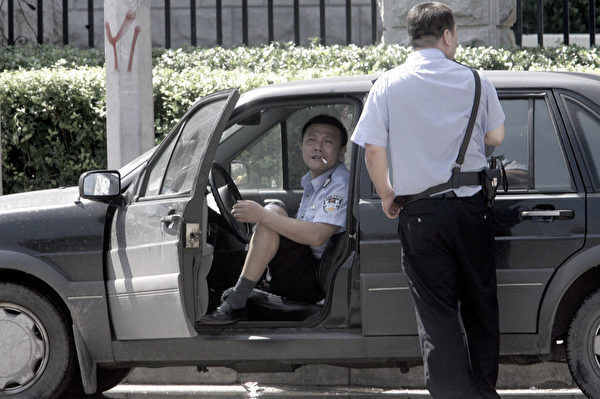
Mr. Zhou, who previously worked in the grassroots public security system in Anhui, revealed to reporters, “There are connections between the police and gang members. Some police officers take money from the gang members. They turn a blind eye to minor incidents of vandalism and theft that do not have a significant societal impact. If the impact is significant, pressure from higher authorities forces them to solve the case within a deadline, so they would ask the gang leaders to find some small fries to take the fall and report to the police, claiming the case has been solved.”
Official reports from the Communist Party of China disclosed that the origins of the Yu brothers’ case in Huaibei can be traced back to 1995, while Zhang’s case in Fuyang began in 2001, with multiple cases spanning the tenures of several local officials.
In the official disclosures, multiple organizations were described as “long-term domination,” “aggressive recruitment of projects,” and “establishment of illegal authority,” with some cases involving resource-intensive areas such as mining areas, townships, and construction projects.
Mr. Zhou mentioned that within their police jurisdiction, if a store is vandalized and the owner reports it, the police can immediately determine which group is responsible because the local police station is very familiar with the criminal methods of the local gangs. “Just by knowing the location of the incident, even without investigating, the police can easily identify the perpetrators. If there’s negative public opinion online, they would typically just arrest a few hired thugs to settle the matter, and the higher-ups turn a blind eye. Because the higher-ups provide benefits to them, they provide benefits to the local police station.”
Mr. Jia, a rights activist in Anhui, stated that gangs are mostly concentrated in Taihe County, Suixi County, and Linquan County. “Linquan is very poor, with a lot of drug trading going on. The funds for the police station in such poor areas are insufficient, so they would engage in transactions with drug dealers. In Taihe and Suixi, local black forces collude with officials, with the officials providing protection while the black society gives the money they make to the officials. I’ve heard that many police station chiefs have been arrested over there, as well as the leaders of the public security bureau criminal investigation team.”
Due to the long durations of many cases, spanning from over ten years to more than 20 years, public opinion is particularly focused on the network of relationships between gangs and Communist Party officials. One mainland netizen commented, “After catching one group, another one emerges.” Another said, “These cases started over a decade ago, and now they are just being made public – many questions deserve further investigation.”
Yao Zhixian, a retired civil servant in Anhui (pseudonym), told reporters, “In China, as long as there are criminals, there are corrupt police officers. In the past, Hong Kong films depicted the collusion between the police and criminals, mutually benefiting from each other. The police maintain contact with members of the black society; it is convenient for them to arrest people, which can earn them merit and receive bribes. Sometimes they also help the arrested gang members get released, getting tens of thousands to hundreds of thousands of yuan for each person.”
Yao Zhixian added, “In the eyes of the authorities, there is no black society in China; it only exists in Hong Kong. In China, they are called groups with the characteristics of the black society. Without police officers and Communist Party officials acting as umbrellas, these black groups could not survive for 20 years, with a membership that could range from tens to hundreds of people. Like a large enterprise, without collusion between officials and businessmen to provide protection, it would be difficult to develop assets worth hundreds of millions.”
In past public cases, incidents of public security and local officials in China being involved in protection networks of criminal organizations have been documented in various regions. Yao Zhixian believes that the “division of labor cooperation” and exchange of interests between the grassroots government of the Communist Party and local criminal forces are more severe than commonly imagined: “Now, the prisons mainly house two types of people – Communist Party corrupt officials and gang members colluding with officials.”