
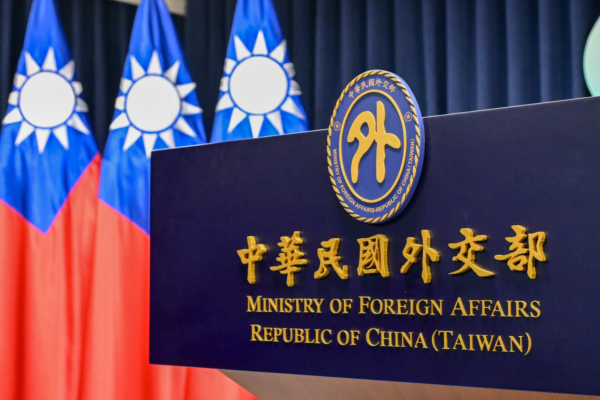
German Foreign Minister Wadephul recently criticized the unilateral changes made by the Chinese Communist Party in the Taiwan Strait. The Ministry of Foreign Affairs of the Republic of China responded by stating that Wadephul’s remarks indicate that stability in the Taiwan Strait is in line with the common interests of like-minded countries and is also a consensus among the international community.
Wadephul, the German Foreign Minister, held the inaugural Germany-Japan Strategic Dialogue with Japanese Foreign Minister Takeru Iwaya on the 18th. During a joint press conference after the meeting, he stated that Germany and Japan share common security interests in the Indo-Pacific region, including the Taiwan Strait, the South China Sea, and the East China Sea.
Wadephul expressed concern about the tense situation in the Indo-Pacific region and China’s continued overt threats to unilaterally change the status quo. He stressed that the use of force is clearly prohibited by the United Nations Charter, a principle that also applies to these regions. Foreign Minister Joseph Wu expressed a warm welcome and gratitude for Wadephul’s relevant remarks.
Previously, the German Foreign Ministry issued a pre-departure press release on August 17 regarding Foreign Minister Wadephul’s visit to Japan and Indonesia. It pointed out that China’s increasingly aggressive stance toward the Taiwan Strait, the East China Sea, and the South China Sea is affecting Europe and threatening the basic principles of global cooperation. The release emphasized the joint response to uphold the international order based on law and rules.
The Ministry of Foreign Affairs of the Republic of China stated that Foreign Minister Wadephul once again referenced the principle of prohibiting the use of force under the United Nations Charter, reaffirming the stance of peace in the Taiwan Strait. This demonstrates that peace and stability in the Taiwan Strait align with the common interests of Germany and like-minded countries, as well as being a consensus within the international community.
The Ministry of Foreign Affairs of the Republic of China will continue to collaborate with Germany and other democratic countries to jointly safeguard peace and stability in the Taiwan Strait and the Indo-Pacific region, as well as uphold freedom, democracy, and the rule-based international order.
Furthermore, in response to Chinese Foreign Minister Wang Yi’s statement after the Lancang-Mekong Cooperation Foreign Ministers’ Meeting on August 15, claiming that international documents such as the Cairo Declaration and the Potsdam Proclamation clearly outlined Japan’s war responsibility and demanding the return of territories stolen from China, including Taiwan, the Ministry of Foreign Affairs must emphatically refute such misinterpretation of historical facts, which misleads the international audience.
Foreign Minister Joseph Wu emphasized that after World War II, the San Francisco Peace Treaty, which has international legal effect, replaced political statements such as the Cairo Declaration and the Potsdam Proclamation. The treaty did not transfer Taiwan to the People’s Republic of China, and the PRC has never ruled Taiwan.
Wu noted that since the mid-1980s, Taiwan has been steadily promoting political liberalization and democratization from the grassroots level. The first direct presidential election was held in 1996, leading to the election of Taiwan’s central administration and legislative representatives by the Taiwanese people, solidifying effective governance. Taiwan’s government represents the only legitimate government of Taiwan and establishes the equal and separate existence between the Republic of China Taiwan and the People’s Republic of China.
Wu stated that through three transitions of political power in 2000, 2008, and 2016, Taiwan has continuously strengthened its democratic system and national identity, reflecting the unwavering belief and will of the Taiwanese people in pursuing freedom and democracy. He emphasized that the separate and independent status of the Republic of China Taiwan and the People’s Republic of China is an objective fact, with the PRC having no authority to represent Taiwan in the international community.
The Ministry of Foreign Affairs of the Republic of China called on the Beijing authorities to pragmatically and rationally recognize that only through respectful and equal dialogue with the democratically elected government representing the Taiwanese people can cross-strait relations be improved. At the same time, the Republic of China sincerely hopes that democratic partners will unite and hold up the “democratic protection umbrella” together to confront the challenge of authoritarianism, safeguard shared values, and uphold the rule-based international order.