
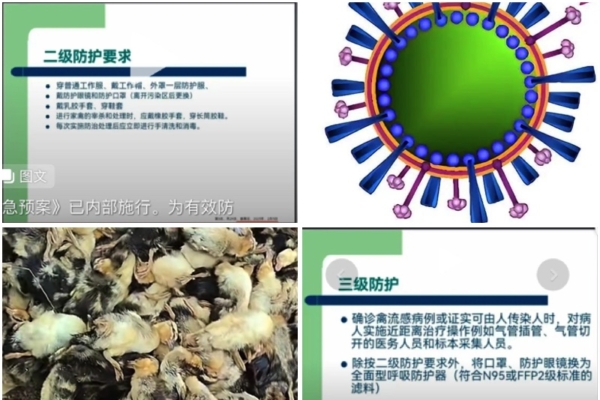
The outbreak of avian influenza (“bird flu”) among mainland Chinese has spread in multiple provinces. This year, poultry farmers in China have also faced serious outbreaks of avian flu and swine fever, resulting in heavy losses. However, the Chinese authorities have been covering up the situation and rarely reporting on it.
On March 10th, a mainland Chinese social media influencer, Li Mingyu (alias), shared with his followers the latest news about the avian flu that he had learned. According to his information, at least four provinces in China – Anhui, Shandong, Guangdong, and Guangxi – are experiencing the spread of avian flu. The outbreak in Anhui has already become severe, with a significant number of cases. Isolation facilities have also been set up in Shandong.
The influencer further emphasized that in Shenzhen, Guangdong Province, in addition to seasonal flu, COVID-19, and the norovirus, cases of avian flu have also emerged recently. He stressed that the people in that area enjoy eating poultry, making avian flu particularly rampant, with over a dozen fatalities reported in a single day.
Li Mingyu underscored, “These incidents are happening quietly in places you can’t see, and this information will not be directly disclosed to the public.”
Another health officer, Li Hua (alias), confirmed on the 10th that cases of avian flu have broken out in various parts of mainland China, with Shenzhen being severely affected and isolation facilities already in place. He explained that the isolation facilities are single rooms, where daily medications and meals are delivered by robots, with on-duty doctors responsible for medication distribution and health checks.
In the past, Epoch Times has reported severe outbreaks of avian flu in Shanxi and Wuhan. Social media videos can also be found as evidence, indicating previous cases of avian flu in Wuhan.
On January 8th, a health worker in Wuhan, known as “Da Bai” (wearing a white protective suit), was captured by local residents while sampling the surroundings of an infected neighborhood at night and the video was shared online.
On November 8th last year, staff from the Macheng Center for Disease Control called residents to come for sampling, inadvertently revealing that this was for testing avian flu and explained, “We are monitoring the epidemic, and there is no need to inform anyone about these matters.”
Public information shows that Macheng City is located in the center of a regional center city planned in the Wuhan metropolitan area, surrounded by Zhengzhou, Hefei, and Wuhan.
Netizens from Jiangsu questioned in the comments section, “Is the disease control center a law enforcement agency?” Some netizens from Guangxi expressed their concern, “Is the epidemic really happening like this?” Mr. Wang from Shanghai commented, “This is how things are in China; they have to wait until they can’t hide it anymore to announce and exterminate, and the farmers have already sold sick chickens in the markets.”
Furthermore, the most recent video footage shows that on March 11th, health workers were disinfecting the homes of residents in a residential compound, sparking various speculations among netizens.
On February 25th, the Chinese “National Emergency Overall Emergency Plan” for 2025 was released, and one of the whistleblowers on avian flu in mainland China commented, “Various regions are actively implementing it, and related prevention and control exercises are ongoing. The Yantai Municipal Government website also urges the public to stay away from live poultry and wild birds to reduce the risk of infection from H5N1 avian influenza.”
He further stated that currently, a large number of wild birds, poultry, and hundreds of mammal species are being frequently infected with H5N1 avian flu, with a 100% mortality rate among animals. There is currently no effective preventive or treatment medication for humans, with a mortality rate of over 50% after infection.
Avian flu H5N1 and swine fever H7N9 have both severely erupted in many places in mainland China.
On March 7th, a poultry farmer from Hebei posted a video saying that the 900 geese she had worked hard to raise all died overnight due to avian flu, with no cure available. In the comment section, she also mentioned that she had previously raised pigs, but they also died from swine fever.
Mr. Sun, who provides technical services to farmers, issued a warning on February 21st, saying, “The avian flu among ducks and geese is very severe this year. From before the Chinese New Year until now, basically all the households have been wiped out. Several farms have even eliminated tens of thousands of ducks. The losses amount to tens of thousands.”
On February 23rd, a bio-technology company in Shandong issued an important notice, warning all personnel involved in the care of geese to avoid entering their farming areas. The recent outbreak of avian flu is particularly severe in Shandong, with significant casualties reported in Anhui and Weifang. Preventive measures must be taken accordingly. After administering the avian flu vaccine, it is essential to administer a second preventive dose with the oral vaccine.
On March 24th, a poultry farming technician named Li Li from Henan also posted a video, stating that avian flu is widespread, and tens of thousands of households have basically been wiped out from before the Chinese New Year until now. Some large farms have suffered losses amounting to tens of thousands.
To address the increasingly severe outbreak of highly pathogenic avian influenza, China has introduced the “2025 Animal Disease Mandatory Immunization Plan.” The first strain to be immunized against is the highly pathogenic avian flu, with all artificially raised poultry such as chickens, ducks, geese, pigeons, quails to be immunized against the H5 and H7 subtypes of highly pathogenic avian flu. Certain requirements are specified for poultry intended for research and vaccine production purposes. In cases where there are restrictions on immunization for export poultry due to special circumstances, the relevant farms must report to the provincial agricultural authorities for approval.
Despite the nationwide requirement for mandatory poultry vaccinations, vaccination has not yet begun in most regions. Shandong began implementation on March 1st, with other regions following suit.
The avian flu whistleblower in China believes that mandatory vaccination will accelerate mutations, increase the risk of human infection, and pose a serious threat to global poultry populations and human health. As various strains of avian flu intensify worldwide, the WHO and official health authorities have clearly stated that more severe epidemics are unavoidable. When faced with widespread human transmission, the consequences will be the same even if poultry supplies are protected, and the poultry industry is preserved.
Furthermore, according to a pre-publication notice on the Urumqi government website, Urümqi city is constructing a large temporary hospital. The public was invited to provide feedback from February 26th to March 5th, 2025.
According to the project brief, the construction project of the Urümqi City temporary hospital is located on Nanyuan Road in Midong District, comprising a single-story temporary hall, three three-story medical staff dormitories, a three-story logistics complex, and a gas boiler room. The proposed total construction area is 52,100.46 square meters, with a volume ratio of 0.51 and a building density of 37.83%.
A whistleblower on avian flu in China publicly introduced this information, mentioning that temporary facilities are continuously being dismantled due to failure to meet defensive and other requirements. However, permanent facilities are being preserved, and construction is ongoing, essential as part of emergency plans. People must be aware of the situation and be prepared for extensive patient placements in case of a major problem. Given the exacerbating influenza worldwide, both the WHO and official health authorities have already made it clear that more severe outbreaks cannot be avoided. “If it were just a matter of being prepared for trouble in times of peace, I wouldn’t say this. Because a new round of threats has emerged.”