
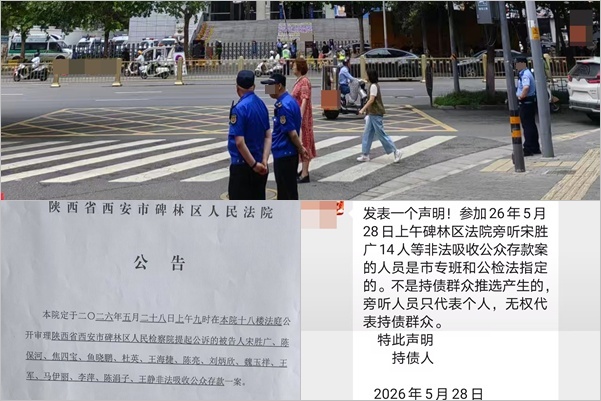
On June 12, 2026, the Shanxi Jingwei national debt case was heard in the Beilin District Court in Xi’an on May 28th. Prior to the hearing, authorities deployed a large number of police forces outside the court and blocked victims in their homes, restricting their movement and preventing them from attending the trial as observers. Victims questioned the authorities for classifying the debt repayment as a criminal case of “illegal absorption of public deposits,” suspecting that it was a way to evade payment responsibilities and expressing concerns that even after a criminal judgment, it might be difficult to recover the funds.
At 9 a.m. on May 28th, the case of “illegal absorption of public deposits” brought against 14 individuals, including Song Shengguang, by the Beilin District Procuratorate, was heard in the Beilin District Court in Xi’an.
According to multiple victims, Xi’an authorities intensified security measures. On the morning of the 28th, traffic controls were in place for a radius of one to two kilometers around the court, with police, auxiliary police, and community security personnel present everywhere.
Seventy-year-old victim Ma Xiaoming, despite suffering from a serious illness, went to the court on the morning of the 28th to prepare for observing the trial but was controlled by the police outside the court, losing his personal freedom until the end of the hearing.
He said that before the hearing, upon his arrival outside the court, local street officials and several police officers rushed towards him, taking him away and controlling him until the end of the noon trial. “(Authorities) were on high alert as if facing a major enemy, with police everywhere, and strict security measures around the court, keeping me under control until noon.”
Not only that, in the days leading up to the hearing, many victims were also warned by local police officers who visited their homes to block them. Ma Xiaoming said, “The police came to my home and many other victims’ homes, warning that it was not allowed to gather outside the court for observation. They said the court had confirmed many attendees and those who weren’t notified should not come to the scene. It is a blatant violation of law and order.”
Several victims have issued statements saying that the Xi’an authorities and the designated observers by the public prosecution have no authority to represent the debt-holding masses.
Ma Xiaoming said, “I am a victim, and I didn’t even know there was supposed to be an election. Observing is my right, what are you selecting? It’s all designated. Such a major case is being blurred like this, deceiving society.”
In March 2025, the Jingwei national debt suddenly defaulted, involving an amount of around one billion yuan, leaving thousands of investors penniless.
At the time, Ma Xiaoming believed in the government-issued “Jingwei national debt” and invested 200,000 yuan of his long-accumulated funds, intended for retirement and medical treatment, in the debt. Multiple victims questioned the authorities for turning the case into a criminal fraud case to evade compensation responsibilities.
Ma Xiaoming stated that the Jingwei national debt was a government borrowing action, but the authorities forcibly categorized it as a criminal act of an “illegal absorption of public deposits” by a criminal group, causing great anger among the victims. “Criminal convictions can be made, but the funds may not be recovered, and the victims’ money may not be returned. Criminals can then evade payment.”
Established in 1996, the Jingwei national debt service department was approved by the Xi’an Municipal Finance Bureau of the Chinese Communist Party and reported to the provincial and national finance departments. For nearly 30 years, it has operated openly on the streets of Xi’an, handling repayments normally. In 2003, when there was a temporary difficulty in repayment, the local government intervened to assist.