
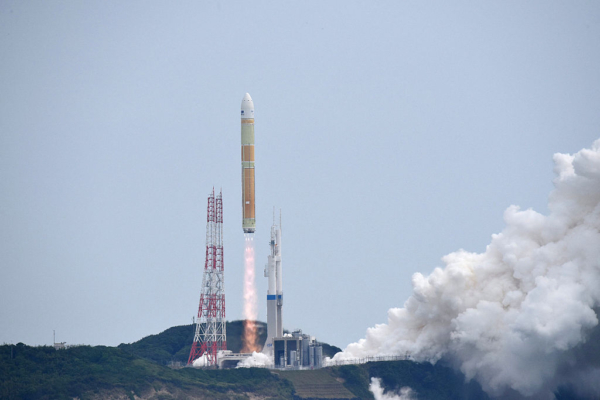
On Friday morning (June 12), the Japan Aerospace Exploration Agency (JAXA) successfully launched the H3 Rocket No. 6 from the Tanegashima Space Center in Kagoshima Prefecture. The rocket lifted off at 9:53 a.m. local time and entered its scheduled orbit approximately 580 kilometers above the Earth about 15 minutes later.
According to the report by the Japanese news agency Jiji Press, this mission marks the first operational launch of the H3 rocket since the failure in December 2025, a span of about six months from the previous accident. The success of this launch is seen as a crucial step for Japan to rebuild the reliability of the H3 rocket and regain confidence in the market.
Aside from verifying the performance of the rocket systems, another key objective of this mission was to test the “30 configuration,” which is the most cost-effective and structurally simplified configuration in the H3 series.
JAXA stated that for this mission, No. 6 did not carry large commercial or government satellites but verification equipment and six small satellites developed by multiple Japanese universities and research institutions. After reaching its designated orbit, the rocket will sequentially release these satellites.
The development of the H3 rocket has faced its challenges. From March 2023 to December of last year, a total of seven launches were conducted, with failures for No. 1 and No. 8.
The inaugural flight in 2023 failed due to a second-stage engine ignition problem, followed by several successful launches. However, the mission of No. 8 in December 2025 encountered another failure. JAXA’s investigation revealed that the accident stemmed from quality issues with components in the satellite payload section, for which relevant improvement measures have been carried out.
No. 6 experienced a delay in launch plans following an engine combustion test failure in July last year, but it successfully launched this Friday.
Since its early stages of development, the H3 rocket has aimed to enter the global satellite launch market. Depending on mission requirements, the H3 can adopt various configurations. Previous successful launches included the “22 configuration” equipped with two solid boosters and the “24 configuration” with four solid boosters, offering the highest payload capacity.
The “30 configuration” executed in this mission removed solid boosters, making it the most simplified in structure and with the lowest launch costs in the H3 series. Despite lower payload capacity, it is sufficient to meet the demand for launching around 4-ton class Earth observation satellites commonly used in government missions.
JAXA stated that if the 30 configuration achieves normalized operations in the future, it will effectively achieve the initial goal set for the H3 development, cutting launch costs to about half of the H2A rocket.
In recent years, the global commercial aerospace market competition has become increasingly fierce, with companies like SpaceX significantly reducing launch costs through reusable rockets. Japan, on the other hand, aims to enhance its competitiveness in the global satellite launch market by leveraging the reliability and cost-effectiveness of the H3 rocket.