
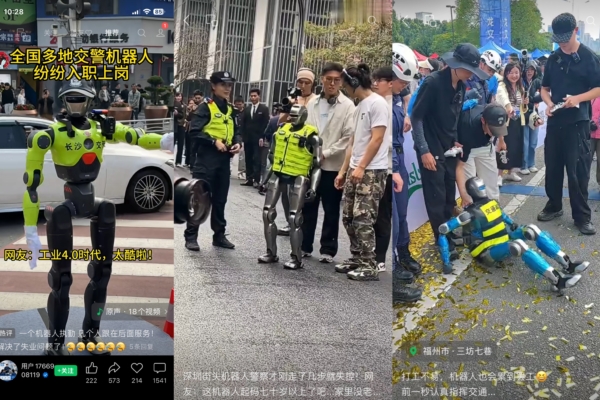
Recently, in mainland China, there has been the emergence of “traffic police robots” on duty as shown in videos. Cities such as Changsha in Hunan, Shenzhen in Guangdong, Hangzhou in Zhejiang, and others have been promoting the use of robots in traffic management, guidance, and patrol. Similar videos have also circulated in places like Chibi in Hubei. Officials have touted this as an upgrade to “smart traffic management,” but netizens in the video comment sections have mocked it, pointing out that behind these robot duties still require human follow-up services, likening it to “serving robots with multiple people behind.”
Several videos related to robots have been circulating on Chinese social media platforms. In some videos, robots accidentally kick bystanders during performances, or suddenly fall down and need to be carried away by staff, eliciting laughter from onlookers. Comments from netizens include remarks like, “Why is the robot not behaving? Did the remote control break?”
In a video spread online, a humanoid robot with a fluorescent yellow “Changsha Traffic Management” logo was seen walking near a zebra crossing in Changsha, with several staff members following behind. Many people on the street stopped to watch. The caption in the video read, “Traffic police robots have been employed in various regions across the country.” In the comment section, there were sarcastic remarks such as, “One robot on duty with several people serving behind! Unemployment problem solved!” and “One remote-controlled toy, four babysitting services, perfectly solving the employment problem.” Some even questioned, “Are robots taking up staff positions?”
Mr. Zou, a restaurant owner near the May 1st Square in Changsha, criticized the government’s promotion of robots while neglecting job opportunities for the local people. He mentioned an incident where a robot suddenly stopped on the road on June 11th, causing traffic congestion. He remarked, “A robot stood still on the road blocking traffic, and they had to carry the robot away. It seems these robots are of low quality, indicating immature technology.”
According to a report by the Hunan Provincial Government’s website, on April 1st, an intelligent traffic control robot was officially put into service at the Simen Gate in Changsha. The robot is equipped with functions such as intersection management, safety education, and intelligent dynamic guidance to assist frontline traffic police in repetitive duties and enhance the smart transportation construction in Changsha.
Apart from Changsha, similar projects have appeared in Shenzhen, Hangzhou, Chibi, among other places. State media CCTV reported that in Shenzhen, Guangdong, “robot traffic police” have been deployed to direct traffic. During the May 1st holiday period in Hangzhou, Zhejiang, China’s first officially organized traffic management robot squadron named “Hangzhou Police Intel” consisted of 15 intelligent traffic control robots, mainly responsible for guiding pedestrians, traffic control, and assisting tourists with directions.
In a video from the streets of Shenzhen, a robot almost lost balance after a few steps and had to be immediately supported by people nearby. Staff on-site commented that the ground was a bit slippery, which led to laughter from onlookers.
Chinese people are skeptical of this “technological law enforcement.” In commentary sections on related videos, some questioned the necessity of replacing human traffic police who were already doing a great job. Concerns were raised about staff reductions due to the introduction of robots and whether these robots are really improving efficiency.
Safety concerns regarding Chinese robots in public settings have also sparked controversy. On June 1st, a netizen from Xinjiang posted a video showing their child being accidentally kicked by a robot during a performance at the Urumqi Botanical Garden amusement park. The video depicted the robot performing martial arts moves, unintentionally kicking the boy in the abdomen, causing him to fall in pain. The parent stated that they reported the incident to the police, thankfully, the child was not seriously injured.
Mr. Xu, a software engineer from an internet company in Shenzhen, expressed that although China’s robot development started early, its performance is unstable, with software malfunctions being a common occurrence. He commented, “Due to government subsidies, there is currently a rush to produce robots, similar to the trend in electric vehicles a few years ago. I heard that the software system updates have lagged behind, causing issues in data reception by the robot, leading to malfunctions.”
Mr. Xu noted that the mass production of robots in China is primarily driven by expanding the market and seeking exports to Southeast Asian countries. He emphasized that deploying such robots on the streets involves not only concerns about mobility and traffic direction but also raises questions regarding maintenance, costs, accountability in case of mishaps, and the responsibility of manufacturers, operators, procurement departments, and on-site management teams. If robots require significant human supervision, remote control, handling, and upkeep, the idea of “replacing manpower” may actually result in increased human involvement rather than reducing it. If robots lose control or cause harm in public spaces, all the involved parties should bear responsibility, and they must not evade blame under the guise of “technological experiments.”