
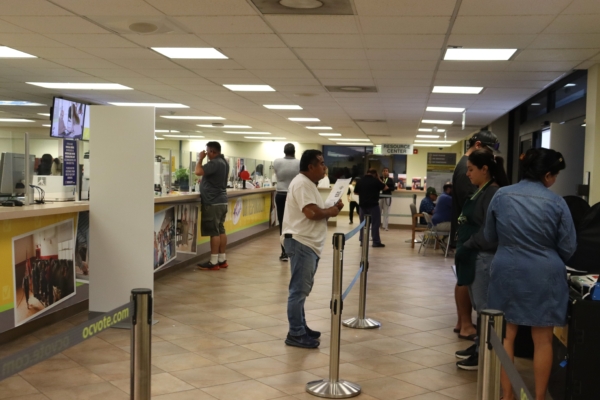
California has been counting votes since election day on June 2nd until noon on the 9th, with a voter turnout reaching 34.8%, similar to previous primary election turnouts. However, there is still a month left until the election results confirmation day set by the Secretary of State’s office on July 10th, so the final results for state senators and assembly members are subject to change.
In this primary election, California will select the top two candidates for governor, Secretary of State, congressmen, state senators, and assembly members to advance to the November election. On June 2nd, the voter turnout was at 25% (approximately 70% of votes counted). It has been observed that as the counting progresses, the Democratic (D) candidates have seen a higher increase in their vote share compared to Republican (R), other party, and non-party preference (NPP) candidates, regardless of the party’s dominance in the district.
Normally, as the count increases, the percentage changes are minimal, or in Democratic-dominant areas, Democratic candidates’ vote share increases, while in Republican-dominant areas, the Republican lead expands. However, in California, the Democratic candidates have seen significant increases in their votes as the count progresses.
For instance, in the Republican-dominant 32nd State Senate District, incumbent Senator Kelly Seyarto (R) led Democrat Tiffanie Tate (D) with 59.7% to 40.3% on June 6th. However, the gap narrowed by 1.4% two days later, making it 59% to 41%.
In the 36th district, incumbent Tony Strickland (R) initially led Chris Duncan (D) with 55.3% to 44.7%, but his advantage decreased from 10.6% to 7.8% two days later.
A similar trend is evident in the State Assembly races. In the Republican-dominant 70th district, incumbent Tri Ta (R) led Paula Swift (D) with 55.5% on the morning of June 8th, but by the afternoon, the lead decreased to 54.6%, a loss of 1.8% advantage. The situation was similar in the 1st district.
In competitive districts, even a 0.5% to 1% fluctuation in vote share with each update can have a significant impact. In the 45th Congressional District, Derek Tran (D) led five Republican candidates with 50.1% on June 3rd and extended his lead to 53.4% by June 9th. This mirrors Tran’s comeback in the 2024 election when he overtook the incumbent Republican Congressman Park Yoon-Joo by 653 votes.
Looking at the State Senate primary results, it is predicted that Democrats are likely to retain their current 14 seats in November, while Republicans will strive to keep their existing 6 seats. Incumbent Republican Senators Roger Niello, Kelly Seyarto, and Tony Strickland are expected to secure re-election in the 6th, 32nd, and 36th districts respectively. Additionally, newcomer Nathan Magsig (R) may win in the 12th district.
In the 4th district, challengers Jaron Brandon (D) and Alexandra Duarte (R) have surpassed incumbent Republican Senator Marie Alvarado-Gil. Duarte, benefiting from Alvarado-Gil’s 27.1% vote share, is expected to retain this Republican seat in the general election.
In the 40th district, incumbent Senate Republican leader Brian W. Jones’s term is expiring, and his supported candidate Ed Musgrove is currently in third place. Democratic newcomer Mara Elliott garnered 47.5% in the primary race, posing a challenge to the Republican seat.
Among the 60 Democratic incumbent State Assembly members, 9 are not seeking reelection. Damon Connolly (12th district), Avelino Valencia (68th district), and others are running for State Senate seats. Democratic incumbent Esmeralda Soria (27th district) is competing for the 14th district State Senate seat, making it a race to watch in November. Jasmeet Bains (35th district) and Jacqui Irwin (42nd district) are running for Congressional seats.
Republican incumbent Joshua Hoover in the 7th district is facing a strong challenge from Democrat Amy L. Slavensky. As of June 9th, Hoover leads with 51.0%, a slight decrease from the previous day.
In the 47th district, incumbent Republican Greg Wallis is narrowly ahead with 48.7% on June 9th, down by 0.3% from the day before, as two Democratic challengers collectively obtained 51.3% of the votes.
These developments in California’s primary elections indicate a potential shift in the composition of the State Assembly and Senate, suggesting a possible Democratic increase in seats in November, while Republicans aim to maintain their presence in the legislature.