
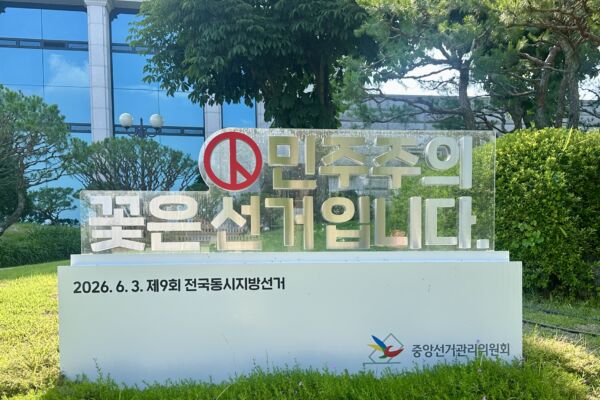
In the aftermath of the ballot shortage incident during the local elections in South Korea on June 3, the issue is still simmering. The National Election Commission of South Korea announced on the 8th that out of 14,288 polling stations nationwide, 91 encountered ballot shortages on the day of the vote, causing some voters to wait for extended periods and even be unable to cast their ballots.
Following social scrutiny of the incident, on June 10, 18 university student associations in South Korea simultaneously released a declaration called “Current Affairs Declaration,” demanding a thorough investigation, accountability, and reform of the Central Election Management Commission. The day after, a joint probe team of prosecutors and police launched searches of the Central Election Management Commission as well as multiple local election management offices.
June 10 marked the 39th anniversary of the “June 10 Democratic Resistance” in South Korea. On that day, around 6 p.m., student councils from 16 universities including Korea University, Kyung Hee University, Korea University, Pusan National University, Sogang University, Seoul National University, Sungkyunkwan University, Yonsei University, Hanyang University, and Hongik University, publicly read out the “Current Affairs Declaration” on their respective campuses. Seoul National University participated through online signatures.
In their statement, the students widely called for the government to uncover the truth through a national investigation and special prosecution, hold those responsible accountable, and devise effective remedies for voters whose political rights were infringed.
They emphasized that the ballot shortage should not be simply dismissed as an administrative error but seen as a violation of the basic rights of citizens. They urged the government and the parliament to propose measures to prevent future occurrences and promote structural reforms of the Central Election Management Commission.
The students clarified that their actions were not intended to support any specific political party or political agenda such as election fraud or calls for a re-election, but rather as young intellectuals defending the fundamental values of democracy.
On the same day, a student at Seoul National University emphasized, “The right to participate in politics is the most basic right supporting democracy, and the value of each person’s vote should not be compromised under any circumstances.”
At Yonsei University, the emergency response committee chairman of the Student Council condemned the incident as a major violation of basic rights. He criticized the government for failing to safeguard the fundamental right of citizens to participate in politics due to incompetence and complacency within state agencies.
He stressed that the issue was not about progress versus conservatism, ruling party versus opposition, or favoring any particular candidate but concerned the rights of citizens, the constitution, and the question of whether South Korea can continue to exist as a democratic republic.
A student present at the scene told reporters, “Silence is the greatest accomplice to injustice. It is our responsibility to stand on the side of justice and not turn a blind eye to societal injustices.”
The President of Kyung Hee University Student Association expressed that the obstruction by the state of citizens’ legitimate exercise of their votes was not a mere administrative error but a violation of basic rights. He stated that the student association at Kyung Hee University would continue to speak out until the damaged political rights are fully restored.
Meanwhile, the Student Council of Korea University demanded the government to utilize all available means to uncover the truth, overhaul the Central Election Management Commission comprehensively, and reflect the voice of the youth in the process of restoring democratic institutions.
At Pusan National University, students condensed their demands to “equal vote rights.” The Student Council of the university stated that what they sought was the most fundamental and common-sense principle in a democratic society, that is, ensuring that the vote of every citizen receives equal protection.
On that day, around 170 departmental jackets were placed on the stage in October Square at Pusan National University. These jackets belonged to students who were unable to attend due to exams. By leaving behind their jackets, they participated in the declaration of current affairs.
The President of Hongik University Student Council questioned, “Why should the right to vote be forcibly halted?” She stated that the ballot shortage incident posed a serious challenge to South Korea’s democratic foundation – the right to political participation – and should not be simplistically regarded as administrative chaos.
Even during the final exam period at various universities, many students participated in the demonstrations. Observers noted that several universities used social media platforms like Instagram and YouTube to announce or livestream events, with many alumni showing support on their alma mater’s social media platforms. The image above is from a post on Han Yang University’s Instagram page.
Amid external scrutiny, the Central Election Management Commission initiated the “Ballot Shortage Incident Truth Investigation Committee” on June 10. The committee, composed of 6 external individuals recommended by citizen groups, legal professionals, the media, and academia, is expected to operate until June 19.
At the first meeting, the committee chairman, lawyer Choe Hyun-seok, expressed that the ballot shortage incident was an unprecedented event that should never have occurred in a free democratic nation. He asserted that this cannot be explained by mere administrative errors or predicting failures but represents a severe constitutional crisis involving the infringement of citizens’ political rights.
Choe stated that the committee would objectively and neutrally investigate the full scope of the event, make the investigation results public, hold individuals accountable, and offer reform suggestions regarding the issues exposed in the election management system.
Following the self-investigation by the election commission, the joint probe team of prosecutors and police also initiated forced searches. According to reports from Yonhap News Agency, starting at 9 a.m. on June 11, the prosecutors and police conducted raids on 7 implicated departments, including the Central Election Management Commission, citing suspicions of violating the Public Official Election Act, dereliction of duty, corruption, and breach of trust, with the search process lasting 13 hours.
Legal sources in South Korea on June 12 stated that the investigative team had started organizing the meeting records and other data obtained from institutions like the Central Election Management Commission. The prosecutors and police are currently analyzing the gathered evidence and are expected to further summon relevant individuals to clarify the causes and assign responsibility in the ballot shortage incident.