
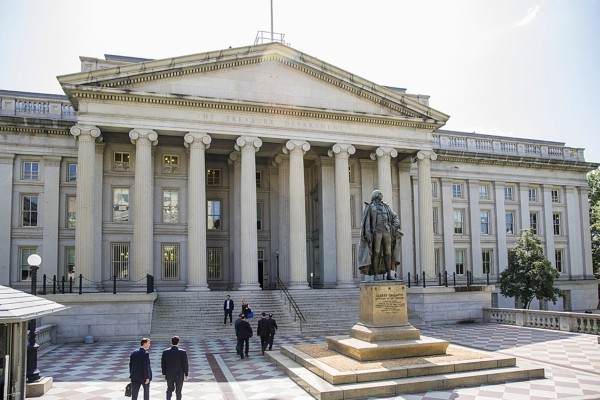
On Thursday, May 21, the U.S. Department of the Treasury announced sanctions on 9 individuals, including the incoming Iranian Ambassador to Lebanon. The reason cited was their obstruction of peace processes in the Middle East and hindrance of the disarmament of the Iran-backed Hezbollah.
The Office of Foreign Assets Control (OFAC) of the U.S. Department of the Treasury stated that these officials had infiltrated Lebanon’s parliament, military, and security agencies, with their role being to maintain the influence of the Iran-backed terrorist organization Hezbollah on key Lebanese institutions.
U.S. Treasury Secretary Scott Bessent emphasized in a statement that “Hezbollah is a terrorist organization that must be fully disarmed. The Treasury Department will continue to take action against officials who infiltrate the Lebanese government, tolerate Hezbollah’s senseless violence against the Lebanese people, and obstruct peace.”
The Treasury Department mentioned that the U.S. government will freeze the assets of these 9 individuals in the U.S. and prohibit American citizens and entities from engaging in any transactions with them (unless authorized by OFAC). Any foreign financial institutions found violating these sanctions by dealing with them may face U.S. secondary sanctions, potentially losing the ability to open correspondent accounts in the U.S.
The Treasury Department stated that today’s actions were taken under the revised U.S. Executive Order 13224 (Authority to Combat Terrorism). The U.S. State Department designated Hezbollah as a “Specially Designated Global Terrorist” (SDGT) on October 31, 2001, based on this Executive Order and listed it as a “Foreign Terrorist Organization” under Section 219 of the Immigration and Nationality Act on October 8, 1997.
Hezbollah, founded in 1982 by the Iranian Islamic Revolutionary Guard Corps, has been designated as a “terrorist organization” by Europe, the U.S., and several Gulf countries, but Iran’s allies like China and Russia have not categorized it as such.
The U.S. holds Hezbollah responsible for the series of suicide bombings in 1983, including the suicide attack on the U.S. Embassy in Beirut and the bombing of the U.S. Marine barracks in Beirut, resulting in the deaths of 241 American soldiers. Additionally, a French military barracks was also destroyed, leading to the deaths of 58 French paratroopers.
In response, U.S. State Department spokesperson Tommy Pigott announced that the U.S. will offer rewards of up to $10 million for information contributing to the disruption of Hezbollah’s terrorist financing mechanisms.
Pigott stated in a release, “This is just the beginning. Anyone who continues to harbor or cooperate with the terrorist organization, or in any way undermines Lebanon’s sovereignty, should understand that they will be held accountable.”
He explained, “For Lebanon to restore stability, security, and independence, Hezbollah must be fully disarmed, allowing the Lebanese government to regain exclusive jurisdiction over national security affairs.”
The Treasury Department noted that Hezbollah relies on a network of political representatives, including parliament members, to advance its agenda and ignore the Lebanese government’s calls for disarmament. These individuals are entrenched in Hezbollah’s leadership or closely cooperate with it, promoting Hezbollah’s agenda at the expense of the legitimate government and all Lebanese people regardless of region or religious beliefs.
The Treasury Department provided detailed information on the 9 individuals:
Mohamed Abdel-Mottaleb Fanich, leading the Hezbollah Executive Committee, responsible for restructuring the organization’s administrative and institutional structure to advance its mission of maintaining armed presence in Lebanon. He is also one of the organization’s founders, holding multiple leadership positions.
Hassan Nizammeddine Fadlallah, elected as a Hezbollah representative in the Lebanese parliament since 2005. He assisted in founding the U.S.-sanctioned Al Nour Radio and served as an executive in the U.S.-sanctioned Al Manar TV.
Ibrahim al-Moussawi, currently heading the Hezbollah Media Committee and elected representative of the organization in parliament.
Hussein Al-Hajj Hassan, a prominent Hezbollah member since 1982 and a parliament representative for the organization since 1996, playing a key role in opposition to disarming the terrorist organization.
Mohammad Reza Sheibani, the appointed Iranian Ambassador to Lebanon, had his approval revoked by the Lebanese Foreign Ministry, declaring him unwelcome and ordering him to leave Beirut.
Ahmad Asaad Baalbaki and Ali Ahmad Safawi, security officials of the Amal Movement, a political ally of Hezbollah and security partner, coordinating displays of force and intimidation against Hezbollah’s political adversaries in Lebanon.
Major General Khattar Nasser Eldin, Director of Lebanon’s State Security Department, and Colonel Samir Hamadi, Director of the Dahiyah branch of the Lebanese Armed Forces Intelligence Bureau, shared vital information with Hezbollah during the ongoing conflicts in the past year.