
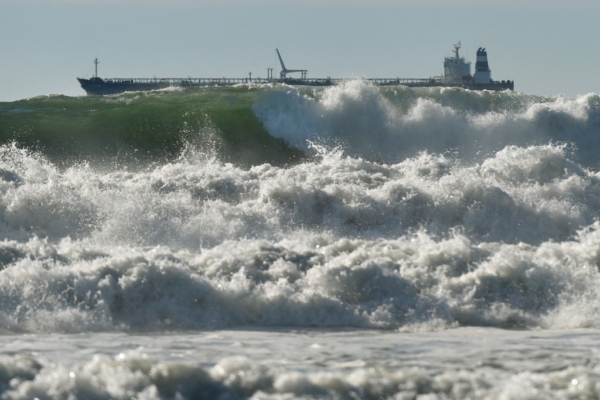
Weather experts announced on Thursday (June 11) that a historic “super El Niño” has officially formed in the Pacific Ocean. This behind-the-scenes driver of global climate chaos is essentially a natural phenomenon of abnormally warm tropical Pacific seawater, and the intensity of this event is expected to reach historic levels, bringing unpredictable impacts to humanity.
According to the latest report released by the National Oceanic and Atmospheric Administration (NOAA) of the United States, it is expected that this phenomenon will further intensify, evolving into an extremely strong or “super” El Niño event. Experts warn that as a naturally occurring periodic warming of seawater, this El Niño will interact with the current record-high global temperatures, creating a “adding fuel to fire” effect that will lead to significant changes in global weather patterns, severely impacting economies of various countries, and triggering heatwaves, floods, droughts, and wildfires.
United Nations Secretary-General António Guterres referred to this El Niño as a global “climate emergency.” In a video address on Thursday, he bluntly stated, “The El Niño phenomenon will add fuel to a warming world.”
El Niño is a periodic weather pattern in the tropical Pacific region, characterized by abnormally warm sea surface temperatures near the equator. It alters wind patterns and triggers chain reactions in global weather patterns.
NOAA’s Climate Prediction Center predicts that the probability of this El Niño event evolving into a “extremely strong” event (commonly known as a “super El Niño”) in late autumn and early winter this year is 63%. According to NOAA, this event is expected to be “one of the largest El Niño events on record since 1950.” The center expresses confidence in this prediction, highlighting a 100% probability of the El Niño persisting into autumn and a very high probability of it continuing into winter.
Meteorologists predict that its potency will rival, if not surpass, the record-breaking El Niño event that began in 1997, which led to global heatwaves, floods, droughts, tornadoes, and wildfires, causing billions of dollars in losses.
To be classified as a “super El Niño,” sea surface temperatures in the tropical Pacific must be at least 2 degrees Celsius above average. Some reliable computer models indicate that this threshold will be significantly exceeded.
Abby Frazier, a climate scientist from Clark University, stated that the warm deep-sea waters associated with El Niño will bring “a substantial amount of additional heat to the ocean surface, providing the driving force for numerous extreme events globally.” She emphasized that particularly in the Pacific region, the situation could rapidly become very critical.
Over the past few months, driven by changes in wind patterns, anomalously warm seawater has been flowing from the western Pacific towards the tropical eastern Pacific. This warm water, located approximately 600 to 1,000 feet (about 183 to 305 meters) below the sea surface, has started rising to the surface in the region several thousand miles eastwards near South America.
Super El Niño events are relatively rare, with recent occurrences in 2015-2016, 1997-1998, and 1982-1983.
However, this event is fundamentally different from all previous El Niños in history. Scientists stress that the current global climate background is much hotter than during any previous El Niño period. In essence, in all El Niño events that have occurred in the past—let alone super El Niños, global climate has never been as warm as it is now. Humanity is venturing into uncharted climatic territory alongside the super El Niño.
Due to El Niño involving the transfer of large amounts of heat energy from the ocean to the atmosphere, it will further raise global average surface temperatures in the context of current frequent extreme weather events. Several climate scientists predict that, due to the lag effect, 2027 is almost certain to surpass 2024, setting a new record for the hottest year on Earth.
But that’s not all: each El Niño event, even a super El Niño event, will not unfold exactly as expected, and unexpected circumstances are bound to arise during its occurrence.
The impacts of this weather pattern vary by region, giving rise to distinct “winners” and “losers” worldwide:
Hurricane Seasons:
El Niño typically suppresses Atlantic hurricane season activity but exacerbates the hurricane seasons in the central and eastern Pacific. Frazier noted that this means the U.S. East Coast and the Gulf Coast could expect some relief, but the risks for Hawaii and other Pacific islands are significantly heightened.
United States and Canada:
From the northern U.S. to western Canada and Alaska, significantly warmer winters than average are expected. In contrast, the southern U.S. region tends to be wetter and colder, as more active jet streams will guide more storms toward the area. With moisture-rich jet streams making landfall on the coast, California may experience more frequent storm-induced rainfall floods.
Asia and Australia:
During El Niño events, Australia and Indonesia are prone to severe droughts and heatwaves, leading to wildfires and water shortages. In the summer, monsoon rainfall in India and Southeast Asia tends to decrease, exacerbating extreme high temperatures during the summer. Parts of southern and eastern Asia generally experience warm, dry winters.
Americas and Africa:
Northwestern South America (including Peru) and southeastern South America are likely to experience heavy rainfall and floods due to neighboring warm waters, while southeastern Brazil can expect unusually high temperatures. North to Central America tends to be relatively dry. Northeast Africa (near the Horn of Africa) may undergo drastic weather changes—shifting from severe drought to dangerous flooding, while southeastern Africa could experience worsening drought from December to February.
Marine Ecology:
Given the sensitivity of corals to temperature anomalies, this event is expected to cause widespread marine heatwaves and lethal coral bleaching globally.
Apart from environmental disasters, high temperatures will directly impact economies. Marshall Burke, a climate economist at Stanford University, stated that a strong El Niño will weaken economic growth through effects such as disaster losses and disruptions in food supplies.
However, the situation in agriculture is mixed. Michael Ferrari, research director at investment firm Moby, indicated that growing conditions for grains and seeds (especially soybeans) look optimistic in 18 major planting states in the U.S., but concerns arise for dairy and livestock.
Normally, El Niño forms during the summer, peaks in late autumn or early winter, and fades in the following spring. However, Muhammad Azhar Ehsan, a climate scientist and El Niño expert at Columbia University, predicted, based on strong early indicators in recent weeks, that this El Niño will peak one to two months earlier than usual.
Gabriel Vecchi, a climate scientist from Princeton University, also highlighted strong and significant early signs, including the advancement of warm water towards the surface of the Pacific, indicating that large El Niño events typically endure longer.
Even before its official formation, this event garnered various nicknames due to its astounding data, ranging from “super El Niño” to “Godzilla”, describing its immense scale and destructive power. In the face of unprecedented climate upheaval, Ehsan emphasized, “Instead of fear, let’s prepare everyone.”
(This article referenced reports from CNN and The Associated Press)