
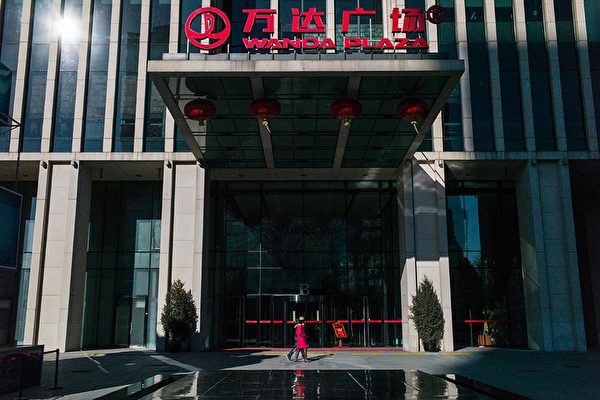
Wanda Plazas, once considered high-quality assets, are now becoming “hot potatoes” that everyone is eager to get rid of. Recently, the state-owned enterprise China Construction First Bureau (CCFB) took over Hunan Changde Wanda Plaza and Sichuan Suining Wanda Plaza, but less than half a year later, they put them up for sale, attracting market attention.
In recent years, Wanda Group under Wang Jianlin’s leadership has been continuously selling off assets in a bid to survive. However, it’s not just Wanda selling assets now. Even the initial “white knights” are starting to line up to exit, indicating that China’s commercial real estate sector is facing escalating downward pressure.
According to an announcement from the Shenzhen United Property Rights Exchange, the 100% equity of Changde Wanda Real Estate Co., Ltd. and Suining Wanda Plaza Investment Co., Ltd. have entered the pre-disclosure stage of listing for transfer, with CCFB as the transferor for both entities.
It is noteworthy that these two companies completed the equity changes back in January this year.
Business registration data shows that on January 7th, Changde Wanda Real Estate Co., Ltd. changed ownership from a Wanda Group subsidiary to being fully owned by CCFB; on January 15th, CCFB acquired 100% equity of Suining Wanda Plaza Investment Co., Ltd.
This means that CCFB decided to sell off the related assets within just about 5 months of taking them over.
The “Daily Economic News” reported on June 8th that industry insiders previously revealed that these two transactions were not initiated by CCFB, but rather Wanda used assets to offset project debt, turning CCFB from a construction party into a project owner.
Why is CCFB eager to offload these assets? Bai Wenxi, Vice Chairman of the China Enterprise Capital Alliance, analyzed that state-owned construction enterprises taking over commercial real estate projects is essentially a debt preservation act, rather than a long-term investment strategy.
He stated that the operational logic of commercial complexes is vastly different from construction work, requiring expertise in investment attraction, tenant management, customer flow cultivation, and sustainable operational capabilities, none of which are core strengths of construction SOEs.
Bai Wenxi pointed out that if CCFB continues to hold these assets, they will face three major pressures: high holding costs, including tax fees, maintenance costs, and capital utilization costs; state-owned enterprises value asset turnover rate and profitability in their performance evaluations, long-term holding of inefficient assets will drag down performance; and the liquidity of commercial real estate continues to decline, the longer they hold onto it, the harder it will be to dispose of. Therefore, rapid sale becomes the most realistic choice.
In fact, since 2023, Wang Jianlin has sold over 80 Wanda Plazas. Buyers include insurance companies, trust institutions, private equity funds, and financial institutions such as Dajia Insurance, New China Insurance, CITIC Trust, Taikang Investment, among others.
Unlike long-term holders like insurance funds, the “CCFB” and other construction companies are more passive in taking over.
Bai Wenxi emphasized that “in the past, exchanging construction for houses or commercial properties was an important channel for construction parties to recover project payments, but in the current real estate downturn, these assets have turned from a cushion into a hot potato.”
Amid ongoing adjustments in China’s real estate market and weak consumption recovery in the commercial sector, Wanda Plazas, once seen as prime core assets, are finding it difficult to escape the fate of reevaluation. From Wanda to acquiring parties, to potential new buyers, everyone is looking for an exit strategy, reflecting that the Chinese commercial real estate market has not yet emerged from its slump cycle.