
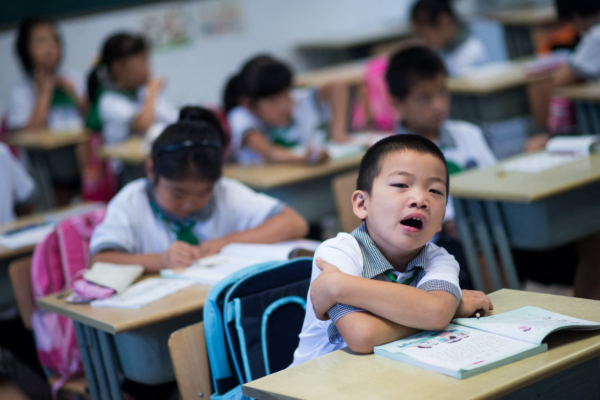
In recent years, the population in China has been continuously decreasing, with the total number of newborns in 2025 dropping to the lowest level in a decade, causing significant impacts on the education system. Schools and kindergartens across the country are struggling with declining student enrollments, leading to numerous mergers and closures, a trend also seen in higher education institutions.
The northeastern provinces of Heilongjiang, Jilin, and Liaoning, once crucial industrial bases in China that attracted a large population, have experienced a sharp decline in population in the past decade. The persisting economic downturn, increasing unemployment, and diminishing desire of young people to marry and have children have contributed to the drastic decrease in population.
A teacher in Jilin, using the pseudonym Zhang Fan, expressed to Epoch Times that the continuous population decline has made it difficult for schools in the northeastern region to attract students, a situation that is deeply concerning. The collapse of the social structure due to the dwindling population has led to a cascade of effects. “In a township in a prefecture-level city in the northeast, all 9 primary schools and 4 junior high schools have been closed down.”
Zhang Fan mentioned that the decreasing student population has directly resulted in challenges for teachers to secure employment. Many teachers have been laid off, transferred, or had to seek other career paths. “In the future, we won’t need as many teachers anymore, our value is diminished.” He predicted, “In 5 years, the number of primary school students will halve, and problems will arise in junior high schools 3 years thereafter.”
This trend is not unique to the northeast; major cities like Beijing and Shanghai are also facing similar situations.
A resident in Beijing, named Gao Feng, shared that due to high living pressures and unstable job conditions, he and his sister have remained unmarried and have no regrets. Many young people around them lack the desire to marry and have children. In recent years, there has been a significant decrease in student enrollments in kindergartens and primary schools, leading to the closure and mergers of many local schools.
“The population is plummeting sharply here, our kindergartens were merged long ago, there are no more kindergartens, no more children. Primary schools are also being merged continuously,” said Gao Feng.
Shanghai has also witnessed a similar scenario.
Qi Jin, a native Shanghainese, pointed out that the three-year epidemic and sustained economic downturn have dealt a severe blow to population development. “Especially during the three-year epidemic, a significant number of people died. The Chinese Communist Party claimed to have around 1.4 billion people, but I estimate there are now only about 900 million left.”
He mentioned that many nurseries and primary schools that were previously open have now been merged or closed down. “People have left, there’s no one left.”
Not only are primary and secondary schools and kindergartens affected, but Chinese universities are also experiencing a significant number of discontinued majors.
According to data from the Chinese Ministry of Education, between 2020 and 2024, a total of 5,345 majors in Chinese universities were discontinued. Specifically, 518 were discontinued in 2020, 804 in 2021, 925 in 2022, 1,670 in 2023, and 1,428 in 2024.
Data shows that from 2021 to 2025, over 25 private universities have been shut down. From 2019 to 2024, at least 55 specialist colleges have “disappeared” due to mergers or discontinuations.
Analysts believe that besides the decrease in student population due to the declining birth rate, the breakdown of the financial chain in some universities is also a contributing factor.
(All interviewees are pseudonyms)