
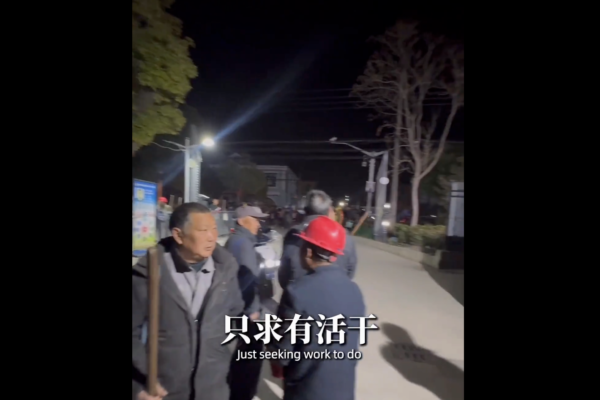
China’s economy continues to decline, leading to a surge of unemployed workers flooding into the gig economy. Despite the Chinese Communist Party’s official narrative of “singing the bright economic tune,” the CCP’s party media articles have portrayed the gig economy market in a positive light, claiming that in the past two years, Beijing’s gig economy market has transitioned from a “people seeking work” to “work seeking people” model, with some making “over ten thousand yuan per month,” yet failing to mention the grim conditions faced by gig workers.
On May 17th, the CCP’s party media People’s Daily published an article titled “Gig Economy Market Makes It Easy for Us to Find Work, Provides Security,” claiming that “both online and offline efforts in Beijing are supporting gig workers with an ‘umbrella of security,'” and noting that this is the first article in the series “Stable Employment, My Job Search Story.”
The article mentions the gig economy market at Majuqiao in southern Beijing: labor brokers like Bahongbo holding gig lists stand in front of vehicles, counting numbers, taking photos… once the process is completed, gig workers line up orderly to get on board. About two years ago, at the same moment, gig workers were still crowded on the roadside curbs at the old intersection, scrambling for jobs, bargaining. The article claims this is the official demonstration of improving employment services.
The article also describes the so-called “warm service” by CCP official agencies, mentioning that by the end of April this year, Majuqiao gig market had a success rate of 76.8% in matching workers with jobs. Through online service platforms, gig workers in Beijing have now shifted from “people seeking work” to “work seeking people.” In June 2025, the Jingshi gig market was established and operated, with Liuyanhui becoming the first gig worker to earn over ten thousand yuan in a month in the market, and so on.
However, the article does not mention a single word about the grim reality behind the gig economy market.
As traditional job-creating industries in China such as real estate have fallen into crises or stagnation, the gig worker group, known as “flexible employment,” has now become one of the largest groups in China’s labor market.
The Majuqiao gig market in Tongzhou, Beijing, is a gathering place for people from all walks of life who are struggling for a living. Li Banjiang, a mainland self-media person, published an article in late January this year about his research on the Majuqiao gig market, mentioning that the market is filled with many people who cannot find work and have no way out, resorting to selling personal information or even selling blood to make ends meet.
The article also mentioned that a new gig market was established in Majuqiao in September 2023 after government-regulated transformations and is equipped with facilities including offline service halls, free breakfast, shuttle buses, and more. Inside the hall, there is hot water, power supply, and television. Some labor intermediaries have set up offices here to recruit workers promptly. However, the article’s author says, in reality, the efficiency of job-seeking in the new gig market is lower. Moreover, the number of gig workers that can be found in Majuqiao daily is decreasing.
Epoch Times reported in February this year that over the years, the “plasma economy” has continued to develop in secret in China. In the capital Beijing, many people who cannot find work in the gig economy market have been forced to become blood sellers in dire survival conditions. The CCP’s high-level health center, the 301 Hospital, is also one link in the illegal “plasma economy” chain.
Not only in Beijing, but in major cities like Guangzhou and Shanghai, migrant workers are crowding into the gig economy market, leading to fierce competition.
In late March, a blogger released a video showing a large gathering of job seekers at one of the largest gig economy markets in the country, “Guangzhou Qiaonan New Street,” creating a scene that was astounding. The video was later removed from the Douyin platform.