
Global Financial Markets Experience Severe Turbulence Amid Rising Geopolitical Tensions in the Middle East and Tech Stocks Facing Corrections
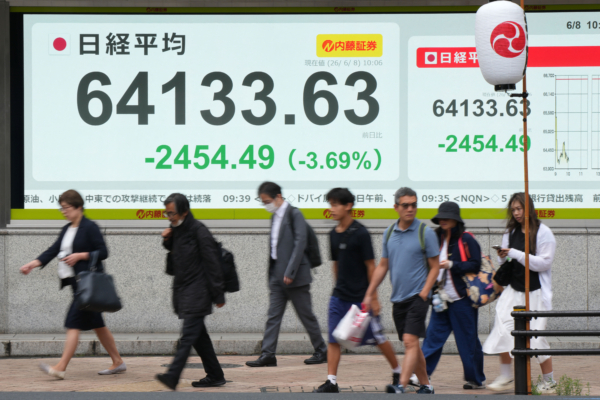
On Monday (June 8), global financial markets witnessed significant turmoil triggered by escalating tensions in the Middle East and a correction in the tech sector. Asian stock markets plummeted at the opening bell as market sentiment leaned towards risk aversion.
On Sunday, Iran launched missiles towards Israel, putting the fragile ceasefire agreement in jeopardy once again. Prior to the attack, Iranian Speaker MB Ghalibaf stated on the social platform X that the US naval blockade and violations of agreements regarding Lebanon had breached the ceasefire.
This direct escalation led to a surge in international oil prices, with Brent crude futures jumping by 2.6% in early trading on Monday, reaching $95.45 per barrel.
Asian markets experienced a sharp decline on Monday as investors hit the brakes on the hot artificial intelligence (AI) market. South Korea’s KOSPI index plummeted by 8% at the opening, triggering a 20-minute trading halt and retracting nearly 17% from the historical high set the previous week. Japan’s Nikkei 225 index also fell by over 3.5% in early trading.
Taiwan’s stock market, primarily driven by tech stocks, also faced heavy selling pressure. The Taiwan Weighted Index dropped by over 5% at the opening, with 1,194 stocks recording declines.
This sell-off wave continued from the downtrend seen in the US stock market on the previous Friday. The Nasdaq index plunged by 4.18% on Friday following the stronger-than-expected May non-farm payroll report, raising concerns of a possible interest rate hike by the Federal Reserve (Fed). The S&P 500 index fell by 2.64%, closing at 7,383.74 points, while the Dow Jones index dropped by 695 points to end the week’s trading at 50,866.78 points.
Looking at the whole week, the S&P 500 index fell by over 2% last week, the Nasdaq index dropped by 4.7%, and the Dow Jones index closed slightly lower.
Market analysts point out that the months-long AI-driven rally is now under scrutiny. Bob Savage, Head of Market Macro Strategy at BNY Mellon Bank in New York, told Reuters, “The narrative of ‘AI driving everything’ showed cracks last week.”
“Whether this is a healthy correction after the stock market’s 9-week rally or the market has already peaked remains the key question. The high interest in SpaceX and Anthropic IPOs in the market is part of this stagnation – whether to make room for new market valuations or to reassess values,” Savage said.
Callie Cox, Chief Market Strategist at Ritholtz Wealth Management, analyzed, “The stock market may be becoming a victim of its own success.”
She told CNBC that despite improvements in the job market, the persistent threat of high inflation continues to loom over investors. In a high-rate and high-cost pressure environment, growth and momentum investment strategies may be hindered.
Investors are closely watching for clues on inflation trends from the US May Consumer Price Index (CPI) and Producer Price Index (PPI) reports set to be released on Wednesday and Thursday.
Furthermore, Elon Musk’s SpaceX is expected to go public on Friday, becoming one of the largest IPOs in Wall Street history and potentially the biggest test yet for the AI valuation narrative in the market.
Cox commented, “The excessive enthusiasm of past market cycles often signaled by heavyweight fundraising transactions, hence there is currently an awkward silence surrounding the potential market signals that could be released.”
With increased market volatility, the cryptocurrency market continues to be under pressure, hovering just below the $63,000 levels. Last week, Bitcoin recorded its largest weekly decline since the collapse of FTX, dropping by approximately 16%.