
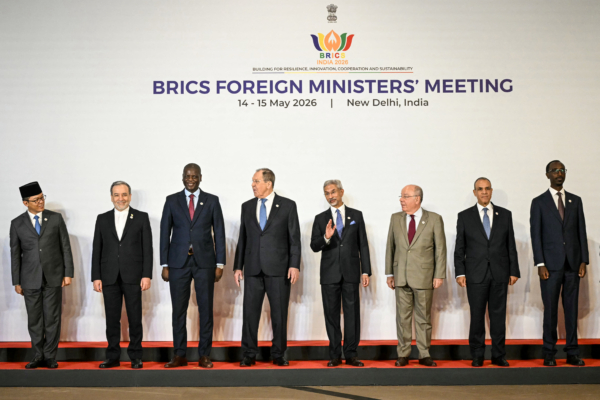
On Friday, May 15, the two-day BRICS Foreign Ministers’ Meeting in New Delhi, India, came to a close without the issuance of a joint statement due to significant disagreements among member countries on Middle East issues. India, only in its capacity as the host country, issued a statement indicating that some members have “different views on the Middle East issue.”
During the meeting, Iranian Foreign Minister Abbas Araghchi publicly accused the United Arab Emirates of directly participating in U.S. and Israeli military actions against Iran by providing military bases, airspace, territory, and facilities for them to use, as well as intelligence support.
Iran’s official Islamic Republic News Agency (IRNA) reported on Araghchi’s remarks urging BRICS member countries to explicitly condemn the U.S. and Israel for “illegal aggression violating international law,” but no concrete results emerged.
One of the triggers that led to internal disputes within BRICS was the secret visit of Israeli Prime Minister Benjamin Netanyahu to the UAE. The Israeli Prime Minister’s office confirmed on Wednesday, May 13, that Netanyahu had a secret visit to the UAE, where he met with President Mohamed bin Zayed and described the visit as a “historic breakthrough in bilateral relations.” Abu Dhabi had previously denied the rumors.
UAE Minister of Foreign Affairs Khalifa Shaheen Al Marar also attended the meeting.
Indian Foreign Minister S. Jaishankar highlighted at the meeting that the world is facing “unprecedented geopolitical and economic uncertainties,” emphasizing the fragility of the situation with ongoing tensions, risks to maritime traffic, and disruptions in energy infrastructure.
Ultimately, India, as the host country, issued a statement pointing out that BRICS members have expressed their respective positions on issues such as sovereignty, maritime security, and the protection of civilian lives.
The statement included a footnote mentioning that “one member has reservations on certain aspects related to the freedom of navigation for ships in Gaza and the Bab al-Mandeb Strait,” without naming the specific member.
According to Nikkei Asia, Professor Srikanth Kondapalli from Jawaharlal Nehru University in New Delhi noted that the admission of Iran and the UAE to BRICS in 2024 has made internal disagreements within BRICS even more challenging to resolve.
Amit Ranjan, a researcher at the National University of Singapore’s Institute of South Asian Studies, emphasized that India must balance safeguarding its own interests while fulfilling its role as the chairing country.
At present, BRICS member countries include Brazil, Russia, India, China, South Africa, Egypt, Ethiopia, Iran, the UAE, and Indonesia. While Saudi Arabia was invited to join in 2023, it has not yet become a full-fledged member.