
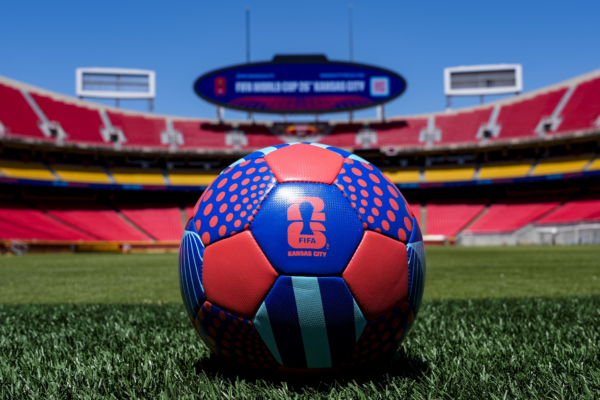
Less than a month before the start of the 2026 FIFA World Cup in the United States, Canada, and Mexico, China Central Television (CCTV) has finally reached a broadcasting agreement with the International Federation of Association Football (FIFA). While the official statement mentioned a rights fee of about $60 million, rumors suggest the deal was struck for over a hundred million dollars. When questioned by the media, FIFA only responded by stating that they have a confidentiality agreement with CCTV. Amidst the murky waters of the actual transaction amount, this months-long copyright tug-of-war reflects subtle shifts in China’s economic downturn pressure and official fiscal mindset.
According to reports from Time Weekly and Cover News, this afternoon on May 15th, China Central Radio and Television General Station, along with FIFA, jointly announced that they have reached a consensus on the new cycle of FIFA World Cup broadcasting rights. The cooperative events include the 2026 and 2030 World Cups, as well as the 2027 and 2031 Women’s World Cups.
It has been reported that based on the cooperation intention, China Central Radio and Television General Station has confirmed to have obtained exclusive all-media rights in mainland China for this cycle of cooperative events, including terrestrial television, pay-per-view television, the internet, and mobile devices.
The protracted “broadcast rights negotiation” has revolved around the core issue of pricing. According to mainland media reports, FIFA initially offered CCTV a broadcast rights fee ranging from $250 to $300 million ($1.8 to $2.1 billion yuan). However, CCTV’s budget expectations were only between $60 to $80 million, leading to a significant gap in expectations between the two sides.
Sources disclosed to The Paper that the copyright agreement between China Central Radio and Television General Station and FIFA has taken effect this afternoon. According to the agreement, the rights fee for the America (US, Canada, Mexico) World Cup is $60 million (approximately 400 million yuan). Following the report, related terms like “CCTV secures World Cup rights for $60 million” trended on Weibo.
Inquiring with FIFA Secretary General Mattias Grafström about the copyright fee issue, he maintained that he couldn’t divulge the details of the agreement since it pertains to China Central Radio and Television General Station and FIFA.
Amidst this prolonged negotiation tug-of-war, there are still disputes over whether this figure is accurate.
However, there are rumors circulating on social platform X with a different narrative.
Renowned football journalist and commentator Li Chengpeng revealed that during negotiations between CCTV and FIFA, there was speculation that the deal was for about $110 million. Blogger “MontesQ” also claimed that, according to insider information, FIFA made a “significant concession” and settled for $110 million as the deal cloes.
Responding to this, some netizens raised doubts, suggesting, “The actual amount might be at $300 million, with CCTV making a small request to have a unified external voice, stating they secured it for $100 million.” The ambiguity in the transaction amount does not just reflect negotiation confidentiality but also invokes deep-seated doubts about China’s actual purchasing power in the market.
Previously, the two sides were deadlocked in negotiations, sparking widespread discussions domestically by an article on Zhihu titled “Failing to sell the World Cup is the most dangerous signal.”
The author of the article pointed out, “When CCTV hesitates to blindly sign the contract, the real danger isn’t in sports but lies in the spending power of the current audience.”
“If CCTV could earn $1 billion from it, do you think they would hesitate for six months over a mere $300 million offer? Even if FIFA slashed the price to $120 million later on, CCTV remained unmoved— essentially, it’s not that it’s too expensive but rather a lack of confidence in recouping the investment.”
Indeed, the backdrop of this negotiation goes far beyond a mere copyright contract.
For this World Cup, China has announced official sponsors, including Wanda, Lenovo, Hisense, Mengniu, and others, with a cumulative investment exceeding $500 million in sponsorship fees. If there’s no official broadcasting domestically, not only will millions of Chinese football fans miss the live World Cup matches, but the hefty corporate sponsorship fees will go down the drain directly.
Seasoned US media personality Fang Wei disagrees with the circulating notion that “FIFA’s asking price is too high.” Speaking to The Epoch Times, he stated that it is merely a pretext disseminated by the Chinese Communist Party. This World Cup has witnessed a significant increase in the scale of matches and the number of participating teams compared to the previous edition. He believes that the price hike is justified.
Fang Wei further emphasized that China has long emphasized its status as the “world’s second-largest economy” with a massive population, therefore deeming FIFA’s asking price for the Chinese market commercially reasonable.
He thinks that CCTV’s insistence on lowering the price stems more from a lack of confidence in market returns. “Because China’s economic tightening is quite severe, domestic purchasing power is very weak, and everyone is tightening their wallets, reluctant to spend. This is a reaction to the harsh reality of the Chinese economy.”
Beijing scholar Yang Ming (alias) told The Epoch Times, “The Chinese Communist Party lavishly spends money domestically and overseas, yet is unwilling to cover the World Cup broadcasting fee.”
He said, “The Chinese Communist Party has already lost the hearts of the people and credibility. If it further offends its domestic football fans, then it will bear the consequences. Though negotiations are currently deadlocked, CCTV will probably end up making the purchase.”
Furthermore, concerning the big external propaganda of the Chinese Communist Party, the aforementioned Zhihu article also stated, “What’s even more laughable is that if you now casually open a short video platform, the entire network is covered with what kind of rhetoric?—’Japan experiences severe inflation, ordinary people can’t even afford rice,’ ‘America is all about zero-cost shopping and shootouts, the streets are full of drugged zombies,’ ‘Europe is deeply embroiled in an energy crisis,’ ‘South Koreans can’t even afford kimchi anymore.’ It seems like apart from us, the whole world is struggling in a living hell of struggle.
“Yet what’s the result? These countries that we mock with ‘can’t afford their meals’ day and night, when faced with several hundred million dollars of World Cup broadcasting fees, they generously shell out real money, not even batting an eye.”
“Their confidence in spending the money comes from what? Their mainstream broadcasters in the domestic market have done the math; this sum not only brings returns but substantial profits too! What are the inherent conditions for making profits? Their people still have a strong willingness to consume, their advertisers are willing to spend money even with their eyes closed.”
The article ridiculed the Chinese Communist Party, “Contrasting with our country, touted as the ‘world’s largest consumer market,’ now unable to even accept a $120 million broadcasting right. Does this slap ring loud enough?”
The article concludes by stating, “The younger generation doesn’t lack love for entertainment. It’s a new instinct they’ve developed towards ‘spending’—caution. Previously, it was consuming first, then thinking about the future. Nowadays, it’s about surviving first, then seeking happiness. When a market starts cutting off ’emotional spending,’ it has already entered a freezing contraction state.”
According to NetEase News, economist and doctoral mentor Zheng Keqiang reposted this article and expressed agreement with its sentiments.