
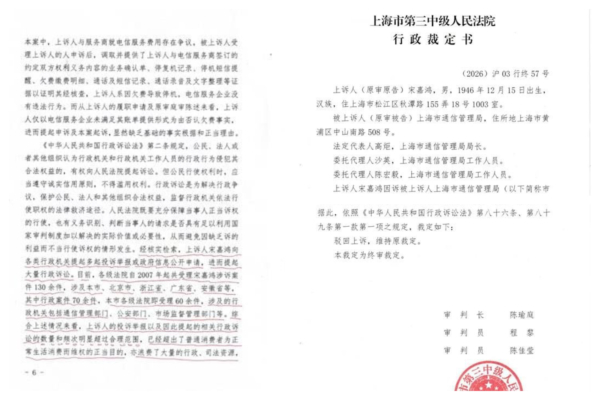
Recently, Shanghai human rights activist Song Jiahong received an “Administrative Ruling” from the Shanghai Third Intermediate People’s Court regarding a telecommunications fee dispute. Judge Chen Yuting stated that since 2007, Song has filed a total of 130 lawsuits (including 70 administrative cases), exceeding the legitimate purpose of safeguarding rights, and specifically declared that Song’s administrative litigation does not have any protectable legal interest.
According to the ruling, Song’s lawsuit cases span across Shanghai, Beijing, Zhejiang, Guangdong, Anhui, and more, with over 70 administrative cases, of which over 60 have been accepted by Shanghai courts at all levels. The administrative agencies involved include telecommunications management departments, public security departments, market supervision departments, and others. The quantity and frequency of the complainant’s complaints and related administrative litigation have exceeded the legitimate purpose of regular consumers safeguarding their rights through normal consumption.
Song Jiahong, a demolition household in the Huangpu District, filed his first administrative lawsuit to challenge the legality of a demolition agreement. Subsequently, due to facing many unjust treatments and suppressions from authorities during his rights protection appeals, he initiated numerous lawsuits.
In December 2024, his China Mobile phone was suddenly suspended due to unpaid fees. Song, not having received any notification via calls or messages before the suspension, resorted to administrative litigation after failed negotiations. Now, with a simple administrative ruling on a telecommunications fee dispute, the Shanghai Third Intermediate People’s Court judge overturned all of Song Jiahong’s administrative lawsuit cases, clarifying that his litigation does not have any protectable legal interest.
Surprised by the decision made by Judge Chen Yuting, Song Jiahong expressed to a reporter, “My first administrative lawsuit was to challenge the illegality of a demolition agreement in the Huangpu District People’s Court. Judge Pan Jiaxiang couldn’t argue against me logically, so he unreasonably expelled me from the courtroom. Obviously the judge violated the law, and the higher courts did not investigate or supervise, yet Pan was even promoted three levels up.”
“As an 80-year-old man with terminal cancer, the government demolished my $5 million house for building the Chengdu Beilu viaduct in downtown. They only compensated me $2 million for an outskirts small apartment and demanded me to purchase an additional 10 square meters at my own cost. However, the government still owes me money to this day. Is Shanghai ruled by law or is it blind to justice?”
Song Jiahong stated, “By law, we fight lawsuits to promote the rule of law, supervise the government’s lawful administration. However, Judge Chen Yuting from the Shanghai Third Intermediate People’s Court used an ‘Administrative Ruling’ to slander my litigation as ‘exceeding the legitimate purpose of rights protection.’ Are there limits to the number of lawsuits? Can’t believe this makes as special news in 2026.”
He further commented, “When the court is corrupt and the country is without hope, it’s not a trivial matter. Under judges not subject to legal supervision, if judgments are not based on facts and laws, wrongful convictions and miscarriages of justice proliferate. If people don’t stand up for their rights, this country will be completely ruined!”
Shanghai municipal government has forcibly demolished a large number of citizens’ houses for various construction projects, creating numerous rights-defending petitioners. These displaced residents have been seeking solutions for over a decade with issues arising during the petitioning process, some resorting to legal actions while others endure silently. Song Jiahong is among the few who understand using legal tools to fight for their legitimate rights.
Similarly, there are numerous demolition households in Shanghai, with a substantial number of petitioners still fighting for their rights up to 119 times in high courts.
On May 12th, some residents from Yangpu District, Huangpu District, Pudong New Area, Putuo District, and Jing’an District of Shanghai, who have been subjected to unjust court judgments on forced relocations, gathered at the Shanghai High People’s Court for the 119th time to defend their rights. They hope to draw attention from the leadership to cease bureaucratic delays and effectively resolve issues of judicial corruption and damages to public interests during relocations.
Like Song Jiahong, these elderly residents in their seventies and eighties have stood outside the Shanghai High People’s Court enduring the scorching sun for years, hoping for a just listener to hear their pleas. However, they are taken back to the petition offices of the high court, submitting documents, only to wait for the process to repeat in a cycle of bureaucratic delay.
Demolition households grassroots activists posted on social media, stating, “From the majority of ‘Compensation and Acquisition Decisions’ in Yangpu District, we can see that the descriptions regarding compensation standards indicate that the assessment company is qualified, and the procedures are legal. The acquisition unit reimburses based on the evaluation, with no irregularities. Such judgments manipulate concepts. Compensation should be based on market value, as clear in all laws and regulations, with explicit directives from the Ministry of Housing and Urban-Rural Development. However, the judgments persistently avoid market-based valuation in Shanghai, turning a blind eye to systematic legal injustices.”
They believe that the property rights obtained from forced demolitions are uncertain, making talks of property replacement illegal. Under the principle of nearest replacement, regardless of elderly, ill individuals, working-age adults, or children needing education, forcibly relocating them over 50 kilometers away to areas lacking enterprises, medical facilities, or schools cannot be justified by ‘clear property rights.’ Houses are for habitation, and residents require living, medical, and educational facilities.
The grassroots activists added, “Regarding such resettlements, whether they align with residents’ past living conditions and survival needs, judges failing to investigate and obtain evidence, completely disregarding facts, rejecting citizens’ objections, signifies not only the abandonment of legitimate oversight over administrative actions but also a loss of basic human decency.”