
Audience friends, hello and welcome to watch “The Truth of a Century”.
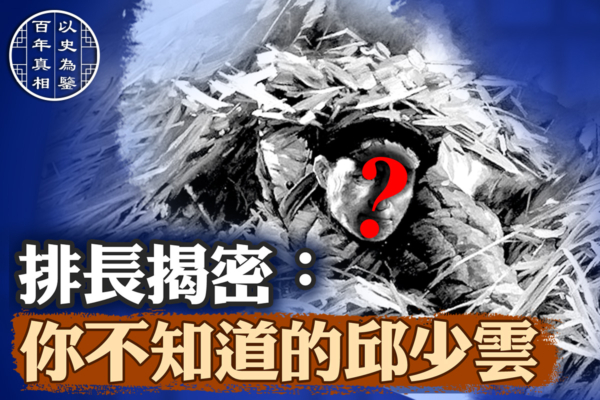
Today, we are going to discuss a figure who was portrayed as a “hero in flames” in the Chinese Communist Party’s propaganda – Qiu Shaoyun. This name, many people have heard since childhood because his story has been written into elementary school language textbooks under the title “My comrade Qiu Shaoyun”.
The story is quite dramatic: in the Korean battlefield in 1952, Qiu Shaoyun was ignited by an incendiary bomb but in order to not expose the troop, he endured the intense flames all over his body without moving for a full thirty minutes, ultimately sacrificing heroically.
It sounds quite tragic.
But here comes the question, can a person really remain motionless for thirty minutes while completely engulfed in flames? Did he have any ammunition on him, and if so, why didn’t it explode? He was very close to the enemy, how could he remain unnoticed for half an hour while being on fire?
In today’s episode, we will uncover the deliberate lies fabricated by the Chinese Communist Party on this “hero.”
According to the Chinese Communist Party’s official statements, Qiu Shaoyun was from Sichuan, joined the military in 1949, and was sent to the Korean battlefield in 1951.
On October 12, 1952, approximately 500 soldiers of their unit were ambushed near the enemy’s position, preparing for a surprise attack. At that moment, an incendiary bomb fell near the hiding place of Qiu Shaoyun, engulfing his entire body in flames.
In order to not expose the target, he endured the excruciating pain of burning flesh, remained motionless for over thirty minutes, and heroically sacrificed himself. Afterwards, he was posthumously recognized as a CCP member.
Such a feat fits well with the CCP’s propaganda of “glorious brightness,” but many people have doubts about the storyline of this story.
Many mainland websites reported that a teacher named Liao Zhongming in Anlu City, Hubei, once carefully analyzed the text “My Comrade Qiu Shaoyun” and found at least three inconsistencies that do not align with basic common sense.
First, where did the weapons go?
Qiu Shaoyun was a frontline soldier and should have been carrying weapons and ammunition. How come he was engulfed in flames for a full thirty minutes without the weapons on him, such as explosive tubes and bullets, exploding? This doesn’t make sense.
Second, how did the enemy not notice?
The text mentions his ambush location being only a little over 60 meters from the enemy, close enough to hear them talking. So, how could the enemy remain completely unaware when a person was fully engulfed in flames, causing the surrounding dry grass to turn to ash?
Third, key details are very vague.
The terminology used in the text, such as the time of “noon” the event occurred, how many people were lurking, can the grass conceal 500 people, and how many enemies were “completely annihilated,” remains ambiguous.
Interestingly, as people questioned the possibility of ammunition igniting during the fire, the CCP officials realized the oversight and quickly decided to alter the story. So, we saw a new version on CCP-controlled media like “People’s Daily.” They changed the description of “remaining motionless while on fire” to a more elaborate explanation – “in order to prevent the explosives and bullets he carried from heating up and exploding, he endured the intense pain of the burning flames, gently pushed the explosives aside, and buried the bullets in the soil.”
However, this revision raised even more suspicion among netizens. Some immediately questioned how such actions wouldn’t be noticed by the nearby enemy forces. Didn’t you say the enemy was only tens of meters away?
Furthermore, none of his comrades nearby got a single spark on them? They all froze like statues? And all the ammunition on them remained quiet and didn’t explode? It’s not a campfire; it’s an incendiary bomb!
By making these adjustments, CCP officials inadvertently exposed more loopholes in the story.
In 2004, a key figure emerged. He was the platoon leader and the on-site commander of Qiu Shaoyun’s unit at that time – Zeng Jiyou. He was interviewed by the Guangxi “Legal Daily,” and right from the start, he dismantled the “heroic deeds” depicted in textbooks.
Firstly, Zeng Jiyou admitted that since Qiu Shaoyun was assigned to lurk closest to the enemy, he wasn’t given any weapons at all, only a pair of wire-cutting pliers. There were no explosives or bullets whatsoever.
Moreover, while the CCP always claimed that Qiu Shaoyun was about 60 meters away from the enemy, Zeng Jiyou stated that it was actually around 30 meters, with only 5 meters separating him from the enemy’s wire net. Meaning, the entire miraculous act of remaining undetected in the fire happened right under the noses of the enemy.
Furthermore, Zeng Jiyou revealed that the frontline ambush consisted not of 500 people, as promoted, but merely 52 soldiers, almost a tenth of the propaganda version. He recalled lying down about 5 meters behind Qiu Shaoyun, and the enemy fired several incendiary bombs one after another. Qiu Shaoyun was not the first soldier to die in action.
When journalists inquired, “Some articles mention that there was a ditch near Qiu Shaoyun, and if he could roll into it, he could have saved himself, is that true?”
Zeng Jiyou bluntly responded, “Where was the ditch? We were halfway up the mountain, and it was cold; where would water come from?”
In simple terms, even the existence of a ditch to extinguish the fire was just a scene fabricated by CCP writers.
Ironically, after the war, Zeng Jiyou was injured and sent back to a domestic hospital for treatment. One day, he overheard a nurse reading from the “People’s Daily” about the report titled “The Great Warrior Qiu Shaoyun.” Initially pleased to see his comrade receiving recognition, as he continued listening, he found discrepancies in the story – such as Qiu Shaoyun carrying explosives on his back, leaving him baffled: “Who made up this nonsense?”
In 1975, while recuperating in Liuzhou, Zeng Jiyou was invited by a school to speak to the students about Qiu Shaoyun’s story. Back then, the story of Qiu Shaoyun was already in textbooks, but having his war comrade personally telling it still intrigued the students.
However, as the classmates noticed discrepancies between “Grandpa Zeng’s” story and the one in the book, they eagerly raised questions one after another.
This unexpected turn of events surprised Zeng Jiyou, prompting him to review the textbooks afterward. Sure enough, he found numerous inconsistencies. He checked some newspapers, which posed similar issues. He summarized several discrepancies:
First, the unit number was incorrect.
The newspapers mentioned the 15th Army, 29th Division, and the 168th Regiment of the Volunteers; however, Zeng Jiyou knew Qiu Shaoyun belonged to the 87th Regiment.
Second, the deployment time was inaccurate.
The news reported Qiu Shaoyun’s deployment to Korea on March 28, 1951, but Zeng Jiyou remembered it as October 23, 1950, with their unit being among the first to cross the Yalu River.
Third, the time and age of death were incorrect.
The paper stated his death on the afternoon of October 12, 1952, at age 26. But Zeng Jiyou recalled it as 4 pm on October 24, 1952, when Qiu Shaoyun was only 20 years old. He emphasized remembering this vividly as it was the day he got injured as well, making the timeline crystal clear.
Fourth, the family background was misrepresented.
The newspapers mentioned his parents and three brothers, whereas Zeng Jiyou knew that Qiu Shaoyun’s father had passed away, leaving only his mother and one younger brother.
Fifth, there were disputes about his military service before joining.
The papers mentioned that Qiu Shaoyun was conscripted by the Nationalist Army before joining the CCP and had worked as a kitchen helper in the 18th Regiment of the Sichuan Army. But Zeng Jiyou never heard him speak of such experiences. During the soldiers’ meetings, Qiu Shaoyun only mentioned his family’s hardships but never talked about being in the military previously.
Furthermore, there was the claim of “meritorious service in anti-bandit operations.” It was said that Qiu Shaoyun captured a bandit named Liu Yi in Ziyang and earned merit. But Zeng Jiyou remembered that they never left Jianyang before going to Korea and that the Jianyang County Brigade had never captured any bandit during that time.
Apart from the platoon leader’s revelations, professionals in various fields have also raised doubts. Particularly, the medical community found the claims surrounding this “flaming hero” to be laden with question marks.
There is a Chinese online article titled “Qiu Shaoyun, the Hero Worth Doubting,” suggesting that at that time, nobody in the unit found Qiu Shaoyun particularly courageous. Some even mentioned that he appeared anxious and afraid before the lurking mission was to be carried out. It is speculated that Qiu Shaoyun might have been directly hit and killed by the incendiary bomb, with no instances of enduring pain for thirty minutes or displaying extraordinary willpower.
In 2008, discussions about this topic gained traction online, with many medical professionals pointing out core doubts from a physiological perspective.
The first doubt: When a person is on fire, can they really remain motionless like a statue?
In real life, the human body’s nerves, skin, and bone marrow cannot withstand high-temperature burns. Even with strong willpower, the body instinctively struggles; it’s a physiological reaction that cannot be controlled. It’s not a matter of willing yourself to stay still.
Moreover, it wasn’t just fire but a military-grade incendiary bomb, with temperatures exceeding a thousand degrees. The flames would stick to the skin, absorb surrounding oxygen, release a lot of carbon monoxide, causing suffocation. In such circumstances, it isn’t about willpower but a direct challenge to the body’s physiological limits.
One analogy posed was if you saw a bomb explode in a crowd in a movie, people would be propelled away. Could anyone say one person had strong willpower to resist flying off? It’s impossible; the body cannot withstand the explosion; that’s common sense.
Therefore, if a person could endure being in flames for thirty minutes without moving, there is only one possibility – they lost consciousness long before, possibly even dead on the spot.
The second doubt: Extensive burn injuries cannot be sustained for such a prolonged period.
Different body parts have varying pain endurance, but nobody can bear extensive burns. Qiu Shaoyun was engulfed in flames all over his body, a level of burn that no one can endure, especially not from a weapon-grade incendiary bomb.
The third doubt: Human levels of unconsciousness can be classified as shallow, moderate, or deep. Even with “mild unconsciousness,” people lose control of their bodies. Tasks like “bearing pain, maintaining willpower” become impossible after losing consciousness.
In essence, if one truly remained “motionless,” the likely scenario is they had already died a while ago.
On March 29, 2015, the CCP military newspaper “PLA Daily” mentioned in a special report titled “How to Teach Party and Military History Well Today” that a military school teacher, while narrating Qiu Shaoyun’s story, faced a student questioning its defiance of basic physiological norms, deeming it implausible.
Moreover, the teachers likened the present-day teaching of party and military history to be somewhat suspenseful as doubts and queries arose in succession.
Audience friends, from the error-riddled textbooks to the firsthand revelations of Qiu Shaoyun’s comrades, and the medical community’s skepticism, what we glimpse is not a hero but a shoddily constructed propaganda image by the CCP.
Qiu Shaoyun’s story is just the tip of this propaganda iceberg. As more and more people start pondering and questioning, can the CCP continue deceiving the public with fabricated tales for long?
That concludes today’s program; thank you for watching. If you enjoyed our show, don’t forget to like, subscribe, and share. See you in the next episode.