
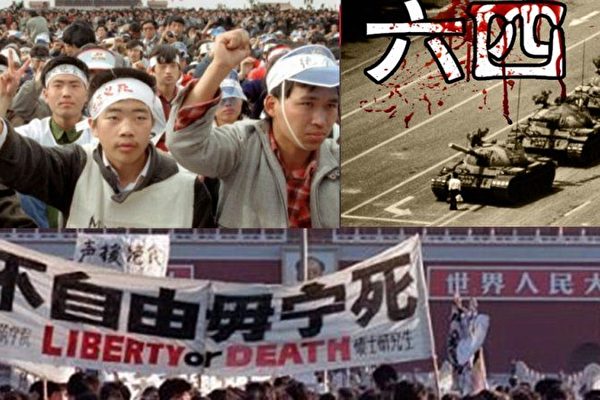
In 1989, the “89 Democracy Movement” and the subsequent Tiananmen Square crackdown known as the “June 4th Incident” have now passed 37 years. Despite the Chinese Communist regime’s ongoing tight control over speech and attempts to erase this bloody history from public memory, survivors and witnesses have never given up seeking the truth and commemorating the events.
Through interviews with eyewitnesses and investigative research, Epoch Times has reconstructed the original intentions behind the anti-corruption movement and the brutal suppression that followed. Under the veil of authoritarian rule, “commemorating June 4th” serves not only as a deep mourning for the deceased but also as a push for China to move towards true democracy and rule of law.
As the anniversary of June 4th approaches each year, the political atmosphere within mainland China becomes tense. Individuals like Chen Xiao and Xu Qing, who were once detained by authorities for participating in commemorative activities, still face stringent surveillance by the police on the 37th anniversary.
Chen Xiao, when interviewed, expressed helplessness, stating, “There is simply no space for speech in the country now. The police are stationed at my house, watching even outside the door.”
Xu Qing also bluntly stated, “It’s not convenient to speak up now, there is no freedom.” These brief remarks vividly reflect the harsh silenced environment surrounding historical memory in present-day Chinese society.
Commenting on the events of ’89 and June 4th, eyewitness Wang Cheng pointed out a turning point in faith experienced after the sound of bullets.
Wang Cheng described how before June 4th, the influence of the Chinese Communist Party’s education and brainwashing deeply affected him, viewing the ruling party as akin to “our own people” like parents or elders, believing that even if they made mistakes, they could be forgiven. However, the crackdown became a watershed moment in his thinking.
Wang Cheng lamented, saying, “After the ’89 incident, post-June 4th, we felt that we no longer considered them as our own people. They are one thing, and we are another.” He emphasized that the CCP, in order to maintain its political privileges and vested interests, “sacrificed the people’s interests, using tanks and machine guns to deal with the people. They are not the same as the people, not part of them.”
Furthermore, Wang Cheng stressed that the authorities using machine guns and tanks against unarmed and peacefully demonstrating ordinary citizens led their generation to realize the complete bankruptcy of brainwashing and see the true nature of it.
From then on, he established an attitude of independent thinking, no longer blindly trusting the political propaganda of the CCP. Criticizing the authoritarian regime, Wang Cheng stated, “Absolute power inevitably leads to absolute greed and corruption, public power must be balanced.”
He believed that only through genuine democratic elections where power is bestowed upon the people through one person, one vote, can the fundamental issues be resolved. Regarding the strict censorship of June 4th discussions by authorities, even warning him not to comment online, he stated firmly, “The more sensitive they are, the more they have something to hide, unable to bear scrutiny.”
Advocating for the rehabilitation of June 4th and promoting democracy and the rule of law in China are part of the same struggle, whereby a truly confident political party should face history squarely, “only through seeking truth and being truly open, can confidently embrace world civilization and bid farewell to the darkness of the past.”
Another eyewitness of the ’89 Democracy Movement, former Shaanxi TV reporter and editor Ma Xiaoming, has been either taken away or restricted in his personal and communication freedom almost every year around the June 4th anniversary for the past 37 years but has consistently insisted on commemorating this day. Each year, on this day, he pays deep respects and tribute to the martyrs who sacrificed themselves and to those who were severely purged after June 4th, some even spending decades in prison.
During an interview with Epoch Times, Ma Xiaoming detailed the economic and social roots of the movement’s eruption.
He positioned the ’89 Democracy Movement as a “magnificent democratic movement in China” and highlighted that the core demand of the masses taking to the streets at the time was to “oppose official corruption and eliminate corruption”.
Ma Xiaoming recalled that China was transitioning from a planned economy to a market economy, implementing an economic policy known as the “dual-track system”. Under this system, after completing state missions, enterprises could privately price and sell excess production of scarce materials like steel and cotton.
Due to market prices often being one to two times higher than the state-fixed prices, the authority to issue permits for selling these goods was in the hands of officials. This enabled officials and their relatives (known as “backyard capitalists”) to amass wealth instantly. “Getting a permit could earn an official thousands, tens of thousands, or even hundreds of thousands of yuan.”
Explaining further, Ma Xiaoming highlighted that at that time, an average person’s monthly salary was only a few dozen yuan. This privilege corruption generated by system flaws fueled strong discontent among the public, leading to demonstrations and petitions by students and various social strata in Beijing and nationwide.
However, this peaceful and rational petition movement ultimately met with a brutal military crackdown. Ma Xiaoming pointed out that a direct consequence of suppressing people’s voices was the emergence of “thousands of corrupt officials”.
He criticized the current anti-corruption policies of the CCP, highlighting that the offspring of leaders who held real power became the biggest “backyard capitalists”, with today’s corrupt officials embezzling billions of national assets often receiving lenient sentences like “suspended death penalty”, paving the way for elite “escape routes”.
Ma Xiaoming frankly stated, “The current corruption and embezzlement are escalating, the more anti-corruption, the more corrupt… How did it escalate to such a degree? It’s the ’89 Democracy Movement, it’s the repression of people’s resistance.”
Official attempts to conceal the scale of deaths and injuries from the Tiananmen Square crackdown have been ongoing. According to Ma Xiaoming’s recollection, the head of the martial law forces once claimed that the death toll was only around 300, while various unofficial sources revealed that the actual numbers were significantly higher.
The Tiananmen Mothers, led by Ding Zilin, meticulously verified a list of 202 named victims; Red Cross estimates ranged between 2,000 to 2,600 deaths and 30,000 wounded; the Public Security Bureau presented a report to the State Council in July 1990 stating 931 deaths and over 22,000 injuries; and declassified British diplomatic files showed a death toll of over ten thousand.
The precise number of casualties awaits the day when the truth is fully made public. However, based on current investigations, it is believed that the majority of June 4th victims were spread throughout various parts of Beijing, especially along West Chang’an Avenue, not just Tiananmen Square itself, including those the authorities labeled as “thugs” executed among the casualties.
The crackdown was followed by comprehensive and severe news censorship. Ma Xiaoming, a former editor at Shaanxi TV, experienced this firsthand, saying, “At the station, there were regulations that prohibited broadcasting certain content, such as people marching on the streets, chanting slogans, reports containing both images and text.”
As Ma Xiaoming reported on the student petition situation in Xi’an and participated in support, he was eventually disciplined and removed from his position, enduring official repression and persecution over the years.
Nevertheless, even under heavy censorship, individuals with a conscience within the system raised the first voice of history.
On June 4, 1989, at 6:25 am, Wu Xiaoyong, deputy director of the English Department of China International Broadcasting (son of former Vice Premier Wu Xueqian), broadcasted an 80-second English news article written by himself, revealing the truth of the crackdown to the world. The duty announcer read:
“Remember, on June 3, 1989, in the capital of China, Beijing, a horrifying tragedy occurred. Tens of thousands of people, many innocent civilians, were killed by soldiers in full combat gear forcibly entering the city… Soldiers drove tanks, firing machine guns at numerous citizens and students attempting to block the tanks.”
The report strongly urged listeners to “join us in condemning this shameless act, trampling on human rights, and the most barbaric suppression of the people.” This was a real report issued by Chinese state media during June 4th, for which Wu Xiaoyong was imprisoned. However, in a later interview, he made it clear that he only fulfilled his duty as a journalist and had no regrets about his choice back then.
As time passes, the scars of bloodshed have not healed. Ma Xiaoming once visited Ding Zilin, the initiator of the “Tiananmen Mothers”, and the couple Jiang Peikun, whose son Jiang Jielian was tragically shot at Muxidi. For many years, the elderly couple has preserved their son’s bed as it was when he slept, with his portrait hanging on the wall.
After this, he once again “expressed mourning to the fallen martyrs and paid tribute to Ding Zilin and the hero group of Tiananmen Mothers.”
Ma Xiaoming stated that for over thirty years, the Tiananmen Mothers have continued their relentless pursuit, unafraid of power, insisting on revealing the truth of June 4th, rehabilitating the victims, and bringing the culprits to justice.
Regarding official attempts to erase memories through time, Ma Xiaoming firmly retorted, “You can close the people’s mouths, but you can’t silence them. You can’t erase it from the people’s memory.”
He pointed out that every time the people see today’s corrupt officials falling from power, they inevitably recall June 4th, and remember the martyrs who sacrificed their lives for social justice.
“In a few decades, even if we are no longer around, the contradictions bubbling within Chinese society will erupt, and the struggles that need to rise will indeed rise.”
Ma Xiaoming affirmed that due to the fundamental issues and authoritarian rule in Chinese society remaining unchanged, the prolonged repression will inevitably lead to more severe social resistance erupting in the future.