
Rumors have been circulating that Philippine Defense Minister Gilberto Teodoro has been included in a sanctions list by the Chinese Communist Party (CCP). Teodoro recently responded by saying that he has no assets in China and has no intention of going there, jokingly remarking that it’s fortunate his ancestors left China. He mentioned that while the Chinese people are friendly, they are overshadowed by the “bullying government system” of the CCP.
On June 3, Philippine media outlet Politiko reported that sources claimed Teodoro and his family have been included in a no-entry list by the CCP, suggesting that if his family has assets in China, they may be frozen.
During a visit to a military camp in Cagayan de Oro City in the Philippines on that afternoon, Teodoro remarked, “I have no assets in China, nor do I plan to go there. Although I would love to visit and try the reputedly delicious food and interact with the friendly people there, all of this is obscured by their oppressive government system.”
Teodoro, who has Chinese heritage, mentioned that his ancestors left China around six to seven generations ago to come to the Philippines, stating, “It’s fortunate they came and never left; otherwise, there wouldn’t be me today.”
Teodoro hails from the prominent Cojuangco family in Philippine politics and business. His mother served as a congresswoman, and his uncle was the chairman and CEO of the San Miguel Corporation in the Philippines. Their ancestors can be traced back to Huan Go, a Chinese immigrant who moved to the Philippines in 1861. In order to assimilate into mainstream society, the family surname was “Hispanized” to Cojuangco.
In mid-May, Teodoro led a team to raid the Chinese-owned steel factory “San Jia Steel” suspected of employing 69 Chinese nationals and one Filipino citizen illegally, implying potential threats to national security.
The Chinese Embassy in the Philippines stated that 64 of the detained Chinese nationals were released on the evening of May 28, while six are still undergoing release procedures.
San Jia Steel is located in an industrial park controlled by the Philippine military. Former chairman Yang Jianxin was arrested in 2024 due to his ties with Alice Guo, a Chinese-Filipino former mayor of Banban City in the Philippines, who was sentenced to life imprisonment last November for human trafficking. Authorities suspect her of being a CCP spy.
Politiko reported that Chinese officials criticized the legality of the Philippine law enforcement action and consequently retaliated by sanctioning Teodoro. However, as of the time of writing, the CCP had not confirmed whether Teodoro had indeed been sanctioned.
Teodoro refuted allegations that the law enforcement action was targeting Chinese citizens, stating, “We are not targeting Chinese citizens; we are targeting illegal activities. It just so happens that the individuals involved in the large-scale cases we uncovered, including illegal mining, happen to be Chinese citizens.”
He quipped, “If you can’t find any evidence of wrongdoing, then you can question my motives. But the illegality of this case is as clear as day, even brighter than my forehead.”
Teodoro’s response to rumors of CCP sanctions against him sparked discussions on social media, with some users criticizing the Philippines while others supported his remarks distinguishing between the CCP government and the Chinese people.
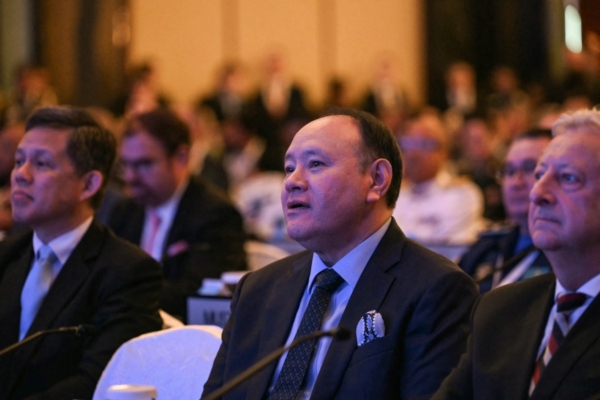
Teodoro’s recent firm stance against the CCP was evident at the Shangri-La Dialogue held in Singapore, where he endorsed Japan’s criticism of the CCP’s “new militarism.”
During last year’s Shangri-La Dialogue, Teodoro referenced Deng Xiaoping, then Vice Premier of the State Council of the PRC, who stated at the United Nations General Assembly in 1974, “Now is not the time, nor will there ever be a time for us to become a superpower.”
Teodoro pointed out that half a century later, the CCP has clearly not adhered to this promise, as Beijing’s actions toward neighboring smaller countries today contradict its initial commitment to “peaceful rise.”