
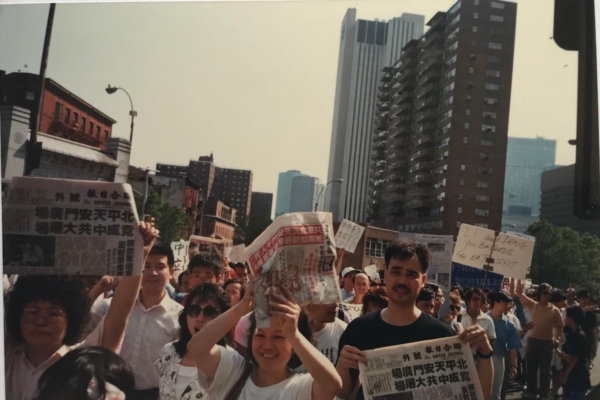
The 1989 Tiananmen Square massacre shocked the world and changed the fate of many people. It also once influenced the landscape of Chinese-language media at that time. Some Chinese newspapers that supported Beijing’s crackdown faced a unified boycott from readers and soon closed down.
In the 1980s, Mrs. Chen, who immigrated to the United States and worked in the media for 30 years, expressed in an interview on June 4th that after the Tiananmen Square incident, New York’s Chinatown was home to many Chinese-language newspapers. Various media outlets had a clear divide in their stance towards Beijing’s shooting repression of students and citizens.
Mrs. Chen recalled the existence of a Chinese newspaper called “The Chinese Journal” back then, which openly supported Beijing’s repression and stirred strong backlash from the Chinese community. A large number of people gathered outside its office near Lafayette Street in Manhattan to demonstrate and protest, even burning newspapers to express their anger.
“At that time, even the staff of the newspaper couldn’t bear it and came out to support the demonstration, and eventually resigned,” said Mrs. Chen. After losing readers, advertisers, and staff, “The Chinese Journal” soon ceased publication.
Another newspaper, “Chinese Overseas Daily,” which had long been considered to have connections with the Chinese Communist Party, went through a dramatic transformation during the Tiananmen Square period. Mrs. Chen mentioned that the newspaper heavily published news supporting the student movement and condemning the crackdown. The staff of the newspaper also participated in street protests to support Beijing students, “similar to Hong Kong’s Wen Wei Po at that time, fighting back.”
However, subsequently, under pressure from the Beijing authorities, the Chairman of “Chinese Overseas Daily,” with the last name Tan, chose to voluntarily end the operation of the newspaper.
As a result, June 4th became an important watershed in the development history of Chinese-language media in New York, also leading many Chinese people to publicly express their support for democracy movements.
Mrs. Chen stated that in the more than ten years following June 4th, commemorations continued to be held annually in New York, with the core support for these activities coming from the Hong Kong immigrant community. “They protest at the Chinese consulate every year, and it has been ongoing for ten years without interruption.”
She recollected that much of the organizing work back then took place in Chinatown’s senior centers, with many Hong Kong-based groups dedicating themselves to organizing and mobilizing. “There were participation from democracy activists, but the ones truly sustaining these activities were Hong Kong people.”
Regarding today’s New York Chinese community, Mrs. Chen admitted that there have been some changes compared to 1989, which are related to the changing structure of the immigrant population and the infiltration of communist influence in the Chinese community.
She stated that among the early Chinese immigrants to the United States, many were refugees who had experienced political movements, the Cultural Revolution, escaping, or family trauma, hence maintaining a high vigilance against the Chinese Communist regime.
However, later Chinese immigrants who came to the US after China’s economic development, “may not necessarily have come for democracy and freedom, but for work, business, or to provide education for their children.” She mentioned that some individuals were misled by the illusion of China’s economic development and had unclear perceptions of China’s human rights conditions and the true nature of the Chinese Communist Party. Nevertheless, in recent years, discussions on issues such as foreign influence, student visas, green card approvals, and transnational political infiltration have heated up in the United States, reflecting the external scrutiny of the expansion of the Chinese Communist Party’s overseas influence.
“Many things do not happen without reason,” she said. “The vigilance we have today is also the accumulation of experiences over the past few decades.”