
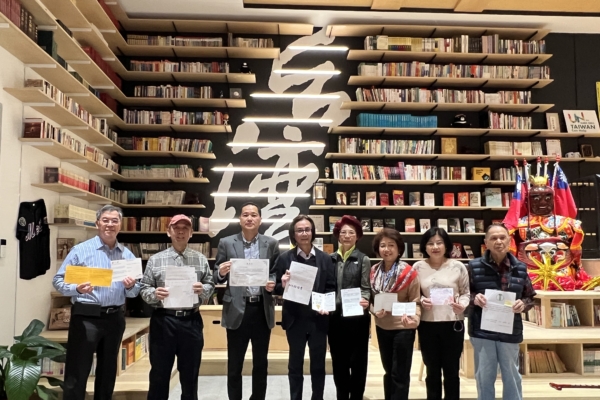
On January 5th, at the ceremony of the “East Coast Overseas Students Association” donating scholarships, the successful leaders of the association, including President Zhang Zijie, Vice President Chen Weixiang, and former President Liu Daming, shared their experiences of studying in Taiwan from Southeast Asia, Hong Kong to Taiwan in their youth. They expressed gratitude towards the Overseas Compatriot Affairs Commission for providing them with the opportunity to be immersed in Chinese culture and receive a solid foundation education in Taiwan, stating that their experience as overseas students was the starting point of their successful lives.
The Republic of China’s Overseas Student Program has been implemented for over 70 years since the 1950s, aiming to encourage overseas Chinese students to return to their home country for education and talent cultivation. For example, Taiwan’s wealthiest man, Lin Baili, was born in Shanghai, grew up in Hong Kong, and entered Taiwan University as an overseas student to study electrical engineering.
Current President Zhang Zijie of the East Coast Association is an overseas student born in Vietnam and now serves as the Chief Engineer of Boeing in the United States. Born in Vietnam in 1959, Zhang Zijie’s father was a diplomat for the Republic of China in Vietnam. Due to the continuous warfare in Vietnam, he moved to Hong Kong with his family at the age of 3. In 1971, at the age of 12, he came to Taiwan to study, attending Taipei Normal University Affiliated Senior High School. In 1984, he moved to the United States, obtained doctoral degrees in computer science and electrical engineering, taught at a university for half a year, joined AT&T Bell Laboratories, and later entered Boeing, where he now serves as the Chief Engineer.
During his time at Taipei Normal University Affiliated Senior High School, a boys’ school, Zhang Zijie expressed deep gratitude for his educational experience in Taiwan, stating, “I learned the most during high school; there were so many talented individuals, everyone was excellent. Therefore, we now want to give back, supporting financially disadvantaged overseas students like ourselves back then.”
Vice President Chen Weixiang, born in Myanmar, arrived in Taiwan for studies at under 7 years old in 1967, not knowing a single word of Chinese at first. Facing challenges understanding classes, he would often cry at school. However, he persevered, taking exams seriously, and by junior high, had ranked among the top students in the class, later entering Taipei Municipal Jianguo High School, ranked first in Taiwan.
In 1983, Chen Weixiang immigrated to the United States, starting from quality control in a jewelry company. Due to his strict quality control resulting in few returns, he earned the admiration of the Jewish boss and eventually became the General Manager, leading 180 employees and achieving an average daily turnover of $3 million. After shifting his business to grocery stores due to jewelry sourcing moving to mainland China, he managed the enterprises successfully. In recent years, seeking more time for family and better retirement benefits, he joined the Metropolitan Transportation Authority (MTA) for a stable nine-to-five job.
Chen Weixiang particularly appreciates his overseas student experience in Taiwan, which laid a solid foundation for his life. He summarized, “Myanmar gave me life, Taiwan gave me a foundation, and the United States gave me opportunities. If I hadn’t gone to study in Taiwan, perhaps I would be nothing today.”
He mentioned how he went from not knowing Chinese at all to mastering the language, and how Taiwan’s education system in the 60s and 70s was rigorous, especially during his time at Jianguo High School, ranked No. 1 in the nation. He reminisced about the carefree youthful days back then, where the school name was proudly displayed on his backpack and jacket.
Former President Liu Daming, another overseas student from Myanmar, excelled academically in Myanmar, which allowed her to apply to Taiwan’s prestigious Taipei First Girls’ Senior High School. However, she struggled with Mandarin pronunciation upon arrival in Taiwan, as she predominantly spoke Burmese in Yangon. Her early days at Taipei were tough, with minimal social interaction and financial difficulties. She even shed tears, but the Overseas Compatriot Affairs Commission provided support, covering tuition fees paid by the Republic of China government.
Among her classmates were overseas students from Laos, Vietnam, Cambodia, and other Southeast Asian countries. In 1974, she was admitted to National Chengchi University’s Business Administration program, where the lighter academic pressure allowed her personality and talents to flourish. She immigrated to the United States in 1980. Liu Daming emphasized how the Overseas Student Program changed her destiny, stating, “The program enabled overseas students to escape the turmoil of their homelands and learn fluent Chinese in the cultural soil of Taiwan, receiving a solid education which was the springboard to their successful lives.”