
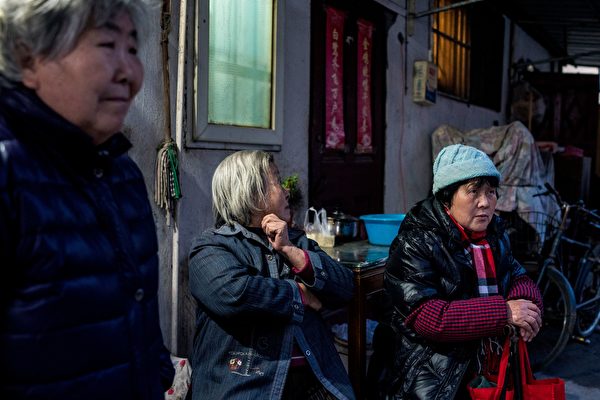
In recent times, the Chinese Communist Party (CCP) has launched the “Mutual Aid Elderly Care” model, with the cooperation of 11 departments including the Ministry of Civil Affairs, in an attempt to alleviate the imminent elderly care crisis by having “young elderly” individuals over 60 years old take care of the elderly.
Experts believe that under financial strain, the government’s push for this “low-cost” policy shifts the elderly care crisis to be “postponed, decentralized, and disguised”. With China facing a demographic shift, issues like rural family hollowing, extreme urban-rural welfare disparities, and high local debts, this “elderly mutual aid” social experiment may likely push many rural elderly into deeper poverty and disability traps.
According to Caixin and official guidance, the CCP government has set ambitious goals: by 2030, 70% of urban and rural communities must have “Mutual Aid Elderly Care” facilities; by 2035, a highly organized system must be established, relying on elderly individuals to provide voluntary services to each other.
While the concept traces back to the “Rural Mutual Happiness Home” in Feixiang, Hebei Province in 2008, the current economic environment has transformed the motivation behind its implementation. Professor Sun Guoxiang from Taiwan’s University of Nanhua, when interviewed by the Epoch Times, pointed out that the core reason for the CCP implementing this model is actually due to financial pressure, rural hollowing, family care breakdown, inadequate professional care supply, rather than being a true institution innovation.
He analyzed that this model essentially socializes and lowers the cost of elderly care responsibility, without professional training and stable subsidies, relying solely on neighborly goodwill may not be sustainable in meeting the long-term needs of the elderly.
Chinese issues expert Wang He shares a similar perspective. He told the Epoch Times that the CCP’s insufficient investment in elderly care is “to avoid government responsibility”. During financial tight situations, instead of cutting redundant personnel and waste in party and government agencies, the CCP has shifted a significant portion of this gap directly to the livelihoods of the people.
According to the Organization for Economic Cooperation and Development (OECD) 2025 “Asia-Pacific Social Overview,” Japan’s social security expenses reach about 25% of GDP, while China’s is only about 10% of GDP, far below the OECD average of around 21%.
The data highlights the severe situation of China’s demographics. According to the National Bureau of Statistics data in January 2026, by the end of 2025, China’s population aged 60 and above has reached 323 million (23%), while the birth population has decreased to 7.92 million, with a natural decrease rate of -2.41‰.
This also marks a complete reversal of the population structure: the proportion of elderly people over 65 (15.9%) has surpassed for the first time the population of children aged 0-14 (15.1%).
Sun Guoxiang emphasized that China’s issue lies in being “old before being rich”, showing “highly unbalanced aging between urban and rural areas”. Urban elderly usually enjoy more generous retirement pensions, medical resources, and support from their children, while rural elderly face challenges such as outflow of children, meager incomes, and distant medical care.
He believes that while Mutual Aid Elderly Care seems mutual, it actually reveals the state’s inability to bear long-term care costs, leading to transferring the burden to communities and younger elderly individuals, creating a structure of “low welfare, low cost, low professionalism”.
Wang He, through comparing data, pointed out that developed countries reach higher levels of per capita GDP when entering an aging society. For instance, when Japan entered into moderate aging in 1994, the per capita GDP nearly reached $40,000, while China, upon entering a similar stage in 2021, had just over $13,000.
The disparity in pension is even more striking: 180 million people in China receiving rural and urban resident pensions (mostly farmers) have an average monthly pension of around 200 RMB, whereas around 23 million retirees from government institutions receive monthly pensions plus allowances and benefits totaling over 6000 RMB, showing a difference of 30 times. Even urban retirees generally receive over 3000 RMB in monthly pension.
In 2025, the central government set the lowest standard for rural and urban resident basic pensions at 143 RMB. A post by blogger “Tang Chaolili” on the “Toutiao” website recently stated that in remote western rural areas, elderly people who did not pay additional fees can only receive this standard as a supplementary living allowance. In the central and western regions, rural resident basic pensions range from 153 RMB to 173 RMB per month, covering only partial daily expenses.
He provided examples like Heilongjiang with an additional 10 RMB provincial subsidy, totaling 163 RMB per month; Henan giving an extra 10 RMB to poor village elders, leading to 153 RMB monthly; and Sichuan providing a uniform 173 RMB per person per month.
The post continued to mention that in prosperous eastern regions, rural elderly can receive between 500 RMB and 705 RMB per month, such as 705 RMB in Suzhou, 515 RMB in Changzhou, 680 RMB in Jiaxing, and 650 RMB in Ningbo.
Furthermore, according to statistics from local social insurance bureaus, in 2024, only four provinces had an average rural pension income exceeding 500 RMB: 1753 RMB in Shanghai, 1524 RMB in Beijing, 563 RMB in Tianjin, and 510 RMB in Zhejiang; and nine provinces had less than 200 RMB, with the bottom five being 168 RMB in Jilin, 175 RMB in Guizhou, 182 RMB in Gansu, 185 RMB in Guangxi, and 185 RMB in Yunnan.
These rural pension incomes include “basic pension” and “individual account pension”, with the latter calculated based on personal contributions and local subsidies. In contrast, retirees from government institutions often receive not only the “basic pension” but also occupational pensions, financial subsidies, local allowances, medical welfare, etc.
Wang He bluntly stated: “The CCP’s current fiscal policy heavily favors interest groups; the so-called people’s livelihood protection, especially in elderly care, is a complete lie.”
In the vast rural areas, the outflow of labor has led to “aging hollow villages” transforming from isolated cases to regional crises. Sun Guoxiang described this structural risk as having “population but no youth; villages but no care capacity”.
As the number of administrative villages and natural villages continues to decline over the long term, rural spaces are shrinking, and elderly care issues have escalated from being private family matters to becoming tinderboxes in grassroots governance.
Wang He analyzed that in rural areas, if the elderly lose their ability to work and have no children to support them, they often fall into extremely dire circumstances.
Research shows that the “abnormal deaths” among rural elderly are closely linked to their quality of life, chronic illness and physical pain, empty-nesting and loneliness, the collapse of the traditional “raising children for old age” model with the outflow of young labor, leading to elderly suffering from loneliness, lack of support, and generally experiencing excessive physical strain.
“How can they take care of other elderly people when they have difficulty taking care of themselves?” Wang He questioned.
Reports from Caixin confirmed this dilemma. The initially praised “Feixiang model” is now facing difficulties due to unstable funding sources and inadequate capacity to accommodate disabled elderly individuals. In western mountainous areas, due to the lack of collective economic sharing, mutual aid centers are essentially non-functional, leaving most elderly people in isolated states of “solely relying on themselves for survival”.
Sun Guoxiang cautioned that this situation could lead to an array of dangers including lonely deaths, vulnerability and exploitation of disabled elderly, and grassroots cadres being forced to bear endless responsibilities.
Local CCP governments are now facing unprecedented difficulties due to the collapse of “land finance”. Ministry of Finance data showed that in January-February 2026, state-owned land use rights transfer income decreased by 25.2% year-on-year, while during the same period, “debt interest payment expenditures” grew by 22%, indicating that debt interest has become the fastest-growing rigid burden on local finances, severely squeezing the budget for people’s livelihoods.
The Mercator Institute for China Studies (MERICS) in Europe analysis pointed out that while social security spending has increased, over a third of it is used to subsidize retirement pensions for civil servants and institutional employees. Nearly one-third is used to subsidize the basic old-age insurance fund for the general public, with very little of the actual social welfare benefits reaching the elderly.
The MERICS report further revealed the policy priorities of the authorities: in the 2026 budget, the central government focused on science and defense, thus squeezing social security expenditures for people’s livelihoods.
Wang He pointed out that resolving the rural elderly care issue in China would only require an estimated 1 trillion RMB, relative to the government’s annual expenditure of over 40 trillion RMB, the issue lies not in financial capacity, “but in their unwillingness to spend on that”.
How long can the “small elderly care for big elderly” model truly sustain itself? Sun Guoxiang’s answer was: “Not for long”. He emphasized that this model can only serve as a short-term “stopgap measure”, unable to become the mainstay of long-term care. With an estimated 46 million disabled elderly individuals expected by 2035 in China, today’s caregivers will become care recipients in 10 years, and by then, a system lacking in professionalism, with low subsidies, relying on personal ties, is bound to malfunction.
Sun Guoxiang concluded, stating that the “Mutual Aid Elderly Care” policy does not solve the crisis, but merely postpones it, shifts it, and masks it. He warned that China’s elderly care is transitioning from a family problem to a financial problem, and then further evolving into a societal stability threat.