
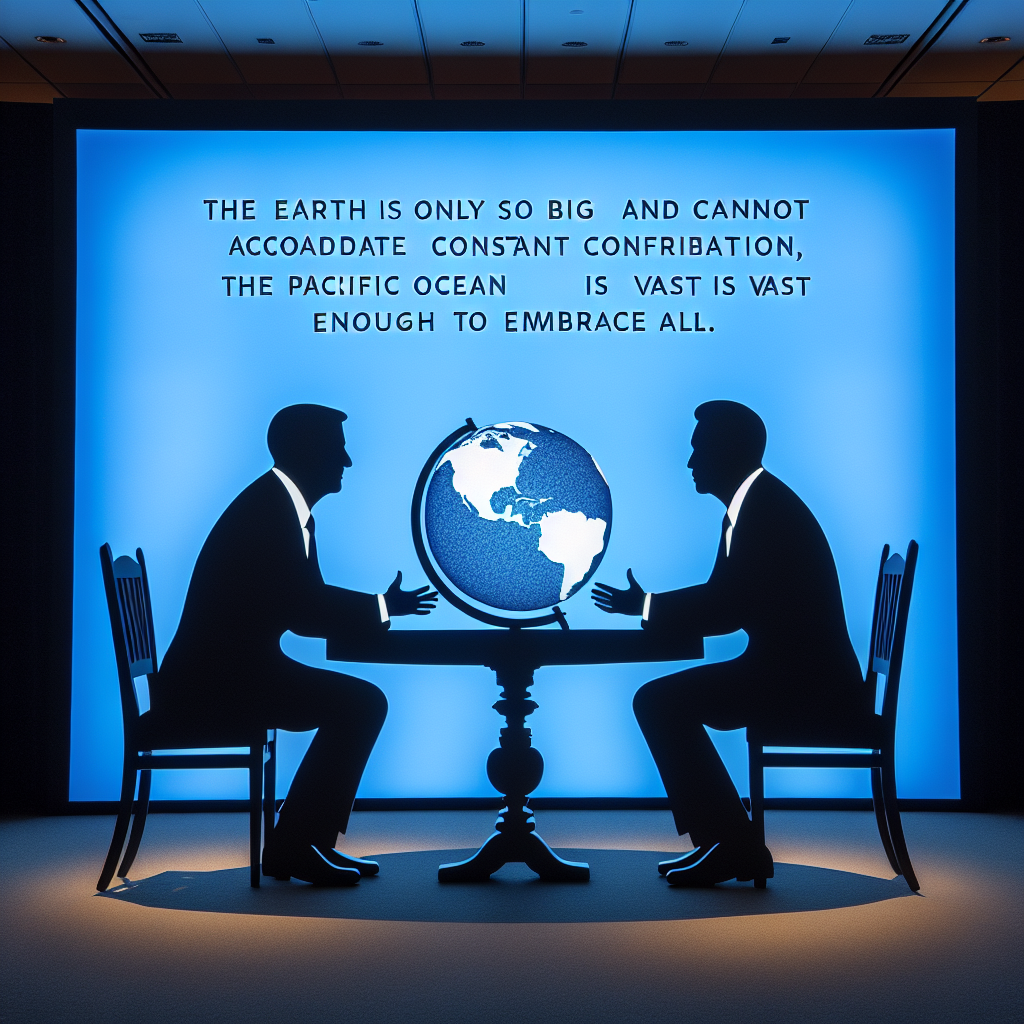
During the upcoming meeting between Trump and Xi, the Chinese Ministry of Foreign Affairs released a short video reiterating old statements, claiming, “The Earth is only so big and cannot accommodate constant confrontation between China and the United States; the Pacific Ocean is vast enough to embrace the beauty of both China and the U.S.” Experts believe that this soft talk from Beijing is aimed at dividing control of the Pacific and realizing their expansion ambitions, but it may not work well with Trump. With structural conflicts between the two countries, the Trump-Xi meeting is expected to have limited breakthroughs on substantive issues.
Official sources from China confirmed that President Trump will conduct a state visit to China from Wednesday to Friday, marking the first face-to-face meeting between the leaders since their summit in South Korea last October, and Trump’s first visit to China in nearly nine years. The visit occurs amidst increasing tensions in bilateral relations in areas such as trade, technology, and defense, with the fragile ceasefire between the U.S. and Iran taking effect recently, while Iran is seen as the “little brother” of China in the Middle East.
On May 11th, the Chinese Ministry of Foreign Affairs released a short video titled “Coexistence for Peace,” expressing the hope for China and the U.S. to move towards each other. The video suggests that while China and the U.S. may not change each other, they can change the way they interact, emphasizing that the Earth is not big enough for constant conflicts between China and the U.S., and the Pacific is wide enough to accommodate both sides beautifully.
Similar phrases like “The Earth is so big” and “the Pacific is vast enough” were previously used by Chinese leader Xi Jinping during his meeting with then-U.S. President Obama in 2013. Beijing has repeated these statements in various contexts concerning Sino-U.S. relations in recent years.
Regarding Beijing’s reiteration of old statements, Strategic expert Chung Chih-tung from Taiwan’s Institute for National Security Studies told Dajiyuan that China has been attempting to carve up the Pacific through the so-called “coexistence,” designating the East Pacific to the U.S. and considering the East Asia region in the West Pacific as China’s sphere of influence.
“This is China’s subjective attempt,” but Chung believes that this strategy from China may not work with Trump. The latest U.S. national security strategy report clearly indicates a plan to construct the first island chain and constrain China’s external expansionism. Trump aims to contain China’s involvement in Latin American affairs while actively maintaining current dominant positions in the Indo-Pacific region. Furthermore, the vast majority of Asian countries do not accept Chinese hegemony in East Asia, with countries like Japan hoping to have the U.S. balance China.
Su Zi-yun, Director of the Department of National Defense Strategy and Resources at Taiwan’s Institute for National Security Studies, told Dajiyuan that the short video released by Chinese official sources is a strategic propaganda, portraying Beijing as a lover of peace willing to share benefits with other countries. Given some conflicts between the U.S. and its allies, Beijing is using this opportunity to present itself as a stable and reliable partner.
Su also believes that China’s stance is effective in the short term but will eventually revert to the competition between the democratic camp and authoritarianism, highlighting a structural issue that Beijing finds hard to overcome.
On May 11th, the Chinese Ministry of Public Security announced that China and the U.S. jointly cracked a transnational drug trafficking case. Early the next day, the South Florida Prosecutor’s Office also issued a statement revealing progress in the case.
China affairs expert Wang He stated that China’s “coexistence for peace” slogan and cooperative gestures are merely superficial and lack substantive meaning. It is expected that the Trump-Xi meeting will not be easygoing.
On Tuesday (May 12), Chinese Foreign Ministry spokesperson Guo Jiakun reiterated at a routine press conference that China’s opposition to the U.S. arms sales to Taiwan is consistent and clear.
On Monday (May 11), Trump told reporters in the Oval Office that he would discuss the Taiwan issue with China during his visit, also promising to once again urge Beijing to release Hong Kong media tycoon Jimmy Lai. Xi Jinping is more likely to bring up the Taiwan issue during the Thursday and Friday meetings this week.
Chung Chih-tung noted that China is more concerned about the Taiwan Strait, while the U.S. focuses on the Strait of Hormuz. Trump hopes Beijing will press Iran for a peaceful deal with the U.S.; Beijing may leverage Trump’s interest in the Strait of Hormuz issue to raise the Taiwan question as a bargaining chip in negotiations.
On Monday, the U.S. Treasury Department announced sanctions on three individuals and nine companies, including four companies in Hong Kong, four in the UAE, and one in Oman, for assisting in Iran’s oil shipments to China.
Additionally on Monday, the U.S. Department of Justice announced that Eileen Wang, the Chinese Mayor of Arcadia, California, had been accused in federal court of acting as an illegal agent for the Chinese government and had agreed to plead guilty and resign from office.
Chung Chih-tung explained that amid the ongoing negative developments between the U.S. and China, there will be no significant changes in the Taiwan arms sales case or the Jimmy Lai case. The U.S. will not halt arms sales to Taiwan due to Chinese protests but instead demand Taiwan to take responsibility for its security and present a more extensive weapons procurement list to enhance its defense capabilities.
Chung emphasized that documents released by U.S. relevant agencies clearly indicate that China stands as the biggest comprehensive threat for the U.S., while Trump plays a role of a good cop. In the future, the U.S. and China cannot completely decouple economically like the U.S. and the Soviet Union during the Cold War; however, competition will intensify in security issues, especially in the Indo-Pacific region.
Wang He stated that Trump faces numerous constraints in his domestic governance, and there are intense internal struggles within the Chinese Communist Party, leading both sides to desire stable relations. However, on substantive issues like those concerning Iran or nuclear weapons, China is unlikely to yield easily. For China, Taiwan is a crucial issue, but Trump is unlikely to back down on the Taiwan arms sales; China hopes the U.S. will publicly oppose Taiwan independence, but it will likely be challenging to achieve.
“It is estimated that there will be no major breakthroughs on both sides. As Trump and Xi will have several more meetings later this year, this meeting is likely just paving the way,” he said.
Su Zi-yun pointed out that the Trump-Xi meeting is like the U.S. knocking directly on China’s door. In the future landscape, Beijing may have some successes, but they will be short-lived. Trump’s primary goal currently is to stabilize the U.S. midterm elections in September, with confronting China being a constant in his global strategic agenda.
Su highlighted that Trump’s strategic structure is unlikely to change significantly as Taiwan is too vital. It’s not only about semiconductors; Taiwan’s geographical location cannot be replaced, involving a core competition between the U.S. and China over maritime power. “The U.S. policy towards Taiwan will not undergo major changes, but tactically, Trump’s language may adjust.”
Regarding the potential discussion of Taiwan arms purchases at the Trump-Xi meeting, Su stated that it is not Trump initiating the discussion but Beijing consistently pushing for it. Beijing knows they cannot completely change U.S. policy towards Taiwan, so they adopt a tactic of gradual advancement.
In 1982, the U.S. had “Six Assurances” towards Taiwan, including commitments that the U.S. would not set an end date for arms sales to Taiwan and would not consult with the PRC on such issues. Su pointed out, considering this historical background, Beijing may raise the issue, and Trump will discuss it, but policies may remain unchanged.
Su warned Taiwan to be vigilant, as the “Six Assurances” do not have legal force. Therefore, Taiwan needs to strengthen its national defense independently, “Not panicking about whether Xi Jinping will attack Taiwan or whether the U.S. will sell weapons. It has been 30 years since the missile crisis in 1996; Taiwan needs to mature further and seek its own growth.”