
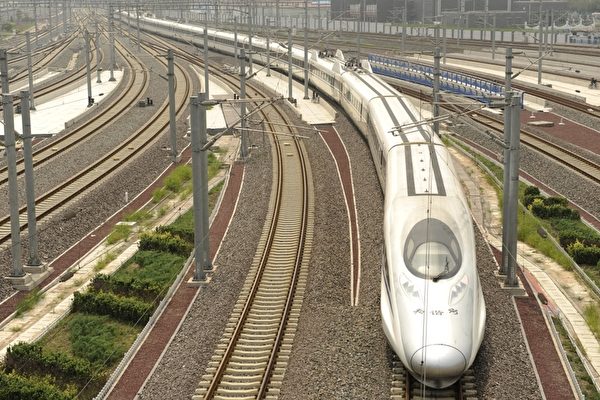
Recently, part of the Beijing-Shanghai high-speed railway line announced a 20% increase in ticket prices. Authorities claim this move is to “improve the market-based pricing mechanism,” but many internet users criticize the authorities for “snatching money.” Some scholars believe that disruptions in Iran’s oil transportation are pushing up China’s overall transportation costs.
On May 11th, the Beijing-Shanghai high-speed railway announced an “optimized adjustment” of ticket prices for the high-speed lines between Beijing and Shanghai, as well as the Hefei to Bengbu high-speed line. This adjustment includes a 20% increase in ticket prices for trains traveling at speeds of 300 to 350 kilometers per hour, and 200 to 250 kilometers per hour.
The company stated that this move is to “improve the market-based pricing mechanism” and announced that they will implement floating discounts based on the publicized ticket prices in the future. The announcement has sparked public attention on the mainland.
Mr. Zhu, a financial scholar from Anhui, told the reporter that this price hike is clearly related to energy pressures, and he believes that there may be more price increases to come. He explained that while high-speed trains do not directly consume gasoline or diesel as they are electric-powered, the generation of electricity requires coal, and the mining, transportation, and maintenance of the coal supply chain all involve significant energy and transportation costs. Any increase in these costs will impact electricity prices and subsequently lead to an increase in high-speed rail operation costs, reflected in ticket prices.
This price adjustment involves China’s core Beijing-Shanghai high-speed rail trunk line, which carries a daily passenger flow of approximately 500,000 to 700,000 people between Beijing and Shanghai.
Mr. Zhu estimated that with the current second-class seat price on the Beijing-Shanghai high-speed rail around 600 yuan, the 20% increase means an additional 120 yuan per ticket. Rough estimates based on the current passenger flow suggest that even if only a portion of passengers are subject to the increased prices, the daily additional revenue could reach tens of millions of yuan.
According to the announcement, this price increase mainly targets the upper limit of the publicized ticket prices, with the actual ticket prices to be determined by a floating mechanism. Officials stated that this move will help “improve the efficiency of ticket resource allocation” and “meet diversified travel demands.” However, many internet users criticize the authorities for shifting costs onto ordinary people under fiscal and energy pressures.
One internet user commented, “Prices are raised and they say it’s to meet customer demand.” Another said, “I used to find high-speed rail convenient, but now it’s getting more and more unaffordable.” Some users mentioned that ordinary train ticket prices have also been continuously rising over the years, with one saying, “The green train fares went up long ago, it used to be 34 yuan from Shanghai to Bengbu, now it’s 62 yuan.” Another mentioned, “When the Shanghai-Hangzhou line first opened, it was around 40 yuan from Shanghai, now it’s around 70 yuan.”
Some internet users connect this price hike to energy prices. One comment read, “Oil prices, electricity prices are going up, it will definitely translate into transportation costs in the end.”
The conflicts involving Iran led to the blockade of the Hormuz Strait, disrupting Iran’s oil exports. China is a major buyer of Iranian oil, and around 45% to 50% of China’s imported crude oil passes through the Hormuz Strait.
Economist Chen Cheng believes that the high-speed rail price hike is related to the current international energy situation, and that “this type of price increase will extend to more areas in the future.”
He told the reporter, “Most of Iran’s oil is sold to China. With the Hormuz Strait blocked, oil transportation may be hindered. China already relies on imported energy, and once transportation issues arise, the overall logistics, power generation, and railway system costs will increase.”
Chen Cheng stated that although China’s high-speed rail runs on electricity, it still depends on the entire energy system for support. He added, “Energy and transportation are closely intertwined. Fluctuations in coal, electricity, and oil prices will ultimately be reflected in the cost bills of railways and logistics. The ‘hoarding for price increase’ phenomenon in the market reflects strong expectations regarding energy price trends.”
For years, China’s railway system has been facing debt and operational pressures. According to Sina Finance, as of the end of 2025, the total assets of the National Railway Group exceeded 10 trillion yuan, with an asset-liability ratio of around 62.5%. Based on this, the total debt scale still exceeds 6 trillion yuan.
In recent years, the Chinese Communist Party has emphasized “expanding domestic demand” and “promoting consumption,” yet at the same time, costs in public sectors such as subways, hydropower, gas, high-speed rail, and airport services have continued to rise.