
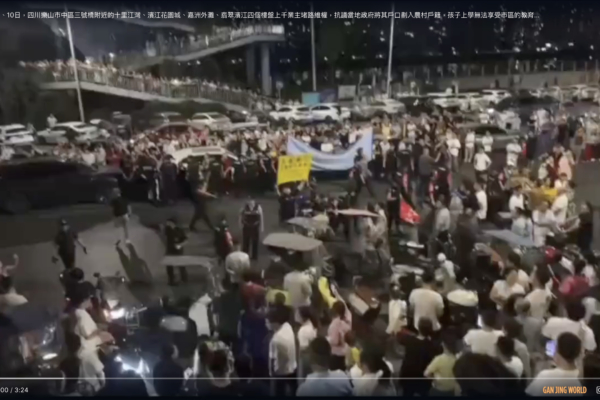
In recent days, over a thousand property owners in residential communities in Leshan City, Sichuan Province have taken to the streets to protest against the local government’s decision to classify their household registrations as rural, rendering their children unable to attend urban schools.
These property owners had originally purchased commercial housing built on state-owned land at high prices, but now they are being included in the village-level management system, sparking strong dissatisfaction. It has been reported that several protesting property owners have been detained by the authorities. This incident is not an isolated case but a concentrated eruption of long-standing contradictions between the household registration system of the Chinese Communist Party and the urbanization process.
On May 9th and 10th, thousands of property owners from Ten Li Jiang Bay, Riverside Garden City, Jiazhou Riverside Bund, and Emerald Riverside in Leshan City’s downtown district staged collective demonstrations near the Third Bridge, protesting the government’s decision to transfer their household registrations to rural areas. During the protests, some property owners temporarily blocked road traffic, resulting in multiple arrests by the police.
The protesting property owners stated that one of the main reasons for their home purchase was to obtain urban household registrations so that their children could access urban educational resources. The reclassification of their purchased properties as rural households has made it difficult for many property owners who have spent their life savings and are still burdened with mortgages to accept this change.
A joint petition indicated that all four communities in this area are commercial residential properties developed on state-owned construction land within the urban planning zone. All property owners legally purchased through the market and have been long-term residents, belonging to urban residents, not members of the Wuhuang Village collective economic organization, and do not benefit from the village residents’ welfare, have no collective land rights, and are not engaged in agricultural production activities.
The petition further pointed out that the entire area has no arable land, countryside courtyards, or rural settlements; it is entirely a modern urban residential community. Due to historical administrative issues related to urban expansion, it was temporarily managed by Wuhuang Village. However, the relevant departments have divided the area based solely on “village jurisdiction,” causing disparities in educational resources with the neighboring Emerald area which receives urban facilities and significantly unequal treatment in public services, which is deemed highly unreasonable.
This application not only presents the legal grounds of the property owners but also reveals the deeper challenges faced by the accelerated urbanization process.
One of the property owners from Emerald Riverside, using the pseudonym Li Yong, expressed on May 11th to Dajiyuan that what property owners find most unacceptable now is the sudden inclusion of their high-priced properties into the rural village-level management system, resulting in their children being deprived of the promised or expected urban educational resources.
According to him, one of the primary reasons many families purchased homes was for their children to attend urban schools in the future. He stated, “The issue remains unresolved—urban household registration, rural status, no access to urban education. These are all for our children’s education needs.”
Li Yong explained that his community is “just a bridge apart,” where the area under the bridge belongs to the Emerald district and can access urban educational resources, while the upper community has been classified under a different rural management.
“When we bought the house, we were told it was the same community. Now, children in the lower community can attend schools in the urban area, but children in our upper community can only attend schools in the town where our community is located,” he pointed out.
He emphasized the significant disparities in educational resources between town schools and urban schools. “Everyone bought a house to ensure their children could attend schools in urban areas. The educational resources in town schools are definitely not as good as those in urban schools,” he added.
Regarding the issue of property prices, Li Yong admitted that this incident has significantly impacted property prices in the community. He mentioned that he purchased his property in 2022 at an average price of over 6500, but currently, prices have dropped to slightly over 4000, nearing 5000. However, he indicated that for those like him with a self-occupancy need, the effect on them is not significant. The core conflict lies in the educational issue.
Another property owner directed their anger towards the substantial disparity between the sales promises made by the developer and the current reality.
A property owner from Ten Li Jiang Bay, using the pseudonym Chen Huizhu, told Dajiyuan that when they bought the house initially, the developer had mentioned that their children could attend urban schools in the future. She said, “They told me back then that children could attend schools in the Xujiabian area, but it turned out not to be the case.” The sudden reclassification into rural management in the past two days has triggered strong emotions among property owners.
“If we are classified as rural now, children can only attend schools in the town,” she added.
In her view, this not only impacts children’s education but also fundamentally changes the nature and value perception of the properties. “We bought expensive houses, and now our children cannot attend urban schools,” she expressed. “Being put under village management means being classified as rural, and these expensive houses become rural properties.”
Chen Huizhu believed that she and many property owners spent millions to purchase commercial housing to obtain urban lifestyle and educational resources, but now they feel “downgraded.”
“Why pay over a million for a rural house? You can build a house in the countryside for much less. It’s very tragic,” she lamented.
Another property owner, Zhou Hongwei from Riverside Garden City, expressed to Dajiyuan that what property owners are most dissatisfied with is the developer’s long-standing promotion of concepts such as “Emerald Community” and “school district housing” during the purchase, but now the four communities have been classified under rural village-level management.
“We purchased expensive houses, and the developer promoted them as school district houses; this area is the Emerald community, and the land was sold by the government to the developer. Now, they have classified our four communities as rural,” Zhou Hongwei stated.
He believed that the most significant impact remains on children’s education issues. “Children cannot attend the schools previously advertised, expensive commercial housing now becomes rural household, relocated to the town. The teaching quality will definitely diminish. Can the town public schools match the quality of city schools?”
Zhou Hongwei mentioned that he spent 600,000 yuan on purchasing his house and nearly 800,000 yuan on renovations. “Others spent over a million too,” he said, but now “house prices have dropped significantly.”
Zhou Hongwei particularly questioned why commercial housing would be included in the rural management system. He asked, “Some have already transferred their household registrations, directly into Wuhuang Village. The issue is, how could commercial housing be put under rural management and rural household registrations?”
He stated that many families emptied their savings, took out loans to purchase houses, with the aim of providing their children with better educational opportunities. “We spent tens or hundreds of thousands to buy houses to give our children better education, not expecting this outcome.”
In his opinion, the root of the problem lies in the fact that the land originally belonged to the village collective but was later sold by the government to developers for commercial housing development. “Because this land belongs to Wuhuang Village, the government sold it to developers, earning money from us but does not want to take responsibility and passes it over to the village.”
Zhou Hongwei also revealed that property owners held multiple documents proving their affiliation with the urban area. “Our property certificates, gas receipts all state ‘Emerald Road, downtown district’,” he said. Since they are classified under rural management, theoretically, they should be entitled to the corresponding village collective rights, but the reality proves otherwise.
He further questioned, if they were clearly informed that they belonged to rural management initially, many people would not have made the purchase. “If they mentioned it was rural when we made the purchase, we would definitely not buy houses here. We have invested our hard-earned money, still have loans to pay off.”
Regarding the developer’s promotion issues, he raised a counter-question: “I bought my house in 2022, should the developer inform the government about their sales promotions?”
Zhou Hongwei mentioned that it involves “four developments, thousands of units, tens of thousands of people,” noting that “almost every family has children.” Many property owners are feeling extremely disappointed.
Regarding the current situation of safeguarding their rights, he mentioned that when property owners sought explanations from the government, the officials even claimed they had made a mistake. “The government saying things like that is nothing but deceit,” he remarked.
According to Zhou Hongwei, “Over a thousand property owners are involved in safeguarding their rights, and five or six people have already been arrested.”
Therefore, many property owners have decided to continue safeguarding their rights. “We are preparing to petition and report to Beijing,” he added.
He revealed that currently, property owners have decided to give the government one month to resolve the educational issues and have organized the selection of representatives from each building to communicate with the relevant departments.
The large-scale civil protest in Leshan is not an isolated incident. In June 2024, villagers from Luoli Dam Village in Leshan, Sichuan, surrounded the gates of the Yanlanzhou Tianlai construction site, protesting against the local government’s use of land leased from villagers for housing development.
In fact, the aforementioned rights protection incident in Leshan is just a microcosm of the long-standing contradictions in the household registration system of the Chinese Communist Party and the urbanization process.
In July 2024, the State Council of the Chinese Communist Party issued the “Five-Year Action Plan for the New Urbanization Strategy,” announcing a new round of “agricultural population transfer to urbanization” actions, aiming to increase the urbanization rate of permanent residents to nearly 70% within five years.
The plan stated, “Loosening and relaxing residency restrictions except for certain super-large cities, adopting a household registration system based on the place of regular residence. Fully implement the cancellation of residency restrictions for cities with a permanent resident population of less than 3 million, fully relax the requirements for permanent residency in cities with a population of 3 to 5 million. Improve the points-based residency policy for cities with a permanent resident population of over 5 million super-large cities, encouraging the removal of annual residency quotas.”
Professor Xie Tian from the Darla Moore School of Business at the University of South Carolina previously explained to Dajiyuan, “The Chinese economy is in recession and urgently needs people to absorb the excess real estate in cities. The real estate problem is very severe because it involves financial institutions.” He mentioned that the Chinese Communist Party’s introduction of a new round of the “agricultural population transfer to urbanization” action plan is actually targeting the money and land in the hands of farmers.
Associate Professor Feng Chongyi from the University of Technology Sydney in Australia stated, “Currently, China faces three major crises: a real estate crisis, a financial crisis, and a government fiscal crisis. Authorities lack effective solutions because they have run out of money and lack a ‘white knight’ to revive the real estate market. Therefore, they are looking at rural areas, particularly at those who have made some money in the cities to act as ‘white knights.'”
(For security reasons, the interviewed property owners Li Yong, Chen Huizhu, and Zhou Hongwei mentioned above are pseudonyms.)