
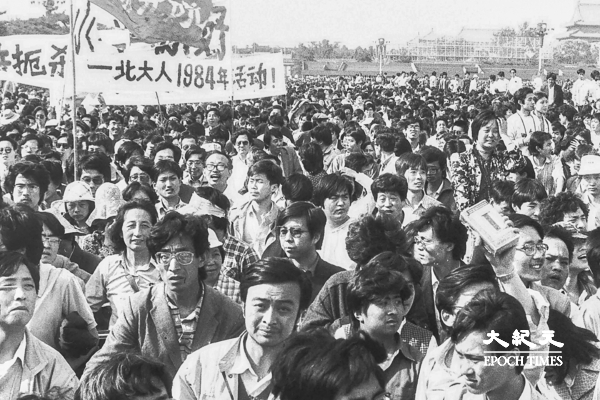
On June 4th of this year marks the 37th anniversary of the Tiananmen Square protests, and security has been tightened in and around Beijing’s Tiananmen Square. Beijing residents have informed reporters that multiple routes leading to the square have been closed off, and there is a noticeable presence of police officers and plainclothes personnel near the Great Hall of the People.
On June 4th, Liaoning visitor Ms. Liu, who is currently in Beijing, told Epoch Times during an interview that there are numerous guard posts and police cars along the 200-meter stretch from the front gate to Tiananmen Square. She mentioned seeing many police cars and plainclothes vehicles parked in areas where parking is typically not allowed and shared an encounter with an out-of-town visitor who inquired about the heavy police presence upon learning it was the anniversary of the “June Fourth” incident.
Another visitor, Ms. Zhao, disclosed to reporters, “There are police cars parked at Liubukou, Nanchang Street, the alley entrance west of the Great Hall of the People, and street intersections. People passing by are required to show their IDs, and visitors are immediately taken into parked cars upon identification.” She also mentioned that security measures this year are particularly strict and that even the Tiananmen Mothers were reportedly not allowed to visit the cemetery to pay their respects.
A resident in Nanchizi revealed to reporters that security measures around Tiananmen Square are significantly heightened than usual, with increased inspections required to enter specific areas. He described encountering more police cars on the streets, police officers stationed inside vehicles, and a police officer at a street corner checking IDs using a card-reader for entry onto Chang’an Street.
The unnamed resident further explained, “Although the area around the square is usually tightly controlled, today is different. Some intersections are entirely sealed off. The alley entrance near the Great Hall of the People is also guarded by police and plainclothes officers. If you linger for a moment, they will come over and inquire about your business because today is ‘June Fourth.’ The number of years has been forgotten, but the events of that year remain vivid in memory.”
The resident recounted that on the anniversary of “June Fourth,” there are police officers along Tiananmen Square, Chang’an Street, and nearby subway exits, with military personnel seated inside underground tunnels observing passersby. He mentioned that most older citizens are aware of the significance of the day, but no one dares to openly mention “June Fourth.”
Internet platforms in mainland China are also under increased scrutiny. Several netizens informed reporters that leading up to and following June 4th, platforms such as WeChat groups, Moments, Weibo, Xiaohongshu, etc., have noticeably tightened restrictions on discussions, censoring content that would normally be permitted.
An active netizen, Mr. Qin, stated, “This year, there is a lack of any content related to June Fourth on WeChat groups. Last year, there were posts with candles, white flowers, and I shared them too. But this year, no one is sharing such content. The state security officers warned me that sharing a June Fourth image could lead to a 10-day detention, and he would also face reprimand.”
In reviewing over twenty chat groups, reporters observed discussions related to Iran, Hamas, and Ukraine but found no mention of “June Fourth.”
Beijing human rights advocate Mr. Zhou informed reporters that many people have been subjected to increased monitoring and stability maintenance measures this year. He disclosed, “I am also under surveillance. There is a car downstairs instructing me not to access the external internet for a few days until June 6th.”
For over thirty years, on the anniversary of “June Fourth,” some netizens would express their condolences through candlelight visuals, white flowers, black and white images, the number “8964,” homophonic puns, etc. However, this year, such content has vanished from social media and group discussions. Mr. Zhou remarked, “The silence in the groups is suffocatingly eerie. I envy those overseas.”
On June 3rd, Taiwan’s Mainland Affairs Council issued a statement urging the Chinese Communist Party to confront the historical truth of “June Fourth” and respond to the public’s demands for fairness, justice, basic rights, and citizen participation. The council highlighted that the youth who participated in the 1989 movement held reform ideals, yet Beijing has failed to provide historical justice to relevant individuals. The statement cited the 30th anniversary of Taiwan’s direct presidential elections as evidence that the democratic system is suitable for the Chinese community and called on Beijing to respect the choices of the Taiwanese people, cease military and political pressure on Taiwan, and initiate dialogue on the basis of equality and dignity. On the evening of June 4th, various civil organizations in Taiwan will hold a commemorative event for the June Fourth anniversary.