
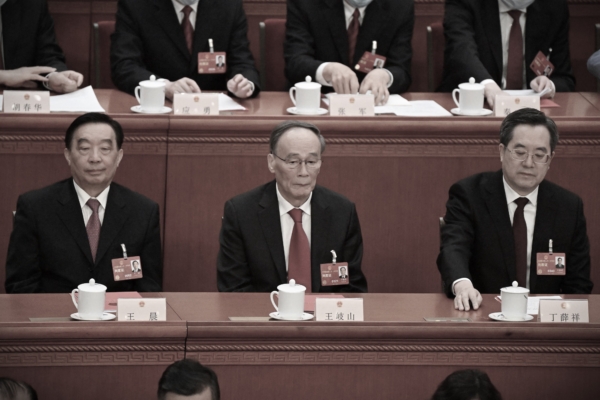
On June 2, former Director of the Central Commission for Discipline Inspection of the Chinese Communist Party, Li Xiaohong, was officially announced to have been taken down from his position. Li Xiaohong, 73 years old, has long held important positions in the financial system and is considered a key political secretary and core staff member for the former Secretary of the Central Commission for Discipline Inspection, Wang Qishan. The two worked together in the Beijing Municipal Government in their early years and later collaborated for an extended period in financial regulation and the Central Inspection Team. Li Xiaohong is the latest to fall from Wang Qishan’s inner circle. With this, almost all of Wang Qishan’s former core secretaries have been ousted.
Dong Hong, known as the “grand secretary in Wang Qishan’s circle,” and former Deputy Director-General of the Central Inspection Team, was investigated in 2020 and sentenced to death with reprieve in 2022. Tian Huiyu, who served as a secretary during Wang Qishan’s time at Construction Bank and former CEO of China Merchants Bank, was taken down in 2022 and sentenced to death with reprieve in 2024. Zhou Liang, Wang Qishan’s most trusted “top secretary,” who had followed Wang Qishan for over twenty years and previously served as the Deputy Director-General of the former State Administration of Financial Supervision, was investigated while in office in March 2026.
From 2012 to 2017, Wang Qishan helped Xi Jinping eliminate a large number of political enemies, creating a stance of anti-corruption between Xi and Wang. However, now all of Wang Qishan’s former associates and core secretaries have been taken down.
Senior media figure Li Su, on New Tang Dynasty Television’s “News Talk,” mentioned that the cleansing of Wang Qishan’s former associates is not due to any personal grudge between Xi Jinping and Wang Qishan. In fact, it is rumored that Xi Jinping had once stayed at Wang Qishan’s place, with the two even sharing a blanket. Initially working in the financial field, Wang Qishan was specifically appointed by Xi Jinping as the Secretary of the Discipline Inspection Commission to help with the anti-corruption campaign. Wang Qishan effectively helped Xi Jinping eliminate dissidents under the guise of anti-corruption, strengthening Xi’s political position. Xi Jinping also returned the favor by appointing Wang Qishan as Vice President for four years when he turned 70, a retirement age, allowing Wang to attend meetings of the Central Political Bureau Standing Committee, colloquially referred to as the eighth member.
Li Su analyzed that although it is unlikely that actions will be taken against Wang Qishan himself, there is a high possibility that those around him will be targeted. In today’s era where everyone is corrupt and power-hungry, there is little room for error. Li Su pointed out three reasons behind the purification of Wang Qishan’s allies:
First, there is skepticism about their loyalty to Xi Jinping as they were originally promoted by Wang Qishan, not Xi Jinping. Even if these individuals are loyal to Xi Jinping, Xi may not trust them entirely.
Second, there is a need to make room for others within the system. Regardless of Wang Qishan’s previous achievements and capabilities, having been retired for some years, in Chinese politics, personal charisma and influence wane once power is lost.
Third, the Chinese Communist Party is facing financial constraints, squeezing out ill-gotten gains from these individuals to replenish the national treasury, simultaneously using them as a warning to others.
Li Su concluded by saying that ultimately, the fate of those associated with Wang Qishan lies mostly in corruption issues, with various outcomes possible. However, the targeting of individuals at the bureau or deputy bureau levels may not necessarily involve Xi Jinping’s intervention but could be driven by internal political struggles.
Henghe, host of “Henghe Commentary,” agreed with Li Su’s analysis, indicating that at present, Xi Jinping is unlikely to take direct action against Wang Qishan. The essential factor is that Xi Jinping does not need to protect Wang Qishan’s allies since combating corruption is a critical aspect of his governance philosophy.
The issue of combating corruption is vital for Xi Jinping, not just to eliminate political adversaries, but to thoroughly cleanse the party internally. Like Mao Zedong’s perpetual revolution concept, Xi Jinping aims to reform the Communist Party by rooting out internal impurities, truly believing in the process. Therefore, the crackdown on corruption is indispensable unless there are special reasons for protection. Xi Jinping employs this method to carry out self-revolution and continuity of revolutions within the party, striving to preserve the party’s purity. Although their strategies differ, their core ideologies align in self-cleansing the party.
Individuals under Wang Qishan are mainly entrenched in the financial system, where corruption is rampant. They had also participated in anti-corruption efforts alongside Wang Qishan, during which the inspection teams were notoriously bribed, surpassing the amounts extorted from those they targeted. Hence, the chances of Wang Qishan’s subordinates facing scrutiny are higher, and Xi Jinping is unlikely to intervene to safeguard them.
Li Xiaohong, long seen as a backbone in Wang Qishan’s financial regulatory and central inspection systems, is believed by Dr. Chen Wenjia, a Ph.D. from Osaka University of Commerce and Vice President of Kainan University, not to have fallen solely due to an anti-corruption case but signifies the beginning of a new phase in the CCP’s high-level power structure focusing on de-factionalization and de-historicization. He explained this from two perspectives:
First, it is not so much about anti-corruption as it is about political asset clearance. Since the 18th National Congress, Wang Qishan led the anti-corruption movement and was one of Xi Jinping’s most crucial political allies. However, a characteristic of CCP politics is that while power can be shared, influence cannot be continued. Once the leader consolidates power, those who facilitated their rise often become potential risks, leading to the clearance of old associates and even the systematic removal of political networks.
Second, Xi Jinping aims to reshape the mid-level structure of the disciplinary inspection system. During Wang Qishan’s era, a robust disciplinary culture was established, with the disciplinary commission known as the party’s sword. However, from current developments, Xi Jinping does not wish to retain any vestiges of Wang’s influence in the disciplinary system. Individuals like Dong Hong, Tian Huiyu, Zhou Liang, and now Li Xiaohong, are all characterized by their long political ties with Wang Qishan. As these figures gradually exit the stage, the disciplinary system and financial regulatory system will fully transform into Xi’s camp. In other words, Xi Jinping’s current objective is not corruption eradication but addressing the network issues stemming from historical connections.
Concerning whether Li Xi would become the next Wang Qishan, Chen Wenjia believes that while the short-term probability is low, there exist long-term risks. Wang Qishan’s background in the financial system, Beijing’s municipal government, and ties to the “red second-generation” provide him with an independent political capital and network. In contrast, the current Secretary of the Discipline Inspection Commission, Li Xi, mainly depends on Xi Jinping while his power stems from Xi’s authorization or his own faction. Nevertheless, in CCP history, the higher an individual’s power, the more likely they become a target for prevention and clearance, suggesting that Li Xi may face a situation similar to Wang Qishan’s at some point.
Chen Wenjia emphasized that Li Xiaohong’s downfall is not about Wang Qishan’s personal fate but signals from Xi Jinping to the entire party: even those who previously helped solidify Xi’s control may gradually become marginalized and eventually purged if they form independent political networks.
He stated that this is a recurring pattern within CCP’s power dynamics, where anti-corruption leads to power concentration, followed by a new wave of corruption, triggering another anti-corruption campaign. This self-supervision system within the CCP cannot fundamentally eradicate its corruption issues and ultimately devolves into political purges.
Refer to the video “News Talk” – The Sad Purge of Former “Anti-Corruption Heroes,” Will Li Xi Be the Next Wang Qishan?