
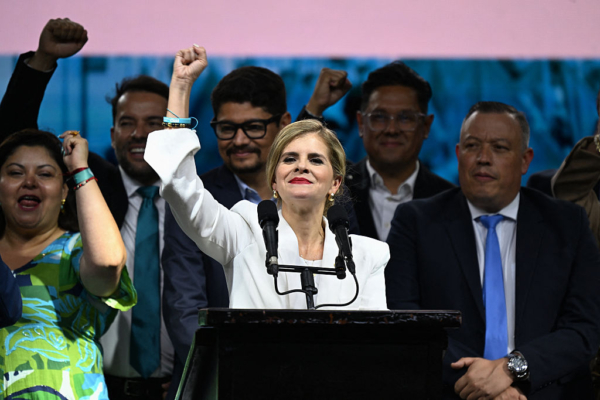
Local time on Sunday (February 1st), Costa Rica in Central America held presidential and parliamentary elections. The results are in, with Laura Fernandez, the candidate for the conservative populist Sovereign People’s Party (PPSOS), winning the election.
The report from the Supreme Electoral Court shows that with 93.79% of the votes counted, Laura Fernandez has received 48.33% of the votes. In second place is the socialist party National Liberation Party (PLN) candidate Alvaro Ramos. As Fernandez has surpassed the 40% legal threshold for victory, her direct election has been confirmed without the need for a runoff on April 5th.
Ramos conceded defeat on Sunday evening (February 1st), promising to lead a “constructive opposition”. At the same time, incumbent President Rodrigo Chaves congratulated Fernandez on her election.
Twenty candidates competed for the presidency in this election, but preliminary results show that besides Fernandez and Ramos, the other candidates did not reach a 5% vote share.
Voting began at 6:00 am on Sunday and ended at 6:00 pm. Approximately 3.7 million Costa Rican voters were eligible to vote.
After Ramos conceded defeat and President Chaves congratulated Fernandez on her victory, Fernandez addressed her supporters with words of gratitude for her win.
She stated: “Costa Rica has made a choice, to continue on the path of change. This change aims to revitalize and improve the democratic system, returning power to the sovereign people, and creating greater well-being and prosperity for the nation.”
She emphasized: “The Sovereign People’s Party has given me a clear mission: the change will be profound and irreversible.”
As Fernandez announced her victory in the capital of San Jose, surrounded by supporters, she promised to usher in a new political era for Costa Rica.
During her campaign, Fernandez pledged to continue the populist policies of the Chaves government, including promoting constitutional reform and implementing strong security policies to combat crime amid a surge in drug-related violence.
Costa Ricans simultaneously voted for 57 National Assembly members. Fernandez’s party is expected to expand its seats and potentially gain an absolute majority, granting the party important powers such as appointing judges to the Supreme Court.
At 39 years old, Fernandez previously served as a political advisor and public servant in the Costa Rican Ministry of Planning and Economic Policy, before being appointed as a minister by President Chaves in 2022.
A staunch supporter of Chaves, Fernandez has also served as his chief of staff.
Pilar Cisneros, leader of the parliamentary government party and seen as a key figure in Chaves’ administration, revealed that Fernandez was endorsed by President Chaves and around ten core members of his team.
Cisneros stated: “Few people understand the country as well as she does – she knows where the core issues lie in every department.”
Fernandez, known for her dramatic speaking style and passion for dance, often showcases her dance moves at campaign rallies. She was born in the coastal city of Esparza in the Puntarenas province and grew up in San Jose.
Married and with a young daughter, Fernandez, who upholds conservative Catholic beliefs and emphasizes family values, has gained support from the growing evangelical voters in the country.
She openly admires Salvadoran President Nayib Bukele for his tough approach to combating crime and gangs, pledging to implement stringent security policies in high-crime areas. She has also vowed to build a high-security level mega prison modeled after El Salvador’s “Counterterrorism Detention Center” (CECOT).
Fernandez will become Costa Rica’s second female president after Laura Chinchilla, who served from 2010 to 2014.
(This article referenced reports from Reuters and the Associated Press)