
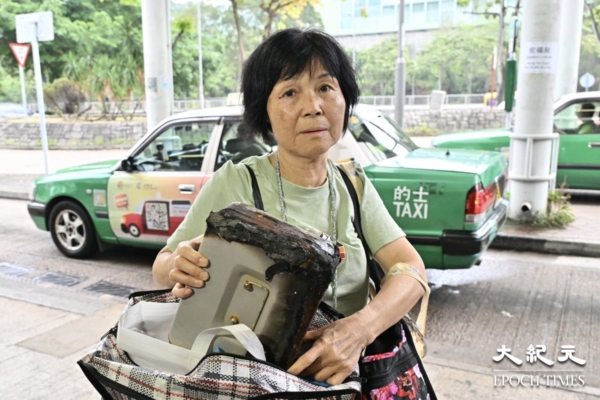
Residents of Hong Kong’s Grand Pau Estate were allowed to return to their units to collect belongings starting on the 20th. The first batch involved residents of Hong Sun House. Many residents came prepared with tools such as shovels, folding carts, suitcases, and red, white, and blue plastic bags to sift through the ashes. Some were able to retrieve valuable documents and sentimental jewelry amidst the debris.
Ms. Tsang, resident of Unit 104, described her entire home as a pile of garbage covered in ashes. She could only salvage a few mementos as the entire place was covered in soot. The unit had no water supply, with shattered and rotten stones scattered on the ground. All items were severely damaged by the fire. The refrigerator and washing machine were completely burnt, leaving only the outer shells. The toilet and sink were shattered, and stones from the walls had fallen out.
Although social workers had shown her photos of the unit beforehand, preparing her for the melted state, the actual return was still shocking. She emphasized that her main goal was to take photos for herself and friends and family to remember.
Initially hoping to take some items, Ms. Tsang ended up only leaving with a jewelry box that was originally under the bed. Covered in a large amount of ashes, she felt lucky to have retrieved this sole item, stating, “This is the only thing I could salvage from the whole house.” Despite the box’s damaged exterior, she planned to open it and inspect its contents at home.
Ms. Tsang revealed that the process of returning to the unit for cleanup was smooth, taking her only an hour. While she left early, other residents were still sorting through their belongings. Due to living on a lower floor, she found climbing up much easier, unlike residents on higher floors who had to wear masks and hats and were more prone to respiratory issues.
She wasn’t worried about theft as she had seen the burnt window frames while passing by after the fire, confirming the extensive damage and ruling out any concerns about theft.
Mr. Leung, residing on the 9th floor, noted that upon entering the unit, he found it completely burnt to ashes. With prior knowledge from photos, he expected to only salvage a few pieces of gold jewelry as other items were unrecoverable.
Successfully retrieving his most sentimental item, his wedding ring, Mr. Leung’s emotions remained relatively stable, feeling that finding the ring was sufficient without much excitement. Remembering where the gold jewelry was placed beforehand, he swiftly located it due to its reflective nature, emphasizing that “real gold fears no fire,” as the jewelry managed to withstand the flames.
Mr. Leung considered the 3-hour process sufficient for him before leaving the scene early. He expressed satisfaction with the government’s arrangements, describing the entire experience as comfortable, well-cared for, and smooth. He confirmed that there was no water seepage in the unit, keeping it dry.
Mr. Leung found no danger in using the stairs, as officials carefully guided residents irrespective of their pace, ensuring a swift and secure arrival at their units. With clean staircases and stable handrails under close monitoring, the chance of accidents was minimal under such arrangements.
He advised other residents to follow the authorities’ instructions and recommended preparing extra clothing due to the hot environment, making clothes prone to dirt. After cleanup, residents were provided with umbrellas and raincoats.
Ms. Cheng, living on the 3rd floor, along with three family members focused on retrieving documents and a few valuable belongings. Accompanied by a social worker, they left at 9 a.m., registering at the community hall and receiving supplies. They were then escorted to the designated area to exchange items before being led to their units by staff and civil patrols. Ms. Cheng spent about three hours upstairs.
Describing her unit’s destruction as completely burnt to ashes with no furniture left, Ms. Cheng estimated that one-third of the space was buried under ash upon entry. The possibility of cabinet collapse due to the fire led to an ash layer that provided some protection. She found that approximately 80% of the documents in the cabinet were intact with some remaining.
Ms. Cheng indicated that the 3-hour cleanup period was enough for her, given the thorough burning of the unit. She felt that the government’s arrangements were acceptable, describing them as “okay.”
Regarding rumors about restrictions on photography, Ms. Cheng clarified that photos were permitted inside units but restricted in public areas outside units for scene protection. She had been reminded downstairs not to photograph other people’s belongings.
With no high expectations beforehand, Ms. Cheng wasn’t particularly disappointed. Having lived in Grand Pau Estate for many years, the return to her unit made her profoundly sad. Planning to bid farewell downstairs before rushing through the upstairs cleanup, where she quickly took photos and left within 3 hours.
During the operation, residents were only allowed to remain on their floors and units, with limited interactions among themselves due to time constraints focused on cleaning personal belongings. She mentioned having no plans for another visit at the moment.
On the first day of the cleanup operation, an accident occurred. At around 4 p.m., a 74-year-old resident on a lower floor felt shortness of breath and dizziness as she prepared to leave after cleanup. She was assisted onto a stretcher bed by staff upon request for help and taken to Tai Po Nethersole Hospital for treatment while remaining conscious.
The government reported that 78 households from Hong Sun House registered for the first-day operation with 11 cases of reported missing possessions to the police. Authorities reminded residents to mentally prepare before heading upstairs and assess if they were physically able to endure the demands of climbing.
This news was translated and rewritten for a broader English-speaking audience to understand the recent events at the Grand Pau Estate in Hong Kong where residents were allowed to return to their units after a fire incident to retrieve their belongings.