
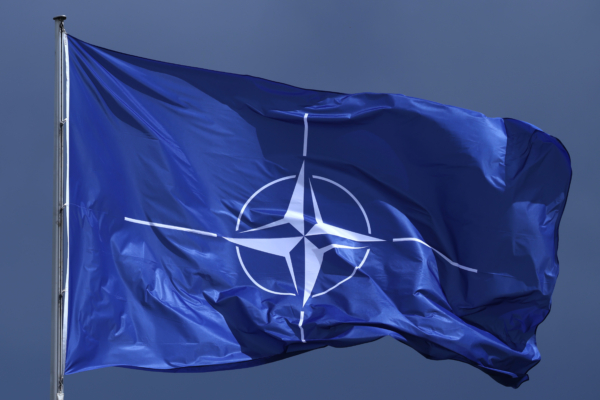
NATO criticized Russia and China’s nuclear policies on Tuesday, April 21, accusing Russia of “violating key arms control commitments” and China of continuing to “rapidly expand its nuclear arsenal” in a lack of transparency. As an international conference approaches, the military alliance urged cooperation between China, Russia, and the United States.
In a statement, NATO’s 32 member countries emphasized their “firm commitment to full compliance” with the Treaty on the Non-Proliferation of Nuclear Weapons (NPT). Since its inception in 1970, the NPT has been a cornerstone of global arms control.
The statement comes ahead of the treaty’s review conference scheduled to be held next week at the United Nations headquarters in New York. The North Atlantic Council of NATO stated in the declaration that “Russia has violated key arms control commitments and taken irresponsible provocative nuclear rhetoric. China continues to rapidly expand and diversify its nuclear arsenal in a lack of transparency.”
NATO Assistant Secretary-General, Boris Ruge, cited examples such as Russia testing its nuclear-capable Oreshnik intermediate-range ballistic missiles twice in Ukraine, as evidence of Moscow’s irresponsible “nuclear signaling.”
He remarked, “Today, we are dealing with Russia, which has withdrawn from all significant arms control agreements, is developing various nuclear delivery systems, and engaged in the largest scale war in Europe since 1945.”
Russia had previously stated in February that it would remain a responsible nuclear power after the expiration of the New START treaty, which set limits on the number of missiles, launchers, and strategic nuclear warheads for both the US and Russia.
The Russian government also criticized NATO member France’s plans to expand its nuclear arsenal, calling it a “highly destabilizing” move that poses a potential threat to Moscow.
Ruge defended France’s actions, labeling them as “appropriate, rational, and transparent responses to the threats we face.” He emphasized, “We are a defensive alliance. We do not brandish nuclear weapons, nor do we make irresponsible nuclear statements, a type of rhetoric we frequently hear from Mr. Putin.”
China, on the other hand, refuted Western criticism of its lack of transparency in expanding its nuclear capabilities. A spokesperson for the Chinese Foreign Ministry stated on Monday, April 20 that China has always maintained its nuclear power at the “lowest level required for national security” and would “never engage in a nuclear arms race.”
However, estimates of nuclear arsenals in various countries present a different picture. According to the Federation of American Scientists, Russia possesses approximately 4,400 nuclear warheads, followed by the US with 3,700 warheads, China ranking third with 620 warheads, exceeding France’s 290 and the UK’s 225 warheads.
Unlike the longstanding arms control communication channels between the US and Russia, Beijing has consistently refused substantive nuclear arms control negotiations with the US, citing its much smaller nuclear arsenal size compared to the US and Russia. However, the Pentagon predicts that by 2030, China may have over 1,000 nuclear warheads, posing a significant threat to regional strategic balance with its rapid and opaque growth.
Ruge expressed NATO’s hope that the upcoming review conference would reach a consensus document emphasizing transparency, risk reduction, and strategic stability. While previous conferences in 2015 and 2022 did not achieve a joint statement, Ruge emphasized that this would not undermine the importance and effectiveness of the NPT treaty itself.