
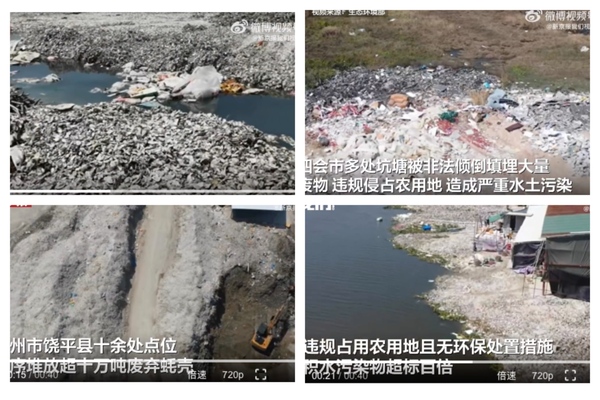
On June 2nd, the topic of “Over 100,000 Tons of Abandoned Oyster Shells in Chaozhou, Guangdong Province” trended on social media.
According to the report by the Central Committee of the Communist Party of China on Ecological and Environmental Protection Inspections on June 2nd, the illegal dumping and landfilling of solid waste in Zhaoqing and Chaozhou, Guangdong Province, have caused severe water and soil pollution.
In Roping County, Chaozhou City, there are a large number of oyster processing sites where oyster shells are haphazardly dumped, with some dumping sites also containing large amounts of household garbage. Twelve illegal oyster shell dumping sites have not taken pollution prevention measures such as leakage prevention. The total amount of dumped shells exceeds 100,000 tons, covering an area of 148.3 acres, including 44.8 acres of agricultural land (including 5.6 acres of permanent basic farmland). Sampling monitoring shows that the chemical oxygen demand, ammonia nitrogen, and total phosphorus concentrations in the accumulated water at the dumping sites are 2470 milligrams per liter, 412 milligrams per liter, 31 milligrams per liter, respectively, exceeding surface water environmental quality Class III standards by 122.5 times, 411 times, and 154 times, respectively.
In some areas of Sihui City in Zhaoqing, there has been a long-standing issue of using ponds for dumping and burying solid waste. One of the ponds has accumulated approximately 80,000 tons of solid waste, encroaching on about 36 acres of agricultural land. Sampling monitoring shows that the chemical oxygen demand and ammonia nitrogen concentrations in the pond water are 126 milligrams per liter and 5.8 milligrams per liter, respectively, exceeding surface water environmental quality Class III standards by 5.3 times and 4.8 times, respectively. Another pond has accumulated approximately 48,000 tons of solid waste, with the surface already leveled, covering an area of about 18 acres, including 17.6 acres of agricultural land (including 3.8 acres of permanent basic farmland).
A video released by the Beijing News shows a large amount of solid waste and abandoned oyster shells being haphazardly dumped, causing severe pollution.
This incident has sparked widespread public concern.
Netizens have stated, “Oyster shells can be used as fertilizer and animal feed, but there is a lack of recycling channels in the local area. Aquafarmers have no proper way to dispose of them, so they can only be left out in the open. Without leakage prevention, rainwater seeps, contaminating nearby water bodies with pollutants exceeding standards by hundreds of times, mixed with household waste, damaging farmland. While wasting resources and polluting the environment, both supervision and the industry chain have shortcomings. In the follow-up remediation, not only should the waste be cleared and daily control strengthened, but it also requires policies to establish a recycling and processing chain to turn waste oyster shells into treasures again.
“The problem lies in the absence of an industry chain for collection, transportation, and distribution in the local area. Individual handlers find it troublesome, and companies do not subsidize transportation, so in the end, waste is just dumped on open land. In essence, it’s not that the oyster shells are useless, it’s that the local area has not established a complete cycle from shore to factory. As long as policies fill the gap in front-end transportation, these 100,000 tons of ‘garbage’ can quickly turn into 100,000 tons of production capacity. The key lies in whether the local area is willing to tackle the challenge of establishing this ‘chain-link’.”