
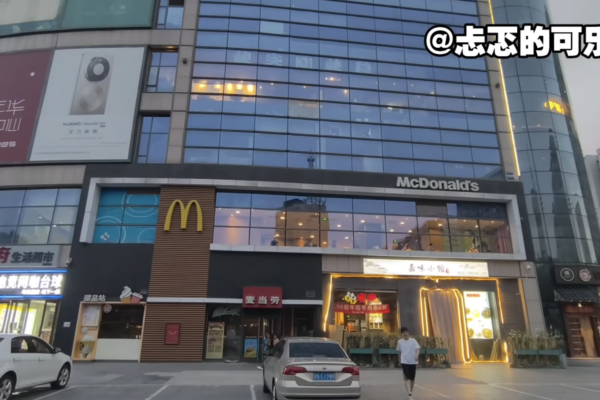
Recently, a large shopping center outside the Second Ring Road in Beijing has been experiencing a decrease in dinner-time traffic, leading to closures or significant operational pressures for restaurants and dining establishments. At the same time, there has been an increase in discussions on social media platforms about street food businesses and flexible employment, with many individuals who previously worked in real estate, intermediaries, e-commerce, and dining industries transitioning to low-threshold business models. Analysts believe that this phenomenon reflects downgraded consumer spending, intensified employment pressures, and the reality of China’s economy entering a stage of stock competition.
A video recently released by Beijing blogger “Anxious Cola Cake” captured the current situation of the “New Prosperity” commercial center located inside the Third Ring Road and outside the Second Ring Road.
During dinner time, the mall was unusually quiet, with many dining establishments nearly empty and some already closed. Even the restaurants still open were offering meal sets for only around 30 to 40 RMB, yet customers were scarce.
The blogger noted that this shopping center’s business was far better before the COVID-19 pandemic, but the foot traffic dropped significantly after the pandemic. Many advertising spaces within the mall have ceased operations, and some floors appear deserted. Apart from children’s training institutions and cinemas that still attract some foot traffic, most other businesses in the mall are experiencing a downturn.
From prosperity to decline, it has taken about seven to eight years,” the blogger lamented. Many commercial complexes in Beijing are facing similar challenges, whether they are mall stores or street-level shops, all enduring significant operational pressures.
It is worth noting that the downturn in the dining industry is not an isolated occurrence.
In recent years, the Chinese dining market has been embroiled in intense price wars, leading to a substantial decrease in foot traffic and shrinking profits for many small and medium-sized eateries. A study published in the academic journal “Humanities and Social Sciences Communications” in 2025 revealed that the COVID-19 lockdown had a profound structural impact on the dining industry from 2020 to 2023, particularly affecting the risk-averse low- to mid-priced independent businesses, causing many to suffer severe losses and mass exits. This has resulted in post-pandemic stock businesses engaging in irrational price wars and internal struggles to compete for remaining foot traffic.
While physical businesses are struggling, the street stall economy is rapidly expanding.
Recently, a video by online celebrity blogger “Brother Dog,” who is involved in the recycling of second-hand dining equipment, has gone viral on social media.
He mentioned that there are now over 30 million street stall operators in various categories across China.
Unlike street vendors mainly comprised of low-income groups ten years ago, today’s stall vendors come from diverse backgrounds, including former restaurant owners, real estate agents, e-commerce sellers, education and training professionals, and even managers of takeaway points.
Furthermore, some street stalls have adopted a chain-operated and corporate model, relying on centralized kitchens for supplies, quickly replicating in different night markets and neighborhoods at a lower cost to dominate the market.
Regarding the notion of “street stalls squeezing out physical stores,” blogger “Anxious Cola Cake” does not completely agree.
He believes that the core issue lies not with street stalls but with inadequate overall consumer spending.
In recent years, rising rents, labor costs, and commissions from delivery platforms have increased, while residents’ income growth remains limited, leading to no significant expansion in total market consumption. In this scenario, physical stores with higher costs are often the first to bear the brunt of the impact.
“In the past, renting a store might have cost only a few thousand yuan, but now it easily reaches tens of thousands; platform commissions are rising, but the average person’s wallet isn’t getting thicker,” he stated. In such an environment, physical stores with higher investments and heavier costs are usually the first to collapse.
When the consumer market cannot continue to expand, physical stores and street stalls are essentially competing for the same group of consumers, intensifying competition.
Behind the trend of street stalls lies an increasingly heavy employment pressure.
In recent years, industries such as real estate, the internet, and education and training have faced continuous pressures, leading to massive layoffs. Many workers are forced to switch to lower-threshold flexible employment fields, including food delivery, ride-hailing, and starting street stall businesses.
The latest data from the National Bureau of Statistics of China shows that in March 2026, the urban youth unemployment rate (excluding students) aged 16 to 24 rose to 16.9%, hitting a new high in recent months; the unemployment rate for the age group of 25 to 29 reached 7.7%. The official urban surveyed unemployment rate also rose to 5.4%, reflecting ongoing weakness in the overall labor market demand.
In fact, the issue of youth unemployment in China has been widely concerning since 2023. In June of that year, the unemployment rate for youths aged 16 to 24 reached a historical peak of 21.3%. Afterward, the authorities temporarily stopped publishing relevant data, only resuming after adjusting the statistical method.
On social media platforms, individuals who had worked in real estate, intermediaries, e-commerce, education and training, and dining industries shared their experiences of transitioning to street stall businesses. Some bloggers even view street stalls as the “last gateway to entrepreneurship.”
However, as more people enter low-threshold industries, new competition surfaces.
“Anxious Cola Cake” pointed out that just as the increase in the number of food delivery riders led to a continuous decline in average income, the street stall economy similarly faces the dilemma of “more people, thinner profits.”
In his view, one prominent issue facing China’s economy is the intensification of stock competition. Whether physical merchants or street stall operators, many are merely redistributing existing demands rather than creating new market increments.
Some netizens on overseas forums discussing China’s youth unemployment issue pointed out that weak consumption and employment pressures are forming a vicious cycle: companies reduce recruitment due to insufficient demand, prompting younger people to cut expenses due to declining income and job prospects, further dragging down consumption.
“Anxious Cola Cake” analysis suggests that from vacant malls, closed restaurants, to expanding night markets and increasing street stalls, what is reflected is not only a change in consumer habits but also the profound structural transformation China’s economy is undergoing amid real estate adjustments, weak domestic demand, and employment pressures.