
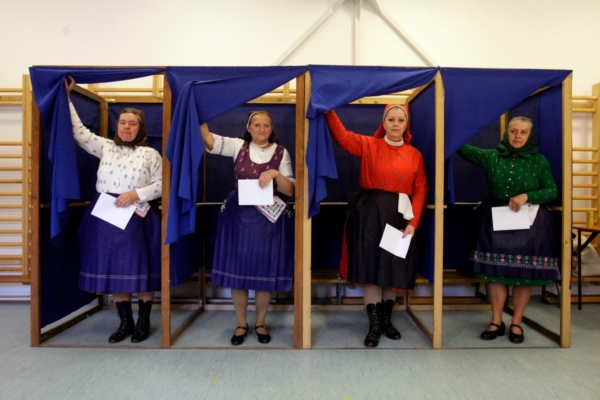
Recently, in Hungary’s parliamentary elections, Péter Magyar’s Tisza Party secured a landslide victory, ending Viktor Orbán’s 16-year rule. Experts suggest that this regime change is expected to reshape Hungary’s relationship with Beijing and possibly help Hungary shed the label of being a “strategic outpost of the Chinese Communist Party,” redirecting the country’s economic diplomacy from being overly pro-China and Russia, towards aligning with the mainstream of the European Union.
In the election on Sunday, Orbán’s party received 37.8% of the votes, facing a crushing defeat. Magyar’s opposition party took the lead with a significant 53.6% of the vote. This marks one of the most significant victory margins in Hungarian elections in the 37 years since the collapse of the communist system.
During Orbán’s leadership, Hungary was regarded as an important gateway for Chinese capital into Europe. Strategic expert Zhong Zhi Dong from Taiwan’s Institute for National Defense and Security Studies revealed that during Orbán’s era, Hungary was known as the “most steadfast outpost of the CCP in the EU” and its closest friend within the European Union.
Over Orbán’s 16-year rule, Hungary became a “European paradise” for Chinese businesses, with investments such as Ningde Times investing 7.3 billion euros to build Europe’s largest battery factory in Debrecen, and BYD investing 4 billion euros to establish Europe’s first car factory in Szege. In 2025 alone, Chinese investments in Hungary exceeded 7 billion euros.
Data shows that in 2025, China became Hungary’s largest source of foreign investment for the third consecutive year, and bilateral trade volume in January-February 2026 surged by nearly 55% compared to the previous period.
Since Chinese leader Xi Jinping proposed the Belt and Road Initiative, Hungary has repeatedly expressed support and actively participated in it. According to information from the Chinese Foreign Ministry, in May 2015, China and Hungary jointly held a Belt and Road seminar in Budapest, leading to deepening cooperation between the two sides. In October 2023, Orbán attended the third Belt and Road International Cooperation Forum in China and made an official visit.
Following the announcement of the Hungarian election results, Beijing congratulated Magyar. However, analysts believe that with the policy adjustments after the political change, Sino-Hungarian relations have entered a period of uncertainty.
Regarding the establishment of the new government, Zhong Zhi Dong believes that due to the Tisza Party’s opposition to Orbán’s overly pro-Beijing stance, “China’s manipulation to differentiate powers within the EU through Hungary is no longer viable.”
Jian Junbo, Director of the Center for EU-China Relations Studies at Fudan University, told Observer Net that the uncertainty of the Tisza Party’s China policy is expected to increase after taking office, potentially introducing more restrictive reviews in areas like law, environmental protection, and human rights in economic and trade cooperation.
Jian Junbo also mentioned that with the Tisza Party coming to power, it can almost certainly bring some changes to Sino-Hungarian relations in the short term, “we just cannot consider Hungary as a ‘strategic outpost’ anymore.”
Yao Yao Yuan, Professor of International Studies at the University of St. Thomas, predicted that Hungary will lean heavily towards the European Union in terms of economic development, which could pose a risk of exclusion or even withdrawal for Chinese investments.
Yao Yao Yuan observed significant changes in Hungary’s internal situation closely tied to external geopolitics. In an interview with Epoch Times, he noted that while Hungary is an EU member, it had been very pro-China and Russia during Orbán’s tenure, leading to significant openness to capital from China and Russia in terms of investments.
Yao Yao Yuan stated that since the outbreak of the conflict in Ukraine, Hungarian people have felt the direct threat of war, and with the intensifying US-China competition, a consensus has gradually formed domestically that “we should not continue to stand with Russia and China,” leading to the opposition party’s landslide victory in the elections.
Additionally, during Orbán’s 16-year rule, an ideology of “illiberal democracy” was implemented. Zhong Zhi Dong mentioned that Orbán’s government showed clear authoritarian tendencies, including strengthening executive power while undermining the independence of the judiciary and media.
According to Euronews, at a victory press conference on April 13, Magyar announced plans to “review” Chinese investments in Hungary, particularly in the electric car sector. However, he also described China as “one of the most important and largest countries in the world,” and stated that he does not intend to radically reverse trade relations.
Magyar proposed “clear regulations” for future foreign investments. He emphasized that the new government’s goal is to ensure that all projects “comply with EU and Hungarian environmental regulations, health procedures, and labor safety standards,” and must bring substantial economic benefits to Hungary.
Magyar stated that he does not want, nor will he accept, foreign companies receiving significant Hungarian subsidies while employing very few Hungarian workers, jeopardizing land, water, and air quality. His new government intends to align with the EU’s “Made in Europe” proposal.
According to Euronews, this draft law is currently being discussed by EU member states and the European Parliament and introduces stricter conditions for foreign investments exceeding 100 million euros in areas such as batteries, electric cars, solar panels, and key raw materials.
The proposal stipulates that if the foreign investor comes from a country with a global market share of 40%, they must employ at least 50% EU workers and could involve technology transfer and restrictions on foreign ownership.
During Orbán’s rule, Zhong Zhi Dong described Hungary as playing the role of a “nail house” in the EU, holding opposite views to the EU mainstream on policies towards Russia and Beijing.
Zhong Zhi Dong specifically pointed out that the EU has adopted a triple positioning towards Beijing, being a “partner, economic competitor, and systemic rival,” advocating for “risk reduction,” while Orbán had often played the role of an opponent, even helping Chinese products pass through Hungary to evade EU trade barriers.
As the EU operates under a “consensus decision” mechanism where a single dissenting vote can thwart a resolution, Orbán’s ability to impede EU’s unified actions on his own is significant. Zhong Zhi Dong believes that with Orbán stepping down, internal unity within the EU will greatly improve.
Yao Yao Yuan analyzed the future in a broader international context, stating that the world is heading towards a “new Cold War,” forming a confrontation between the Western democratic bloc and the authoritarian bloc of China and Russia.
He noted that many countries still adopt a “two-handed policy,” as the US-China relationship has not completely ruptured yet, and both markets are still lucrative. However, as the US-China competition intensifies, the space for playing both sides will decrease.
Yao Yao Yuan anticipated that eventual decoupling between the US and China is inevitable, it’s just a matter of time. After decoupling, countries will have to take sides and gradually, the entire world will have to choose sides in terms of investment, market economy, and production chains.
Currently, Yao Yao Yuan believes that “the EU’s willingness to stand with the US may strengthen, but it cannot completely break off relations with China.”
Looking towards the future of Sino-Hungarian relations, some analysts believe that while short-term changes may occur, Hungary’s economic development still relies on foreign investments. However, Magyar has vowed to review the “opaque” agreements and contracts signed during Orbán’s tenure.
Experts generally see Hungary’s political change as a sign of the country moving away from the “strategic outpost of the CCP” label, attempting to find a new balance between safeguarding national economic interests and fulfilling obligations as an EU member.