
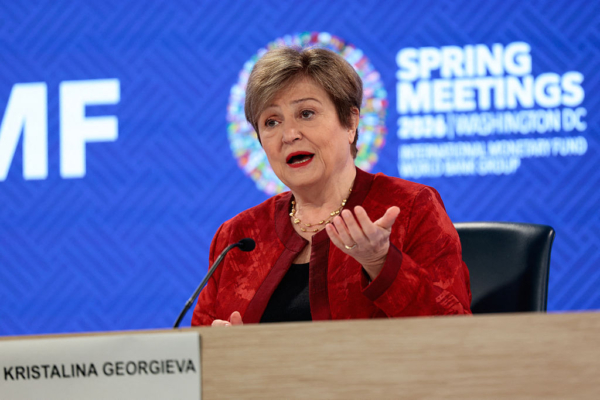
On Wednesday, April 15th, International Monetary Fund (IMF) Managing Director Kristalina Georgieva stated that at least 12 countries are expected to seek new loan programs to cope with the surge in energy prices and supply chain disruptions caused by the conflict in the Middle East, with several sub-Saharan African countries seeking assistance.
Georgieva also warned that even if the conflict were to end swiftly, the closure of the Hormuz Strait would exacerbate energy supply interruptions and urged countries to take measures to reduce fuel consumption.
During a press conference held in Washington, D.C. as part of the IMF and World Bank Spring Meetings, Georgieva emphasized that the disruption caused by the conflict may trigger a new demand for financial assistance ranging from $20 billion to $50 billion, including new loans and expansions to the IMF’s existing financing programs in 39 countries.
She did not disclose specific countries that have requested assistance.
IMF’s Strategic Director, Christian Mummsen, mentioned that the current demand assessment is preliminary and expects the list of countries seeking aid to exceed a dozen.
IMF stated that countries should take measures to conserve energy and implement incentives to reduce dependence on oil in the economy, such as temporarily providing free public transport services.
Georgieva expressed concern about actual supply chain disruptions, especially for Asian countries reliant on oil, natural gas, petrochemicals, helium, fertilizers, and other inputs from Gulf countries.
She mentioned that even if the conflict were to end tomorrow, such disruptions would not disappear overnight, citing the example of ships taking 40 days to reach Fiji due to slow sailing speeds.
“So we need to be prepared, as the effects of supply disruptions in the coming weeks will be more profound,” she added.
Additionally, Georgieva cautioned that countries should take targeted measures rather than offsetting price increases by providing broad energy subsidies, as this would only “prolong the pain of high prices.”
IMF’s Fiscal Affairs Director Rodrigo Valdes stated during the press conference that broad fuel subsidies would have the aforementioned consequences and shift supplies away from poorer countries. He said, “If you try to support demand to counter supply shocks, it will ultimately lead to exacerbated inflation.”
To prevent energy shocks from conflicts evolving into uncontrollable inflation similar to that of the 1970s, IMF urged central banks worldwide to closely monitor signs of wage-price spirals but advised against immediately tightening monetary policies to suppress demand.
“We tell central banks worldwide, if you have good credibility, you should show that your goal is to maintain price stability without being overly hasty,” Georgieva said. “Then wait and see how the situation develops.”
She added that central banks with weaker credibility in controlling inflation may need to take stronger measures, without naming specific countries.
Mummsen noted that financial markets remain orderly, but monetary policies in emerging and developing countries have already tightened due to high borrowing costs.
“In a world full of uncertainty and constant shocks, the message we convey is essentially: first, economic fundamentals are crucial; second, policy flexibility is key,” he stated.
Mummsen highlighted that delays or cancellations in fertilizer transport particularly impact developing countries, estimating that this could lead to an additional 45 million people facing food insecurity.
He pointed out that food price increases have a greater impact on low-income countries, where approximately 36% of consumer spending is on food, compared to about 20% in emerging markets and 9% in developed economies.