
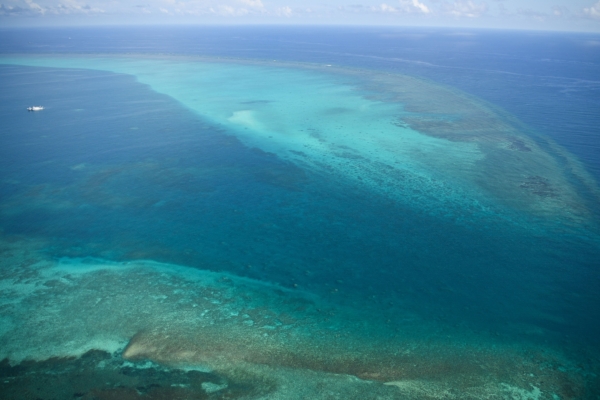
The tension in the South China Sea continues to escalate as satellite images obtained by Reuters show that the Chinese Communist Party (CCP) is intensifying control over the entrance to Scarborough Shoal by using ships and barriers.
Scarborough Shoal is one of the most disputed maritime areas in Asia, where both China and the Philippines have long been in confrontation, leading to concerns about armed conflicts.
On Wednesday, Jay Tarriela, a spokesperson for the Philippine Coast Guard, confirmed to Reuters that the CCP installed a floating barrier measuring 352 meters (1,150 feet) at the entrance to Scarborough Shoal on April 10th and 11th.
“There were six Chinese (CCP) maritime militia ships observed within the shoal, with three more outside, seemingly blocking the entrance to Bajo de Masinloc (the Filipino name for Scarborough Shoal),” he said.
Data from satellite imaging provider Vantor (formerly Maxar Technologies) indicates that on April 10th and 11th, CCP fishing vessels were anchored at the entrance, with a clear image on the 11th showing a barrier across the entrance. Additionally, a ship suspected to be a Chinese navy or coast guard patrol vessel was spotted outside the entrance.
The Chinese Ministry of National Defense did not immediately respond to Reuters’ request for comments.
Scarborough Shoal, traditionally a rich fishing ground, is entirely located within the Exclusive Economic Zone (EEZ) of the Philippines, but Beijing claims sovereignty over it.
Last year, the CCP approved the establishment of a national-level nature reserve in the area, which Philippine security officials condemned as a “clear pretext for occupation.”
Roy Trinidad, spokesperson for the Philippine Navy, stated on Tuesday that from April 5th to 12th, a total of 10 Chinese coast guard ships were detected near Scarborough Shoal.
In response to the increasing threat posed by China, Philippine President Ferdinand Marcos Jr. has adopted a strategy of aligning with Washington. In January of this year, the Philippines conducted joint patrols with the U.S. military around Scarborough Shoal, marking the 11th such exercise between the two treaty allies.
Diplomats point out that the United States may currently be distracted by conflicts with Iran and the reopening of the Strait of Hormuz, leading to close scrutiny of whether Beijing will take further action.
This month, thousands of soldiers from the U.S. and the Philippines will engage in large-scale exercises across the Philippine archipelago, including Zambales province, located approximately 120 nautical miles from Scarborough Shoal.
The South China Sea serves as a vital maritime route for global trade worth over 3 trillion U.S. dollars annually. In addition to Scarborough Shoal, Second Thomas Shoal is also a hotspot of conflict.
On Monday (April 13th), the Philippines accused Chinese “fishermen” of releasing cyanide in the waters of the Spratly Islands, including Second Thomas Shoal, endangering Filipino troops and marine ecology.
According to reports by Agence France-Presse, the Philippine National Security Council (NSC) alleged that Chinese poisoning activities began last year. Major General Trinidad stated that the Philippine military seized a total of 10 bottles of cyanide from fishing vessels affiliated with Chinese naval motherships in February, July, and October of 2025.
Last month, the Philippine military again witnessed Chinese crew members releasing poison near the shoals, with positive test results. A spokesperson for the Chinese Ministry of Foreign Affairs dismissed the Philippine accusations as “political gimmicks.”
The Permanent Court of Arbitration in The Hague ruled in favor of the Philippines in 2016 regarding the disputes over South China Sea sovereignty. However, China refused to accept the outcome.