
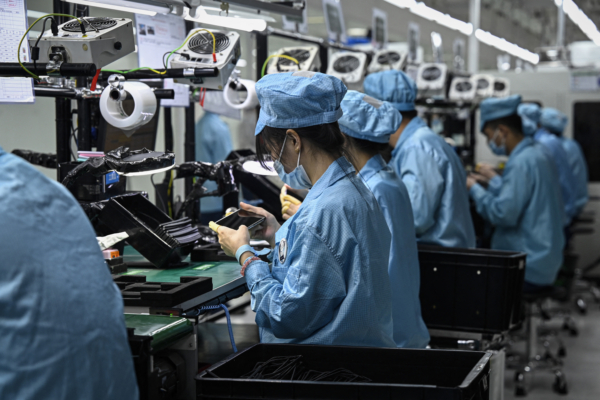
Dongguan, Guangdong, once known as the “high-paying manufacturing base,” is now undergoing significant changes. According to a factory manager in the area, with a decrease in company orders and a reduction in working hours, the actual monthly income has generally fallen to between 3000 yuan and 5000 yuan. Recruitment agencies promoting “monthly income of six to seven thousand” have been criticized for exaggerating their advertisements.
Recently, job postings in Dongguan claiming “monthly income of over 6000 yuan” have been circulating online. Several frontline workers revealed this week that in small and medium-sized factories, due to fluctuating orders, overtime opportunities have decreased, resulting in lower overtime pay. After deducting social insurance, housing fund contributions, and daily expenses, the take-home pay for formal employees typically ranges from 3000 yuan to 4000 yuan; in larger factories, monthly incomes generally range from 4000 yuan to 5000 yuan, with positions that can reach over 6000 yuan becoming increasingly scarce, often requiring working six days a week for more than eight hours a day.
Yi Donghui, an employee at an electronic company in Dongguan, told reporters, “Two years ago, when orders were high, we worked overtime for three to four hours every day and could earn six to seven thousand a month. Now, with no overtime, the usual income is just over 3000 yuan. After paying rent and food expenses, there’s very little left each month.”
An internet user named “Dongguan New Chinese Clothing Collection Store” posted a video saying that after this spring, there has been a noticeable decrease in people coming to work in Dongguan. They stated, “Now, working tirelessly, working 12 hours a day, one can only earn four to five thousand yuan a month.”
Mr. Zhao, who has been engaged in foreign trade processing in Dongguan for over twenty years, told reporters that when he first arrived in Dongguan, many factories posted job advertisements listing job responsibilities and benefits. Nowadays, many factories have moved out, leaving their gates and workshops empty.
Mr. Zhao mentioned that the factories still operating in Dongguan have chosen to halt production or take breaks due to a lack of orders: “Many factories around us have moved away, some to Vietnam and Southeast Asia, some shifting to foreign trade, with scales shrinking to the size of workshops in the early 1990s, employing a dozen or twenty workers. Dongguan is really finished.” He stated that the manufacturing industry in Shenzhen and Dongguan has entered a downturn phase and is unlikely to recover in the short term.
Mr. Yin, a private entrepreneur in Shenzhen, told reporters that China has entered a stage of labor surplus: “Exports are shrinking, the market is relatively quiet, and doing business is becoming increasingly difficult. Previously, Dongguan offered more favorable conditions to attract Shenzhen enterprises, such as low-priced land and tax incentives to fill the void left by departing factories. However, if companies cannot secure orders, these incentives become ineffective. Recently, I heard that the salaries in some Dongguan factories next month may approach the government’s minimum wage.”
According to the standards released by the Human Resources and Social Security Department of Dongguan City, the current minimum monthly wage in Dongguan is 2300 yuan, and the minimum hourly wage is 22.2 yuan.
Wang Peng, a Chinese labor issues scholar, told reporters that Dongguan workers’ income structure has long relied on “low base salary + high overtime pay,” and once these conditions disappear, income will decrease. He said, “Dongguan’s so-called high income is largely supported by long hours of overtime, but this model is not stable. When companies withdraw or orders decline, factories usually reduce overtime first rather than increase base wages, and salaries quickly plummet.”
Regarding the popular claim on the internet of “monthly income of 6000 to 8000 yuan,” factory manager Mr. Zhao said, “Many of these are recruitment advertisements from intermediaries. Once you’ve paid them, they find excuses to lower your wages to 3000 yuan. Do you work or not? It’s up to you.”
Some internet users mentioned that Dongguan has long relied on maintaining production through low base wages and high-intensity overtime, a model often referred to by outsiders as “sweatshops.” Some comments pointed out that this reliance on cheap labor is a continuation of the “population dividend” and could be challenging to sustain once external conditions change.
Dongguan was once known as the “world’s factory.” However, recent videos and photos posted by netizens show that some streets and shopping malls in the area have fewer people, some factory buildings are vacant, and some shops are offered for sale at low prices.
One netizen commented, “There used to be job postings everywhere, but now many factories are closed, and people have dispersed.” Another comment stated, “It’s not about transformation; it’s that this model is no longer sustainable.” Another person said, “Relying on lowering labor costs for growth was a road that could not go far. It has now reached a dead end.”