
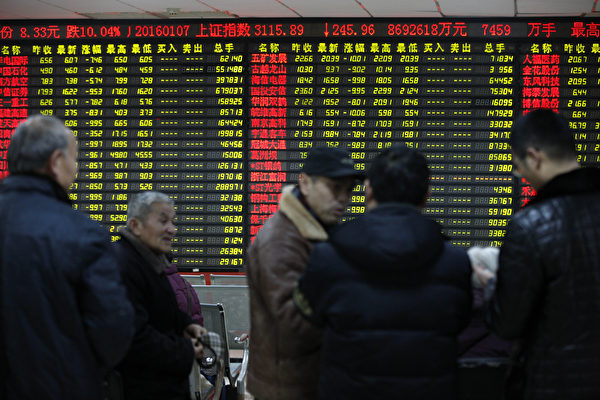
On June 21st, the Shanghai A-shares dropped below the key 3000-point mark. Market experts believe that the downward trend of the Shanghai Composite Index will continue.
The Shanghai Composite Index opened at 2998.24 points on June 21st. It briefly rose above 3000 points at 9:32 am before swiftly dropping below that level again. Around 9:46 am, the index climbed back above 3000 points, only to fall below it again around 10:20 am. By the midday break, the Shanghai Composite Index had been fluctuating below 3000 points, closing at 2993 points, down 11 points or 0.39%, with a turnover of 168.591 billion yuan.
During the afternoon session, the Shanghai Composite Index rose above 3000 points around 1:29 pm but continued to oscillate downwards. Throughout the afternoon, it fluctuated around the 3000-point mark three times before closing at 2998.14 points, ultimately breaching the 3000-point level. The Shanghai Composite Index fell below 3000 points at least six times during the day.
Overall on June 21st, the Shanghai Composite Index dropped a maximum of 19 points to a low of 2985 points during trading and closed the day at 2998 points, down 7 points or 0.24%, with a turnover of 280.275 billion yuan.
This week, the Shanghai Composite Index has experienced a continuous decline for three days, with a cumulative drop of 1.14%.
Additionally, the Shenzhen Component Index closed at 9064 points, down 4 points or 0.04%, with a turnover of 339.311 billion yuan. The CSI 300 Index closed at 3495 points, down 7 points or 0.22%, while the ChiNext Index reported 1755 points, down 6 points or 0.39%.
According to data from Wind, a financial information provider, there were 2383 stocks that gained value, 2684 stocks that declined, and 295 stocks that remained unchanged in Shanghai, Shenzhen, and the Beijing Stock Exchange.
Regarding the breach of the 3000-point mark by the Shanghai Composite Index, an analysis by a mainland WeChat account “Financial Views” on June 21st mentioned that on that day, the “national team” supported the market by purchasing CSI 300 and SSE 50 ETFs to hold above 3000 points, but they did not anticipate it was a futures index settlement day. Heavyweight stocks like Moutai and China Yangtze Power faced forced selling, resulting in the index dropping below 3000 points. The failure to maintain this key level despite significant intervention was seen as a setback.
On the same day, the total turnover of Shanghai and Shenzhen stock markets was 619.3 billion yuan, a decrease of 104.8 billion yuan from the previous day, with Shanghai’s turnover at 280.3 billion yuan and Shenzhen’s at 339.3 billion yuan.
Data indicates a trend of capital outflows from the market since June 20th. On that day, the total turnover of both markets reached 724.4 billion yuan, slightly higher than the previous trading day. However, there was a net capital outflow of over 39.6 billion yuan from the broader market.
In response to recent A-share performance, Fu Hao, the head of investment allocation at Guotou Securities, told Huaxia Times on June 21st that risk appetite had rapidly declined, and the mid-term VIX index (volatility index) had risen, indicating heightened market concerns about future risks.
A report from Hong Kong’s Economic Daily on the 21st cited an analysis from Founder Securities, stating that breaching the 3000-point mark by the Shanghai Composite Index was inevitable. The market would now depend on whether market confidence could be restored, if trading volumes in Shanghai and Shenzhen could rebound, and if the “national team” would inject funds or if financial stability funds would be introduced. Without these developments, A-shares would likely see only structural movements without systemic improvements.
Regarding future market trends, Zhang Cheng, Chief Investment Advisor at Da Cheng Securities, stated to Huaxia Times that the current turnover in the A-share market had been hovering around 700 billion yuan, indicating a lack of off-market funds entering the market. With no fresh capital inflows, the market continued to experience downward pressure. In the absence of bullish forces driving the market, it was likely to move in the path of least resistance. The market was expected to fluctuate around the 3000-point mark, highlighting the importance of increased trading volume over the index level.
Taiwanese economist Wu Jialong analyzed the situation for Epoch Times, noting that Beijing’s efforts to stabilize the stock market required restoring confidence, which could only come from stable policies, promising economic prospects, and avoiding constant policy changes. However, the issue lies in the fact that the Chinese Communist Party controls everything and frequently introduces new regulations, creating uncertainty.