
Recently, a popular internet celebrity beverage in mainland China with annual sales exceeding 1 billion yuan has been revealed to have only 2.7% actual grapefruit juice content in its flagship “grapefruit-flavored” product, with the main ingredients being sugar and water. Industry insiders point out that this marketing strategy, which relies on enhancing fruit associations through trademarks and rhetoric, is suspected of defrauding or misleading consumers.
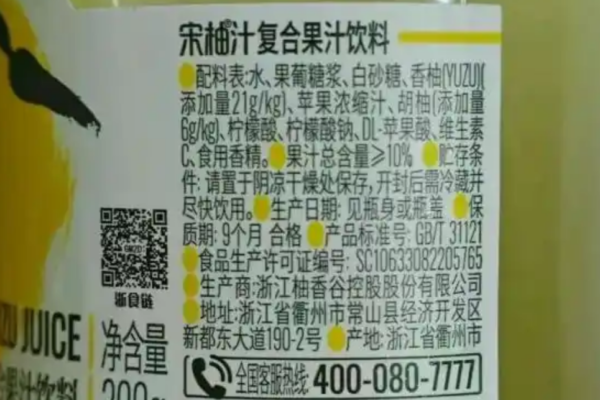
According to reports from various mainland Chinese news outlets, a popular internet celebrity beverage previously known as “Double Grapefruit Juice” that was popular in the Jiangsu, Zhejiang, and Shanghai dining circles, now renamed as “Song Grapefruit Juice,” has sparked a huge controversy after consumers exposed its true ingredient list. Despite its core selling point being the “grapefruit,” the ingredient list reveals that the total grapefruit juice content is only about 2.7%, with the main components being water, fruit glucose syrup, and white sugar, giving it a taste more akin to flavored sugar water rather than pure fruit juice.
Media investigations have shown that this product labeled as a “mixed fruit juice beverage” has grapefruit juice content with 21 g/kg (2.1%) of Pomelo juice and 6 g/kg (0.6%) of Shaddock juice. Both combined, the actual grapefruit juice proportion is 2.7%. To meet the regulation requiring the “total juice content ≥ 10%” for mixed fruit juice beverages, the product supplements the remaining percentage by adding concentrated apple juice, thus achieving “compliant naming” within the legal framework. However, its prominent promotion of “grapefruit flavor” and “refreshing healthiness” has been criticized for being potentially misleading.
The controversy escalated further due to consumer rights advocacy. A consumer posted a review video on a short video platform, criticizing that they actually “spent money on pure fruit juice but bought a bottle of grapefruit-flavored sugar water,” questioning the product for being “misleading,” only to receive a cease-and-desist letter from the legal representation of the Song Grapefruit Juice manufacturer a few days later, demanding the removal of the related video and accusing the consumer of “tarnishing the brand.” This action was interpreted by public opinion as an attempt to “suppress criticism,” leading to a wider backlash.
Under the sustained pressure of public sentiment, the company involved responded that the product is classified as a mixed fruit juice beverage, with the overall formula compliant with national standards, emphasizing that grapefruit ingredients should not be added in large quantities due to their sour and bitter characteristics, stating that the current ratio is a result of optimizing the taste experience. At the same time, the company denied that the product has any “sugar-reducing” effect and clarified that such assertions were not officially released.
It is worth noting that the prominently marked “Song Grapefruit” on the product packaging is a registered trademark, not the name of a fruit variety. Industry insiders point out that this naming convention of “trademark + flavor association” is becoming a common strategy for some beverage companies to navigate the grey areas of regulation.
Food industry analysts state that the current standards do not impose mandatory proportion requirements for single fruit content, allowing some companies to engage in “borderline marketing” within legal boundaries, potentially deceiving or misleading consumers.
Legal professionals point out that while the naming itself may not necessarily be in violation, systematic promotion causing consumers to have a substantive misunderstanding of the product’s core attributes could still cross the red line of false or misleading commercial advertising.
According to reports, there have been indications of adjustments on some e-commerce platforms’ product promotional pages. However, channels such as canned products have not completely synchronized similar promotions.
Public information shows that Song Grapefruit Juice is a product under Zhejiang Yuxianggu Holdings Co., Ltd., with Tianyancha data indicating that the company was established in May 2013 with a registered capital of 37.5 million yuan.
Data disclosed by the company reveals that the single product sales of Song Grapefruit Juice reached nearly 4 billion yuan in 2022, increased to nearly 6 billion yuan in 2023, and surpassed 10 billion yuan in annual sales in 2024. Song Grapefruit Juice has advertised as the national sales leader for several consecutive years.
According to third-party data, Yuxianggu Beverage flagship store achieved total live sales of 2.5 to 5 million yuan in the past three months. In addition, the official website of the shopping platform shows that Li Jiaqi once recommended the Song Grapefruit series beverages during a live stream.
Intellectual property information indicates that Yuxianggu has registered “Song Grapefruit” as a trademark.