
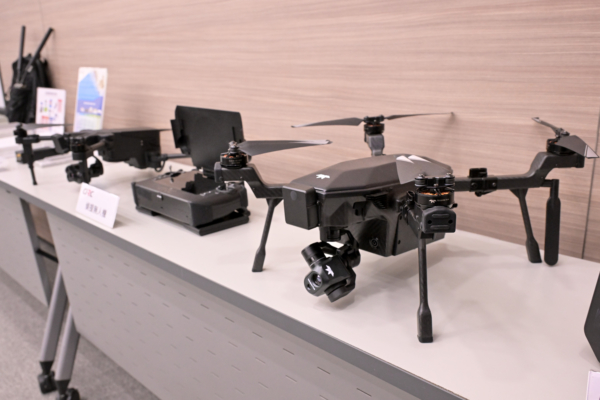
Facing the threat of massive military construction and export control by the Chinese Communist Party, Japan has begun to strengthen regional security partnerships and relax decades-old defense export restrictions. Taiwan is also seeking opportunities to enhance supply chain cooperation, especially in the field of unmanned drones.
According to the latest analysis by the Nikkei Shimbun, China still dominates the supply chain for unmanned drones with low cost, and cooperation in the unmanned drone field between Japan and Taiwan is still in its infancy stage.
The article quotes Deng Hongyuan, a policy analyst at the Democratic Society and Emerging Technology Research Institute (DSET) in Taiwan, who mentioned that China recently implemented export controls on dual-use items to Japan, including restrictions on major companies such as Mitsubishi Heavy Industries and Kawasaki Heavy Industries. This could stimulate Japan’s development of unmanned drones, especially in the areas of components like batteries and motors that rely on rare earths from China.
Last Friday, Taiwan’s defense budget was cut by more than a third due to obstruction by opposition lawmakers, with the most notable being the cancellation of Taiwan’s plan to enhance its UAV production capabilities, casting a shadow over Taiwan’s UAV development program.
Despite this, industries in both countries are still promoting increasing cooperation. DSET analysis shows that since 2020, companies, industry associations, and research institutions in both countries have signed a total of 15 agreements. The signing institutions include Taiwan’s Taiwan Boutique UAV International Business Opportunities Alliance (Tediboa) established by the Ministry of Economic Affairs, the Industrial Technology Research Institute supported by the government, as well as Japan’s two major UAV alliances: the Japan UAV Industry Promotion Association and the Japan UAV Alliance. Cooperation focuses on supply chain and technology development, disaster prevention and reduction, emergency response, autonomous flight testing, and application deployment.
In addition, Taiwan’s 7A UAV company has signed two new agreements with Japanese companies this year: one is to collaborate with AlterSky to develop large-scale logistics UAVs, and the other is to work with Autonomy HD to integrate the Taiwan-Japan UAV industry supply chain and develop the next generation of autonomous UAVs.
The article points out that although Taiwan and Japan do not have formal diplomatic relations, Japan is still Taiwan’s most important security and political partner after the United States. In November last year, Japanese Prime Minister Naotake Takamichi stated in parliament that a conflict in Taiwan could pose an “existential threat” to Japan. Over the past year, Taiwan’s Minister of Foreign Affairs Joseph Wu and Executive Yuan Chief Zhao Zhengtai have visited Japan in a personal capacity, marking the first known visits since the two countries severed diplomatic ties in 1972.
Deng Hongyuan cited statistics from the Japan Customs Office indicating that China remains the largest source of civil drones in Japan to date. In just the past year, Japan imported 124,936 drones from China, accounting for over 90% of the market share.
To change the current situation and enhance supply chain resilience, the Ministry of Economy, Trade, and Industry of Japan announced a plan in September last year aimed at achieving a domestic UAV production capacity of 80,000 units by 2030, while also cooperating with allied countries in key components such as motors, batteries, communication modules, and flight controllers.
According to Deng Hongyuan in an interview with Nikkei Asia, Taiwan has demonstrated high reliability and production capacity in the field of UAV motors and batteries in Ukraine and Eastern Europe, showing cost competitiveness in diversifying the supply chain away from China, making it an ideal partner for Japan’s stable supply of key components for domestic UAV production.
The government of Taiwan’s President Lai Ching-te is also working to promote Taiwan’s UAV industry, which may not be as competitive in terms of cost and production scale as China, but has strong technological advantages.
Katsuya Yamamoto, Director of the Tokyo Sasakawa Peace Foundation’s Strategic Deterrence Project, told Nikkei Asia that civilian UAV applications in Japan and Taiwan have seen significant growth, and there is enormous potential for cooperation between private enterprises in both regions, which could rapidly deepen. This cooperation should start at the civilian level and eventually evolve into dual-use military-civilian cooperation.
Analysts believe that there is still a long way to go for Japan-Taiwan UAV cooperation. DSET estimates that last year Taiwan exported only 45 UAVs to Japan, while Japan exported only 3 to Taiwan. On the other hand, Taiwan exported over 120,000 drones to countries such as Poland, the Czech Republic, and the United States.
Deng Hongyuan mentioned that Taiwan’s current UAV cooperation models typically include exporting low-cost small drones to Eastern Europe to support Ukraine’s resistance against Russia, exporting components to Europe and the US to replace Chinese products, participating in bids for US federal and local government UAV projects, and cooperating with foreign companies to bid on Taiwanese government procurement projects.
These collaboration models are based on the premise that partner countries have a certain level of production capacity, procurement scale, and technological ecosystem. Japan’s large-scale UAV production capacity and domestication rate have been lagging behind other countries for a long time and have not yet established a large-scale industrial ecosystem, making it difficult for Taiwanese companies to find suitable partners in Japan for technology cooperation, component supply, or joint participation in government tenders.
Not only will the deepening of UAV cooperation take time, but Yamamoto also believes that Japan’s relaxation of export controls will not quickly lead to deepened cooperation in the field of weapons or defense equipment between Japan and Taiwan. This is because reaching agreements will require more time for both sides, just like when Japan reached agreements with the UK, Australia, or the Philippines, it takes time.
Some high-level figures in the foreign defense industry also believe that the significant shift in Japan’s defense export policy will ultimately impact Taiwan. Japan may provide some subsystems that can be used for dual-use platforms and systems to Taiwan’s domestic defense industry, but it is unlikely to provide power systems or complete branded platforms such as vessels or aircraft to Taiwan’s military. As for UAVs, the two sides may send delegations to each other, likely facilitated by non-governmental organizations and industry associations to promote cooperation rather than direct government-to-government contact.