
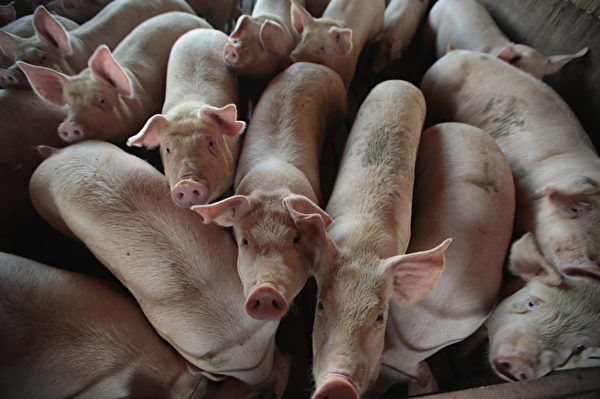
In April of this year, China’s three major listed pig enterprises, Muyuan Group, New Hope, and Wens Foodstuff Group, have successively released their sales data for live pigs in April 2026. The data shows that the sales volume of the three major pig enterprises has increased compared to the previous year, but both the month-on-month and year-on-year sales revenue have decreased. This indicates that the pig prices are still lingering at a low level.
On May 9, New Hope Liuhe Co., Ltd. (New Hope), a pig enterprise, released a “Briefing on April 2026 Sales”. The briefing stated: “In April 2026, the company sold 1.2099 million head of market hogs, with a month-on-month change of -7.26% and a year-on-year change of 11.07%. The sales revenue of market hogs was 1.312 billion yuan, with a month-on-month change of -15.24% and a year-on-year change of -32.37%. The significant year-on-year change in sales revenue is mainly due to the significant decrease in pig prices. The average selling price of market hogs was 9.15 yuan/kg, with a month-on-month change of -6.06% and a year-on-year change of -37.76%.”
On May 7, Muyuan Food Co., Ltd. (Muyuan Group) released a “Sales Briefing for April 2026”. The briefing showed: “In April 2026, the company sold 7.143 million head of market hogs, with a year-on-year change of 8.68%; the average selling price of market hogs was 9.45 yuan/kg, with a year-on-year change of -35.54%; the sales revenue of market hogs was 8.503 billion yuan, with a year-on-year change of -32.49%.”
Also on the same day, another listed pig enterprise, Wens Foodstuff Group Co., Ltd. (Wens Group), released a “Briefing on April 2026 Sales of Main Products”. The briefing showed: “In April 2026, the company sold 3.2408 million head of pork (including live pigs and fresh products), with a revenue of 3.860 billion yuan. The average selling price of live pigs was 9.27 yuan/kg, with month-on-month changes of -12.00%, -20.05%, -8.31%, and year-on-year changes of 2.05%, -30.39%, -37.87%.”
When explaining the reasons for the changes in various data, the briefing mentioned: “The main factors affecting the key indicators are as follows: 1. In April 2026, the company’s pork revenue declined year-on-year, mainly due to the significant decrease in the average selling price of live pigs. 2. In April 2026, the average selling price of live pigs decreased year-on-year, mainly due to changes in the domestic live pig market.”
New Hope attributed the significant year-on-year change in sales revenue of market hogs to “market oversupply”, while Muyuan Group stated: “The significant year-on-year decrease in the selling price and revenue of market hogs is mainly affected by the fluctuations in the live pig market.”
Looking at the data from these three pig enterprises, the quantity of market hogs sold has increased year-on-year. However, while the sales volume has increased, both the month-on-month and year-on-year sales revenue have shown declines. At the same time, the average price of market hogs for listed pig enterprises has fallen below 10 yuan/kg across the board, indicating the industry has entered the “era of 9 yuan”, with some companies approaching the 8 yuan threshold.
Specifically, this week, the average price of live pigs has declined on a weekly basis. According to data from China Swine, on May 8, the price of live pigs (lean pigs) was 9.75 yuan/kg, a 0.7% decrease compared to the previous week’s 9.82 yuan/kg on May 1. In terms of the weekly average price, this week’s average price of live pigs was 9.81 yuan/kg, a 1% decrease compared to the previous week’s 9.91 yuan/kg.
According to the data from the National Bureau of Statistics of China, the price of live pigs (lean pigs) was 9.5 yuan/kg in late March 2026 and 9.1 yuan/kg in early April 2026, marking a consecutive near 12-year low for the price of live pigs (lean pigs).
Faced with a sluggish market, large-scale leading breeding enterprises have generally adopted a conservative marketing strategy. According to a report by Economic Daily on May 9, Muyuan Group, Wens Group, New Hope, and other industry leaders noticeably slowed their pace of marketing in April. Muyuan Group sold 7.143 million head of market hogs in April, with a year-on-year increase of only 8.68%; Wens Group marketed 3.2408 million head, with a slight year-on-year increase of 2.05%; and New Hope marketed 1.2099 million head, with a growth rate of 11.07%.
However, compared to the leading enterprises’ strategy of seeking stability and controlling quantity, second-tier and regional pig enterprises have generally expanded against the trend in April, with a significant increase in marketing. Shennong Group sold 318,000 head of market hogs in April, showing a significant year-on-year growth. Relying on increased marketing, despite its average selling price of market hogs being at a low level of 8.65 yuan/kg, Shennong Group’s sales revenue only slightly decreased by 8.46% year-on-year. In addition, Tangrenshen marketed 552,600 live pigs in April, a 26.98% year-on-year increase, and a 2.04% monthly increase; Juxing Farming sold 407,100 head of market fattened pigs, showing a 28.20% year-on-year increase.
Furthermore, Zhenghong Technology sold 15,100 live pigs in April, a 769.38% monthly increase, with a 34.79% year-on-year increase, and the company reported a monthly sales revenue of 137.348 million yuan, a 606.03% monthly increase and a 40.20% year-on-year increase. Zhenghong Technology stated in its announcement that the significant increase in sales was mainly due to the increase in marketing of live pigs.
An analysis from Zhuochuang Information quoted in the report mentioned that the current market presents a “weak supply and demand” situation, but the impact of supply-side contraction on the market will gradually take the lead. It is expected that the average price of live pigs in May may fall between 9.5 yuan/kg and 9.6 yuan/kg.
An analysis from Dadi Futures cited by The Paper on May 9 stated that it is still too early for a reversal in pig prices, terminal demand is average, the driving force for the continuous increase in pig prices is not sufficient, and the existing inventory still needs further digestion before it is beneficial for a subsequent rebound.
China International Capital Corporation believes that the oversupply combined with the decline in medium to long-term demand has led to a larger-than-expected decline in this round of pig prices. Looking ahead, the current situation is still at the beginning of a trend towards reduced pork supply. Judging from the inventory levels, pork supply in the second quarter is expected to remain wide, and there may be an effective marginal decrease in supply after the third quarter. However, with improved breeding efficiency and high weight backgrounds, price elasticity may be limited.