
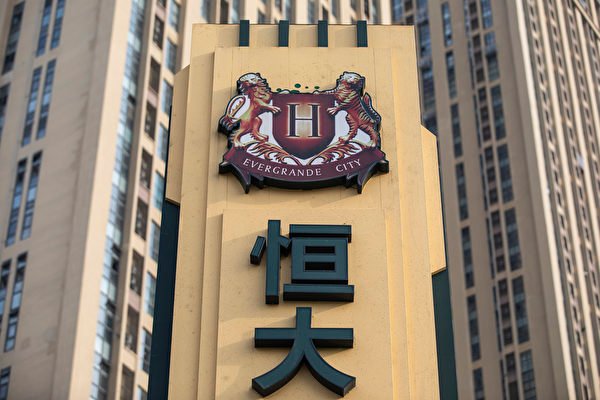
The blockade of the Hormuz Strait has led to a surge in oil prices, drawing attention to China’s new energy industry that receives subsidies based on quantity from the Chinese Communist Party (CCP). On the other hand, from Evergrande Group, Country Garden, to Vanke, well-known real estate companies in China are all struggling with debt issues. The financial risks caused by real estate industry debts have always been a focus of concern, with even South Korea setting up a task force to monitor China’s real estate financial risks.
Professor Chen Songxing from the National Development and Mainland Studies Institute at Taiwan’s University of Culture pointed out on the “Breaking News” program on NTD on May 7th that the government’s reliance on debt to drive the real estate economy has triggered financial risks and fiscal crises. Now, attempting to achieve economic transformation through subsidies would distort development and sacrifice the people’s wellbeing.
Renowned real estate developer Pan Shiyi, who fled to the United States a few years ago, recently stated that for the past few decades, China’s real estate sector has been operating like a Ponzi scheme.
Professor Chen Songxing explained that for a long time, the real estate industry driven by debt has been the engine of economic growth in the PRC. Since 2008, the CCP has injected a large amount of liquidity, resulting in a dramatic increase in overall debt. Based on data from 2024 seen in 2025, the combined debts of the central government, local governments, enterprises, and private individuals including real estate mortgages amount to around 300% to 310% of the GDP, more than double the pre-2008 level. When real estate companies cannot repay their debts, the government orders banks not to call in the loans, which then turn into non-performing assets not officially listed.
Currently, the Chinese real estate market continues to decline, with prices in first-tier cities dropping back to levels from 15 years ago. The vacancy rate for housing is very high, and the population is rapidly decreasing, especially in third, fourth, and fifth-tier cities where houses are nearly unsellable, leading to financial crises in local governments.
Professor Chen stated that the CCP’s policies, including the upcoming 15th Five-Year Plan (from 2026 to 2030), are essentially giving up on the real estate sector and focusing on future technological and personnel transformations, such as electric vehicles, solar panels, and wind power.
According to statistical data, a significant amount of China’s new energy production relies on subsidies, with production increasing the more subsidies are received. As all companies strive to produce vigorously, the costs for electric vehicles, solar panels, and wind power have decreased by an average of 70 to 80 percentage points from the end of 2024 compared to 2019. This decrease in costs has had an effect, as the crisis caused by the blockade of the Hormuz Strait, leading to soaring oil prices, has prompted developing countries and even European countries without funds to purchase oil to import Chinese new energy products, including solar panels.
While there is a substantial amount of exports of solar panels and similar products, they are essentially being dumped and do not bring much profit. This reality means that although they may gain in export volume, they actually lose out on profits due to the low export prices. Chen pointed out that these enterprises in China, especially state-owned enterprises, essentially demand more subsidies from the government after achieving certain production levels, which further burdens the central government financially.
As every enterprise seeks subsidies, regardless of the quality or success of their exports, the more they produce, the more they receive from the government. When exports are not performing well, companies will continue production and demand more subsidies, causing a situation where enterprises start undercutting each other in pricing, such as in the case of electric vehicle companies.
Furthermore, the CCP is rapidly moving towards artificial intelligence (AI), robotics, and automation. Chen believes that even if the new economy excels in these areas, it cannot compensate for losses in other economic sectors. China may have the opportunity to lead the world in future economic and personnel transformations, but before truly benefiting from the contributions of these new industries, the Chinese economy may already be in a systemic crisis.
Chen explained that the employment opportunities provided by the CCP’s new economic policies are actually very limited. The unemployed from previous real estate development or infrastructure construction markets are being forced into wage reductions due to lack of jobs, resulting in a downgraded standard of living. Therefore, the current distorted economic development model in China is exacting a severe toll on the economy, with the people bearing the brunt of the sacrifices.
According to a report from the English version of the Hong Kong-based South China Morning Post on May 4th, research conducted by Li Shi, the director of the Institute for Sharing and Development at Zhejiang University, shows that China’s Gini coefficient has risen from 0.45 in 1995 to over 0.7 in 2023.
The Gini coefficient is an indicator of income distribution fairness, with values between 0 and 1. A smaller Gini coefficient indicates a more equal income distribution, while a larger one indicates a more unequal distribution. The 0.4 mark is considered a “red line” for income inequality, and exceeding this threshold can easily lead to social divides between the rich and poor, potentially causing societal unrest.
Chen remarked that due to unemployment, wage reductions, and deteriorating living conditions for the impoverished while the affluent continue to prosper, the exceedingly high Gini coefficient of 0.7 indicates a looming social crisis in China.
Video Reference: “Breaking the News” – Economic Structural Imbalance Engine is Idle, CCP Debt-Driven Economy May Fall into a Pitfall