
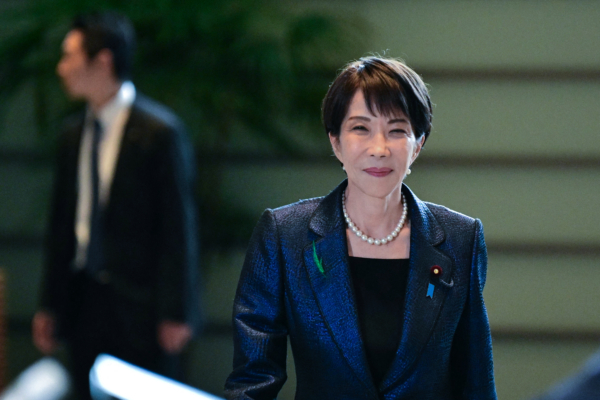
Since May 1st, Japanese Prime Minister Sanae Takamichi has made consecutive visits to Vietnam and Australia. In Vietnam, she introduced a new version of the Free and Open Indo-Pacific Strategy, urging Asian countries to determine their own futures. In Australia, an economic security declaration was issued, emphasizing the quasi-alliance relationship between Japan and Australia. Experts view this as Takamichi reshaping the Indo-Pacific landscape and constructing a de-Chinese Communist Party fortress.
Senior researcher Song Guocheng from the Political Science University’s International Relations Research Center stated on New Tang Dynasty Television’s “Breaking News” program on May 6th that Takamichi’s visits to Vietnam and Australia have two main objectives: autonomy and resilience. She hopes that all countries in the Indo-Pacific region can possess self-sustaining economic capabilities and the ability to withstand threats autonomously.
During her visit to Vietnam on May 1st, Takamichi delivered a speech introducing the new version of the Free and Open Indo-Pacific Strategy, stressing the resilience and autonomy of energy security supply for Asian countries to determine their own futures.
Guocheng noted that Takamichi’s visit to Vietnam had three strategic aspects:
Firstly, the establishment of united sovereign supply chains.
Transitioning from the previous version advocated by Abe of a free and open Indo-Pacific strategy to deep integration of joint sovereignty in supply chains. This means each country is not threatened, each country can act autonomously, and through alliance cooperation, each country can achieve maximum resilience. Each country has the sovereignty over its own economic, technological, and defense capabilities and when united, they collectively have resilience and autonomy.
Guocheng stated that united sovereign supply chain involves two aspects: diversifying from sole reliance and strengthening the security of critical resources. For example, ensuring the security of supply chains for rare earth elements and other critical resources to reduce excessive reliance on China’s economic supply chain.
Furthermore, Guocheng emphasized the need for countries to cultivate autonomy and resilience. For instance, when facing geopolitical challenges such as China’s boycotts or sanctions, the entire alliance system should possess self-sustaining economic capabilities.
Secondly, aiding Vietnam to become a crucial node in the Indo-Pacific’s supply chain security.
Guocheng explained that through economic security guarantees, scientific and technological cooperation, in areas such as energy, critical minerals, artificial intelligence, space communications, and agriculture, Japan and Vietnam will support and exchange resources, embodying the concept of mutual exchange and resource sharing.
Additionally, Takamichi announced a $10 billion investment to assist Vietnam in energy procurement. This includes assisting the Yashima Refinery in northern Vietnam in independent refining through a mechanism of military-civilian cooperation, and rare earth cooperation as Vietnam holds one of the world’s sixth-largest reserves of rare earth minerals.
Guocheng expressed that historically, Vietnam has been stuck between the US and China and influenced by Chinese ideology, relying on the West for economic development and technological assistance. Takamichi aims to elevate Vietnam to a crucial node in the Indo-Pacific’s supply chain security, liberating Vietnam from economic reliance on China. This also signifies that Japan-Vietnam relations may evolve from mere strategic partners to strategic allies.
Thirdly, breaking away from China, reshaping the Indo-Pacific landscape.
Guocheng stated this can be witnessed in two aspects: systematizing economic security and introducing an evolved version of the FOIP (Free and Open Indo-Pacific), including upgrades in technology and digital realms like digital corridors, establishing secure submarine cables, and enhancing satellite communication.
Guocheng believed that from submarine cables, underground rare minerals, maritime communication, to satellite systems cooperation, a comprehensive new security framework is being established. Takamichi’s evolved FOIP demonstrates Japan’s all-encompassing security perspective, not only to counter regional military threats but also to ensure Japan and its allies can maintain autonomy and resilience in the face of potentially intense great power rivalry.
From May 3 to 5, Takamichi conducted an official visit to Australia, where both sides issued an economic security declaration, with a particular emphasis on the quasi-alliance relationship between Japan and Australia. Guocheng clarified that while it’s dubbed a quasi-alliance, it essentially denotes a full-fledged alliance between Japan and Australia. Over the past 50 years, Japan and Australia have been mere trade partners, but now with economic, defense, and anti-communist elements aligned, they have formed a security community. This is demonstrated in three aspects:
Firstly, establishing de-Chinese Communist Party supply chains.
The Japan-Australia supply chain allows Japan to stably access crucial rare earth minerals while creating energy complementarity between the two countries. Additionally, a vital emergency consultation mechanism has been established to address potential future emergencies like the Strait of Hormuz closure. These moves directly weaken China’s ability to weaponize resources.
Secondly, deep integration of Japanese and Australian defense industries and intelligence sharing.
Both countries agreed on Australia procuring 11 top-class escort vessels from Japan. Some of these vessels will be built in Japan, some in Australia, and a portion will be jointly produced to shorten construction timelines, thus deeply integrating Japanese and Australian defense industries. Additionally, they initiated an agreement on strategic network cooperation partnership to enhance intelligence sharing, paving the way for Japan to join the Five Eyes Alliance, forming the Six Eyes Alliance.
Thirdly, constructing an extended island chain beyond the traditional first island chain.
Although not explicitly mentioned during Takamichi’s visit, the significant component lies in building an extended island chain beyond the traditional first island chain, extending from Japan, through Taiwan, the Philippines, possibly via Vietnam, Indonesia, and onward to Australia in a diagonal chain.
Guocheng highlighted that combining the second island chain, the first island chain, and the extended island chain forms a strategic interconnection hook. This configuration creates a wider defense center for the entire Indo-Pacific geopolitics, including potential conflicts in the Taiwan Strait and South China Sea, building a robust defense against Chinese aims to break through the first island chain to the second island chain, substantially weakening their ability for cross-sea offensive operations.
By delving into revamped strategies and alliances with Vietnam and Australia, Japanese Prime Minister Sanae Takamichi is steering Japan towards reshaping the Indo-Pacific landscape and fostering a robust defense against Chinese hegemony. The intricate web of alliances and economic security measures being put in place reflects a bolstered deterrence against potential threats, ensuring regional stability and sovereignty.