
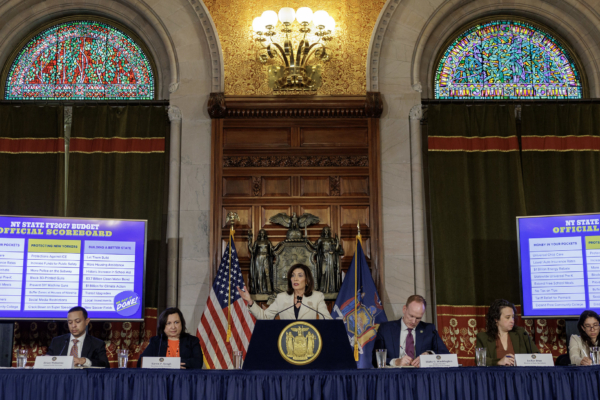
New York Governor Hochul announced at a press conference in Albany on Thursday that the state government has reached a “tentative agreement” with state legislative leaders on a new budget totaling approximately $268 billion for the upcoming fiscal year. The budget covers various issues such as climate policy adjustments, auto insurance reform, public safety, immigrant protections, and education investments. However, Speaker of the State Assembly Carl Heastie stated later on the same day that some details are still pending negotiation, and the budget has not been finalized.
According to the Governor’s office, the state will provide an additional $1.5 billion in aid to New York City, as well as $1.2 billion for childcare expansion funds to help local governments cope with financial pressures. The budget also includes plans to implement a “pied-à-terre tax” on high-priced vacant luxury homes, estimated to generate $500 million in annual revenue for New York City.
On immigration policy, the budget will restrict local law enforcement agencies from cooperating with federal immigration authorities in non-criminal law enforcement situations, including traffic stops. Additionally, local jails will be prohibited from entering into specific cooperation agreements with the U.S. Immigration and Customs Enforcement (ICE) and will limit detention center rental space for federal immigration enforcement use.
Energy and consumer costs were a focal point of the budget negotiations. The State Assembly advocated for giving approximately $1 billion in rebate checks to households that pay natural gas and electricity bills, a measure that Hochul ultimately agreed to include to assist the public in coping with rising energy prices.
There were some adjustments made to the climate policy. Hochul stated that New York State will revise the timeline for achieving the goal of a 40% reduction in carbon emissions by 2030, citing potential additional pressure on energy and fuel prices at the current stage. However, the long-term goal of an 85% emission reduction by 2050 will remain unchanged.
Changes to the auto insurance system are also on the agenda, including limits on compensating the primary party at fault in accidents, requiring insurance companies to obtain state approval before raising premiums, and enhancing supervision of insurance industry profits.
While Governor Hochul indicated on Thursday that a “comprehensive consensus” had been reached with state legislative leaders, Speaker Heastie later stated in a media interview in Albany that there are still dozens of issues to be negotiated, including some fiscal details and the total expenditure scale. Therefore, the budget still requires further confirmation.
The New York State budget for the new fiscal year was originally scheduled to be completed before April 1, but it is currently delayed by over a month. The Governor’s office and the state legislature will now organize the agreement into legislative text for a vote by the state legislature. Senate Majority Leader Andrea Stewart-Cousins recently stated that budget negotiations are “near completion” and anticipated that formal voting procedures could commence next week.