
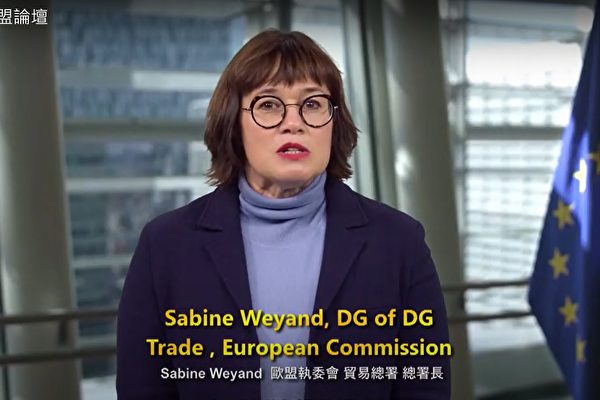
The European Union trade officials warned on Wednesday (May 6th) that the long-frozen China-European Union investment agreement is outdated and should not be reintroduced, as the structural macroeconomic imbalance in China should not be absorbed by the EU.
According to reports from the South China Morning Post on Thursday (May 7th), Sabine Weyand, the EU Director-General for Trade, made it clear during her final public appearance before the European Parliament’s Trade Committee at the end of her seven-year term that she opposes restarting the EU’s Comprehensive Agreement on Investment with China and hinted that Brussels is designating new trade tools to address the consequences of China’s “macroeconomic imbalance.”
The agreement, signed at the end of 2020, was immediately frozen due to human rights violations by China. Weyand stated, “That was an agreement reached with another China (the CCP) in another era.”
She also cited former EU Competition Commissioner Margrethe Vestager, explaining, “If something has been frozen in the freezer for a long time, it should not be taken out and served on the table.”
Previously, Beijing proposed restarting the agreement during contacts with EU leaders and suggested starting negotiations on a China-EU Free Trade Agreement. German Chancellor Friedrich Merz responded positively to this proposal last month.
However, Finnish Minister for Foreign Affairs Elina Valtonen recently stated that Finland may exercise a “veto” on the China-EU investment agreement due to China’s close relationship with Russia.
During the meeting, Weyand pointed out that she is not concerned about cyclical trade imbalances but Beijing’s “structural macroeconomic imbalances,” referring to the policies that suppress domestic demand in line with the International Monetary Fund’s definition, resulting in persistent external trade imbalances and dumping.
Citing forecast data, she indicated that while China’s consumption only accounts for approximately 13% of the global total, its industrial output share is expected to rise from the current 30% to 45% by 2030, posing “macroeconomic imbalances that the world fundamentally cannot absorb.”
According to media reports, EU officials plan to present a newly developed trade tool known as “overcapacity” or “diversification” in a targeted debate on May 29th to the leadership of the European Commission.
Weyand also confirmed on Wednesday that the European Commission will hold a targeted debate on the issue at the end of this month, but stressed that the final decision will be pushed forward by her successor.
She also warned that when formulating trade protection tools, the EU must enable European businesses to enhance their competitiveness, or else “the EU will end up as an industrial museum protecting globally uncompetitive industries.”
Belgian Minister of Foreign Affairs Maxime Prevot, returning from his visit to China this week, pointed out that the EU must be prepared for potential trade retaliation from China but should not retreat.
He told Politico that the EU needs to consider whether it is willing to “endure several years of temporary difficulties to ultimately establish a fair competitive environment.”