
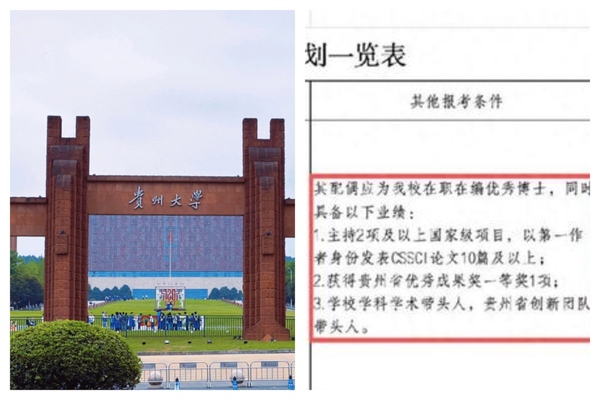
Recently, Guizhou University planned to recruit a staff member for a management position, with the requirement that the applicant’s spouse must be an outstanding doctoral student within the university’s faculty and staff, along with multiple impressive achievements. However, after being criticized for potentially being a position pre-filled with a candidate (known as a “carrot position”), the university halted the recruitment process.
On May 27, a recruitment announcement released by Guizhou University sparked controversy. The announcement indicated that the university was hiring a staff member for the Asset Management Office, and in addition to the standard educational requirements, there was a “special” condition: the applicant’s spouse must be an outstanding doctoral student within the university, holding qualifications such as leading 2 national-level projects, publishing over 10 CSSCI papers, winning a first-class award at the provincial level, and being a leading academic figure in their field and the head of an innovative provincial team.
This issue quickly gained widespread attention on social media, with netizens questioning whether the position was a “carrot position” – a term used to describe positions that are seemingly publicly advertised but already have a predetermined candidate in mind.
Under public pressure, Guizhou University announced on May 31 that the original intention behind creating the position was to address the difficulty of attracting high-level talents rooted in Guizhou who have made outstanding contributions to the university’s development, and that the recruitment process was meant to be simplified. The university acknowledged inappropriate criteria setting in the actual implementation of the recruitment and expressed regret, ultimately deciding to terminate the recruitment.
However, the announcement failed to quell the skepticism and criticism on social media.
A technology blogger and prominent film critic named “Frost Leaves” wrote, “It’s essentially about internal arrangements while still insisting on going through the public recruitment process. There’s nothing wrong with assisting contributors in overcoming difficulties. But setting conditions so stringent that only one person qualifies, then cloaking it in ‘fairness,’ inevitably leads to criticism.”
A workplace blogger named “Cai Yichuan” remarked, “Guizhou University has embedded the term ‘carrot position’ directly into the recruitment announcement… The university claims it’s not a ‘carrot position.’ But when you set conditions so narrowly to include ‘spouse + within the university + currently employed + doctoral degree + specific achievements,’ it’s akin to picking someone based on their ID number. Bringing in talent to universities and helping spouses find jobs is not a new practice. But arranging talent placement is usually done through internal negotiations, not through public recruitment channels.”
A prominent Weibo user named “Connecting Journalist” sarcastically commented, “We understand Guizhou University’s intentions to value talent. They could have easily made an internal decision without tarnishing the words ‘public recruitment.'”
Another Weibo influencer named “Pixiu Perspectives” stated, “It must be said that Guizhou University’s recruitment requirements this time truly defy expectations. When recruiting for higher education talent, not only are the qualifications of the applicant considered, but now they also prioritize reviewing the spouse’s educational background.”
“…Originally, job seekers only needed to polish their own abilities, but nowadays, even the resume of a spouse or partner has quietly become an invisible bonus point for future job applications. It’s hard not to reflect on how the current job environment is becoming increasingly pragmatic, with fierce competition infiltrating every aspect of employment opportunities.”